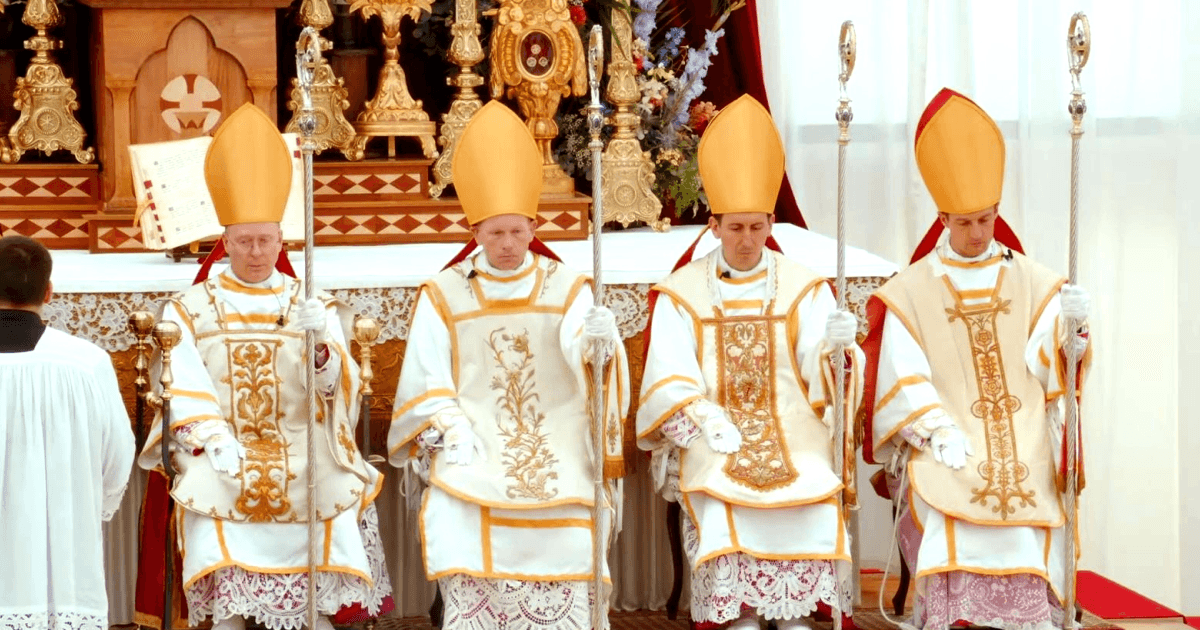
Four new bishops have been consecrated for the Society of Saint Pius X today, against the direct wish of Pope Leo XIV, in an action which the Holy See has warned would incur the penalty of latae sententiae excommunication.
Before a crowd of more than 16,000 gathered at the Society seminary of Écône, Bishop Alfonso de Galarreta consecrated the priests, handpicked to be the bishops who will continue the sacramental ministry of the SSPX for decades to come. Signalling the Society’s long-term planning when it comes to the consecrations, the youngest of the four new bishops is just 36.
Bishop Pascal Schreiber, Bishop Michael Goldade, Bishop Michel Poinsinet de Sivry and Bishop Marc Hanappier now join Bishop Alfonso de Galarreta and Bishop Bernard Fellay to comprise six bishops for the Society.
According to the SSPX, the names and information about the new bishops were presented to Pope Leo, seeking his approval, along with outlining to him “the very particular and exceptional context of these episcopal consecrations”.
“In no way do the [consecrations] constitute a denial of, refusal of, or challenge to the supreme, full, and immediate power of jurisdiction of the Vicar of Christ over the universal Church,” the Society has attested.
SSPX Superior General Fr Davide Pagliarani stated during his homily that the ceremony was one of “joy and hope”. The reason for such emotion was because “in 1988 those who condemned the SSPX announced it would disappear”, yet the Society’s continued growth has shown “God never abandoned us and these consecrations have shown it even more,” opined Pagliarani.
Due to the large number of attending clergy, and thanks to a brief interruption for a thunderstorm, the consecration ceremony lasted more than five hours. Organisation for the event has been under way for months, and the consecrations have garnered immense interest from both Catholic and secular media.
The ceremony comes 38 years after Archbishop Marcel Lefebvre consecrated four bishops in the same spot at Écône, also without the approval or mandate of the Holy See. It was an action which the Holy See declared as schismatic and which led to the automatic excommunication of the bishops involved.
Defending the 1988 and 2026 consecrations, and the need for bishops to continue ordaining priests to celebrate the sacraments in the traditional rites, the SSPX has cited the “state of necessity”, arguing that it is “much worse” than in 1988 since “the decisions taken by Pope Francis are catastrophic”.
Aside from the impressive nature of the ancient ceremony itself, much of the focus is naturally on how the Vatican will respond to the Society’s move.
The current Code of Canon Law, issued in 1983, states that – in the absence of the papal mandate – the bishop consecrating and those receiving the consecration “incur a latae sententiae excommunication reserved to the Apostolic See”. In contrast, the previous Code of 1917 handed out a lesser penalty of suspension on the consecrator and those receiving the order “until the Apostolic See dispenses them”.
Just as in 1988, the Pope has once again not given his mandate for the consecrations. Hence, in place of reading aloud the papal mandate during the ceremony, the liturgical notary read out a declaration which stated:
“It is the Catholic and Roman Church, always faithful to the traditions received from the apostles, who in entirely exceptional circumstances demands that we provide for the upholding of these traditions, that is the deposit of faith, and that we take the means necessary to transmit them faithfully to all men for the salvation of their souls.
“Since the Second Vatican Council up to the present day the authorities in the Church have been animated by a spirit that is contrary to the faith and have been acting against holy tradition. They will no longer endure sound doctrine.”
Just 24 hours beforehand, Pope Leo personally wrote to the Society requesting that they cancel the planned ceremony. “I plead with you and ask you with all my heart: please turn back,” read Leo’s letter. “I urge you to consider carefully the spiritual good of the faithful, because the schismatic act you are about to undertake would deprive them of the licit and, in some cases, even valid reception of the Sacraments, which they love and seek for their sanctification.”
The Society had sought to meet with Pope Leo since August 2025, but when requests for an audience went unanswered they announced on 2 February the date of 1 July for the episcopal consecrations. Such a move prompted a speedy response from the Vatican, but dialogue between the SSPX and the Holy See broke down just over two weeks later.
“I cannot accept the perspective and objectives in the name of which the Dicastery offers to resume dialogue in the present situation, nor indeed the postponement of the date of 1 July,” wrote Fr Pagliarani on 19 February.
Cardinal Victor Manuel Fernández – who has led the Holy See’s meetings with the Society – declared on 13 May that the planned consecrations would “constitute ‘a schismatic act’ and ‘formal adherence to the schism constitutes a grave offence against God and entails the excommunication established under Church law’”.
In response, the SSPX issued a Declaration of Faith which Fr Pagliarani said at the time “seems to us to correspond to the minimum indispensable to be in communion with the Church, and to truly call ourselves Catholics and, consequently, your sons”.
Delivering the homily during Wednesday’s ceremony, Fr Pagliarani defended the consecrations as being “exceptional means which are proportionate to the needs of the Church today”.
“Are we in the process of choosing between the faith and the Church: in order to keep the faith are we separating ourselves from the Church? It’s a false dilemma,” he attested, by way of a response to critics. “We belong to the Church by the integral profession of the faith.”
Pagliarani also suggested the Holy See is speaking a “different language” to the Society, stating:
“We have to admit that we now speak two different languages. We speak the language of the faith – we want the faith and in all simplicity it’s not that complicated… Yet in front of us we have a different language, a different level, they’re speaking of other things. It’s a language of including others, of accompaniment, dialogue – not the faith. We accompany souls in the faith.”
Since negotiations broke down in February it appears that correspondence between the Society and Rome has been limited to the issuing of these statements rather than any fruitful dialogue or theological debate.
But in writing to the Society on Tuesday – and thus finally making a personal outreach to the Society – Pope Leo stated that “the Church is open to a path of dialogue and understanding that the Holy Spirit can make possible and fruitful”.
He also warned that “to tear the seamless garment of Christ is a sin of extreme gravity”. This phrase from the Pope points to the severity of the penalties the Vatican is understood to be preparing to impose.
But the mood within the Society is one, as Pagliarani stated, of joy, with the event at Écône very much a celebration of the consecration of new bishops. Some lay attendees of the Society have similarly welcomed the consecration warmly, while others have lamented the fact that the SSPX remains much in the same position as it did in 1988.
Though the Vatican has already warned that the consecrations incur the penalty of automatic, or latae sententiae, excommunication, a formal response is anticipated from the Holy See. Information from the Holy See has suggested that such a response will come in the coming days.
Michael Haynes is an English journalist in the Holy See Press Corps. He serves as Vatican Correspondent for the Catholic Herald, while readers can follow him at Per Mariam and on X/Twitter @MLJHaynes.


.png)
.png)
.png)