


Clerics who helped create sign language
For millennia, wrote Inés Antón Dayas at National Geographic, those “with hearing impairments encountered marginalisation” because it was believed that they were incapable of mastering language. Under Roman law, for instance, the deaf weren’t allowed to sign a will.That changed with the invention of formal sign language for the hearing-impaired. The inventor, Pedro Ponce de León, a 16th-century Spanish Benedictine monk, was inspired by the sign-language the monks used to communicate during periods of silence.

Sign language for the deaf grew. Two centuries later, it was well-established enough for a French priest, Charles-Michel de l’Épée, to draw up a dictionary. He established 21 schools for the hearing-impaired, and is known as “the father of the deaf”.
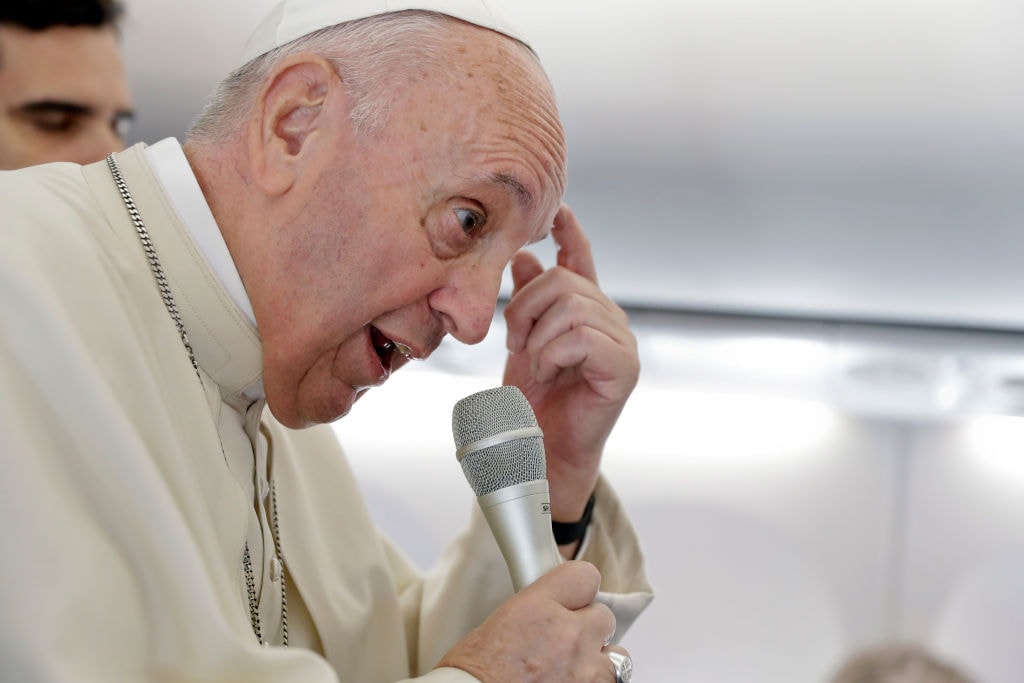
Plane speaking about press conferences
For the journalists who attend them, airborne papal press conferences aren’t cheap: tickets on to the plane are exorbitantly priced. But there’s often a reward, wrote John Allen at Crux: journalists may be able to ask a question which creates a big story and puts their publication on the map. “Of late, however, these in-flight news conferences have been considerably less spicy.” Increasingly, the Pope repeats comments he has made before, or makes points he wants to put on the record.
On the flight back from Romania, there was an obvious question hanging in the air: given new revelations about Theodore McCarrick, what has happened to the Vatican’s inquiry into the scandal? Will anyone be held accountable? Nobody was given the chance to ask that question. “Any news conference would be considered a disappointment – by some, even, a sham – if it wasn’t asked and answered,” wrote John Allen. Now “the only possible conclusion many observers can draw” is that the Vatican is reluctant to address the subject.
When the Twitter mob has it in for a priest
“Twitter has a dark, demonic side.” So Fr Kevin Cusick discovered recently, when he posted a tweet about modest dressing at Mass. “The tweet was taken to imply that I was placing the blame on women for men who cannot control themselves or telling them how to dress in general,” Fr Cusick wrote at the Wanderer. “Nothing could be further from the truth.” But the tweet attracted “nearly unrelenting fury” of “incredible magnitude … Wave after wave of calumnious, blasphemous and obscene memes, gifs, and messages were posted with comments, likes, and retweets ranging up to the tens of thousands.”
Even some Catholics joined in the mockery – a reminder of how divisive Twitter can be. “I have been most edified by the many faithful Catholics on Twitter who beautifully and lovingly express faith and invite others to also experience our covenant love in Christ.” It can certainly be dangerous. But in the end, “this is merely a minor battle in a great war in which our triumphant Lord has already secured the greatest victory, over sin and death.” And Twitter is not the “most effective means at our disposal for disseminating the faith”.