

December 27, 2025
December 27, 2025

The case for St John's assumption

Min read
share

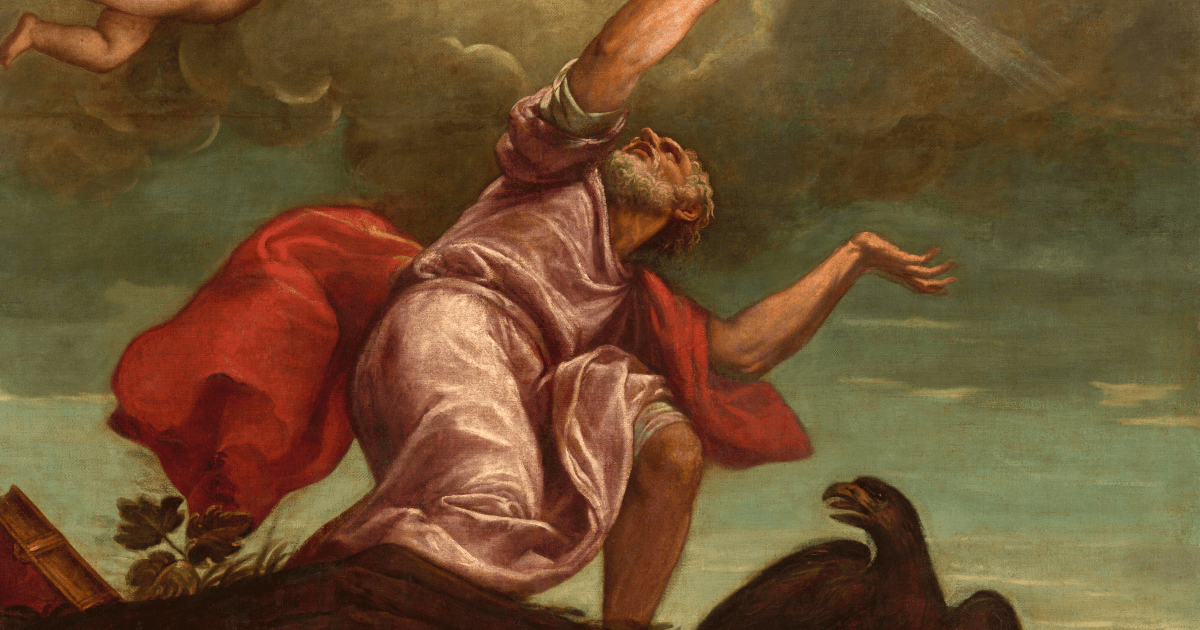
The Christian Faith’s most enigmatic mysteries are often hidden in plain sight. This is certainly true of Yochanan bar Zavdai. Disciple of the Lord, Bishop of Ephesus, Galilean fisherman, foster son of the Queen of Heaven, faithful spectator of Calvary, patron of mariology, divine theologian, evangelist. St John the Apostle is a figure through whom, perhaps second only to the Blessed Virgin, we are brought most intimately close to the person of Christ.

I should know. In England and Wales, and in a small number of other places, converts and catechumens are encouraged to choose a patron saint corresponding to their confirmation name upon being anointed with chrism. During my journey into the Catholic Faith, pious friends counselled me, when I was unsure whom or how to choose, that one ought to pray about it. They told me that your patron will find you. St John, it seems, was the one who found me.
I am not claiming that the Johannine legacy is unknown. The unsurpassed spiritual depth of his Gospel, in which he famously reminds the reader, with mature magnanimity, that he outran St Peter to the empty tomb of Christ, together with his place beside the Marys at the Cross, are commonly recalled in the popular memory of the Faith. He is associated with the eagle, the chalice, the colour red, youth, chastity, violent passion, and love. All of this is relatively well known.

Yet there are one or two things about John of Zebedee, not insignificant, which are strangely hushed, left uncontemplated and unremembered. One of these is the fate of his earthly body. Another is the story of the remarkable miracles which accompanied it for nearly a thousand years.

We often speak of the Assumption of Mary. It is a mystery of the Holy Rosary. Since 1950, it has been a dogma of the Church. Less well known is that the pages of Christian history quietly suggest that John was granted the same dignity. I have come to know that my patron is a ladder to mystical heights and depths for those who care to climb it. It is my hope, by the end of this article, to exhort the reader to do the same. Ad Jesum per Mariam… et Ioannem?

Before approaching the strange question of the fate of his body, however, we must begin at the beginning. The Gospel of John itself acknowledges that there already existed a rumour that he would not die.

After taking Peter aside on the shores of Galilee and asking of him a threefold declaration of faith and love, mirroring his threefold denial, Christ entrusted him with the task of feeding His lambs and sheep. It was then that Peter noticed John following them at a short distance behind.

“Lord,” Peter asked, “and what shall this man do?”

Christ responded, characteristically obliquely, “If I will that he remain till I come, what is it to thee?” John later explains that from this remark arose the rumour of his immortality. “This saying therefore went abroad among the brethren,” he writes, “that that disciple should not die.”

All of this might safely remain within the realm of pious legend were it not for the fact that the testimonies of sacred tradition and historical record converge in a way that suggests there may be more to this rumour than first appears.

One of the earliest accounts comes from the ancient Acts of John, an apocryphal work commonly dated to the second century. It records an elderly John meeting his end by entering a freshly dug grave while still alive, where he prays and gives up his spirit. Although parts of this text are of doubtful provenance, likely later embellishments, the ending appears genuinely ancient and survives in several forms.

Some versions conclude, “And forthwith manna issuing from the tomb was seen of all, which manna that place produceth even unto this day.”

Others record, “We brought a linen cloth and spread it upon him… And on the day following we went forth and found not his body, for it was translated by the power of our Lord Jesus Christ, unto whom be glory.”

Still others report, “On the morrow we dug in the place, and we found not, but only his sandals, and the earth moving, springing up like a well, and after that we remembered that which was spoken by the Lord unto Peter.”

Certain Latin translations, rather than the more common Greek versions, add that immediately after John concluded his final prayer and reclined in the grave, a great light appeared above him for an hour, so bright that no one could look upon it.

Whatever the precise original reading, what should arrest even the sceptical reader are the repeated claims concerning both the mysterious manna, described as a sort of dust, and the disappearance of his body. These claims are not without foundation.

While early authorities such as Eusebius and Polycrates affirm that John’s tomb lay in Ephesus, by the time of St Augustine in the fourth century a rumour had spread throughout Christendom that a strange manna would inexplicably erupt from the earth at this site. Augustine himself admitted that he could not simply dismiss the reports.

Roughly a century later, St Gregory of Tours records the same phenomenon, describing manna in modum farinae, manna like flour, possessing healing properties. He tells us it was gathered and distributed throughout the Christian world for cures and miraculous effects, and he also repeats the tradition that John descended alive into his tomb in his Glory of the Martyrs.

By the eighth century the scale of this phenomenon had become unmistakable. An Anglo Saxon pilgrim named Willibald, later a bishop and saint, recorded his journey to the basilica in Ephesus. Each year, on May 8, during an all night vigil in honour of the Apostle, spontaneous whirlwinds would arise on the surrounding plain, casting down manna which pilgrims from distant lands reverently collected.

For nearly a millennium, until the Islamic conquest of Anatolia and the destruction of the basilica, this event was said to recur annually, witnessed by generations of pilgrims. It stands as one of the most enduringly attested public miracles in Christian memory.

Even St Thomas Aquinas refers to this miracle in his commentary on John’s Gospel. He writes that some say John entered his tomb at Ephesus alive and remains there still alive but sleeping until the Lord comes. They base their theory on the fact that the soil there moves up and down in rhythm with John’s breathing.

What Aquinas also notes is the curious disappearance of John’s body. There are various opinions, he says, about John’s burial. All agree that he was buried in a tomb which still exists. But some say he entered his tomb while still alive and then left it by divine power, transported to the region of Enoch and Elias, where he is being kept until the end of the world. Aquinas goes further, concluding that we should say that he arose with his body, as indicated by the fact that his body cannot be found.

This point is pivotal. While some speculated that John merely slept beneath the earth, all parties, tradition, pilgrims, and chroniclers, agree on one fact. His bodily remains have vanished.

John is unique in this respect. All eleven other Apostles are accounted for, or at least claimed. Even the most cynical observer would expect an ambitious shrine to assert possession of the relics of so central a figure. Yet no one, no swindler, no charlatan, no rival city, ever claimed to possess the body of St John. In this, he shares a strange historical trait with only two others, the Blessed Virgin Mary and St Joseph. As Aquinas notes, it was universally accepted that he was buried in Ephesus. Whether he remained there is another matter.

In the fourth century, Emperor Constantine, eager to endow his new imperial capital with apostolic prestige, attempted to exhume John’s body from the Ephesian tomb in order to translate it to Constantinople. He departed empty handed. No relics were found.

What, then, are we to make of this. Perhaps the Almighty, as He so often does, leaves His signs concealed in plain view, accessible to the humble and the seeking, obscured to the proud and the idle. Like the shepherds of Bethlehem or the Magi from the East, those who search are the ones who find.

John’s Gospel most profoundly treats metaphysical realities, light and darkness, creation and spirit. A determined opponent of dualism, he continues the message of his great Prologue in his Epistle by telling us that darkness is a weak and passing thing, a shadow, something in which there is no life and which only fades away. Meanwhile, the true light now shineth, and cannot be overcome.

Augustine and later theologians would explain that corruption, decay, and death are consequences of sin, absences of divine love, which alone is the source of life. It follows that those who abide most fully in this love would be preserved from this cosmic catastrophe. The Psalmist declared to God, “You will not abandon my soul to Sheol, or let your holy one see corruption.”

For centuries, Our Lady’s Assumption occupied the same place that John’s does now, a pious but widespread belief among informed Christians. Today the Church, exercising her full magisterial authority, confirms it as truth. The evidence suggests that John, rumoured immortal in life, likewise reposes now with the King and Queen of Heaven.

There is far more that could be said of him. Perhaps, as he himself wrote, the world would not be able to contain the books that should be written. This is the Apostle who took the Blessed Virgin into his home and lived with her for decades after the Ascension. His disciples and their successors, Polycarp of Smyrna, Irenaeus of Lyons, Ignatius of Antioch, were instrumental in handing on the Church’s mariological inheritance. Scripture and history alike testify that he was close to Christ’s heart. It is no accident, as Pope Leo XIII reminds us in his prayer to St John, that he alone was permitted to rest his head upon the Divine breast.

Shortly after my conversion to Catholicism, I experienced a brief and foolish buyer’s remorse at having chosen such an obvious and conventional patron. It was only after a conversation with another recent convert that the scales fell from my eyes.

As we exchanged stories of our journeys into the Faith, I felt self deprecating and embarrassed about my reasons for choosing John. I had been baptised in a church named for him. I admired his Gospel. I recognised in myself something of his fiery Boanerges temperament. More frivolously, at the time of my confirmation I was applying, unsuccessfully, to a college at Oxford which I believed, incorrectly, was named after him, and I half hoped his patronage might improve my chances. It was, of course, named for John the Baptist. Providence, however, has a sense of humour. I later attended a college actually named for my patron at another venerable English university, in Durham. Man proposes; God disposes.

So when I sheepishly acknowledged John as my patron, I was startled when my fellow convert exclaimed with genuine enthusiasm, “John the Beloved.” Her affectionate reverence shattered my ingratitude. Often we appreciate too little the great gifts that lie before us each day.

Some truths buried deep within the Christian past risk being forgotten, submerged beneath the dust carried by the winds that lash the ruins of crumbling basilicas. But they are there for those who look. We need only the eyes of mystical faith, and sometimes the help of others, to see.

He could never eclipse the Blessed Virgin, the Rosa Mystica. Yet if you wish to draw close to the heart of Jesus, consider the Johannine path. Stand at the Cross. Abide in love. Remain where others flee. And, like the Beloved Disciple, rest your head upon the Divine breast and listen to the mysteries hidden since the foundation of the world.

The Christian Faith’s most enigmatic mysteries are often hidden in plain sight. This is certainly true of Yochanan bar Zavdai. Disciple of the Lord, Bishop of Ephesus, Galilean fisherman, foster son of the Queen of Heaven, faithful spectator of Calvary, patron of mariology, divine theologian, evangelist. St John the Apostle is a figure through whom, perhaps second only to the Blessed Virgin, we are brought most intimately close to the person of Christ.

I should know. In England and Wales, and in a small number of other places, converts and catechumens are encouraged to choose a patron saint corresponding to their confirmation name upon being anointed with chrism. During my journey into the Catholic Faith, pious friends counselled me, when I was unsure whom or how to choose, that one ought to pray about it. They told me that your patron will find you. St John, it seems, was the one who found me.

I am not claiming that the Johannine legacy is unknown. The unsurpassed spiritual depth of his Gospel, in which he famously reminds the reader, with mature magnanimity, that he outran St Peter to the empty tomb of Christ, together with his place beside the Marys at the Cross, are commonly recalled in the popular memory of the Faith. He is associated with the eagle, the chalice, the colour red, youth, chastity, violent passion, and love. All of this is relatively well known.

Yet there are one or two things about John of Zebedee, not insignificant, which are strangely hushed, left uncontemplated and unremembered. One of these is the fate of his earthly body. Another is the story of the remarkable miracles which accompanied it for nearly a thousand years.

We often speak of the Assumption of Mary. It is a mystery of the Holy Rosary. Since 1950, it has been a dogma of the Church. Less well known is that the pages of Christian history quietly suggest that John was granted the same dignity. I have come to know that my patron is a ladder to mystical heights and depths for those who care to climb it. It is my hope, by the end of this article, to exhort the reader to do the same. Ad Jesum per Mariam… et Ioannem?

Before approaching the strange question of the fate of his body, however, we must begin at the beginning. The Gospel of John itself acknowledges that there already existed a rumour that he would not die.

After taking Peter aside on the shores of Galilee and asking of him a threefold declaration of faith and love, mirroring his threefold denial, Christ entrusted him with the task of feeding His lambs and sheep. It was then that Peter noticed John following them at a short distance behind.

“Lord,” Peter asked, “and what shall this man do?”

Christ responded, characteristically obliquely, “If I will that he remain till I come, what is it to thee?” John later explains that from this remark arose the rumour of his immortality. “This saying therefore went abroad among the brethren,” he writes, “that that disciple should not die.”

All of this might safely remain within the realm of pious legend were it not for the fact that the testimonies of sacred tradition and historical record converge in a way that suggests there may be more to this rumour than first appears.

One of the earliest accounts comes from the ancient Acts of John, an apocryphal work commonly dated to the second century. It records an elderly John meeting his end by entering a freshly dug grave while still alive, where he prays and gives up his spirit. Although parts of this text are of doubtful provenance, likely later embellishments, the ending appears genuinely ancient and survives in several forms.

Some versions conclude, “And forthwith manna issuing from the tomb was seen of all, which manna that place produceth even unto this day.”

Others record, “We brought a linen cloth and spread it upon him… And on the day following we went forth and found not his body, for it was translated by the power of our Lord Jesus Christ, unto whom be glory.”

Still others report, “On the morrow we dug in the place, and we found not, but only his sandals, and the earth moving, springing up like a well, and after that we remembered that which was spoken by the Lord unto Peter.”

Certain Latin translations, rather than the more common Greek versions, add that immediately after John concluded his final prayer and reclined in the grave, a great light appeared above him for an hour, so bright that no one could look upon it.

Whatever the precise original reading, what should arrest even the sceptical reader are the repeated claims concerning both the mysterious manna, described as a sort of dust, and the disappearance of his body. These claims are not without foundation.

While early authorities such as Eusebius and Polycrates affirm that John’s tomb lay in Ephesus, by the time of St Augustine in the fourth century a rumour had spread throughout Christendom that a strange manna would inexplicably erupt from the earth at this site. Augustine himself admitted that he could not simply dismiss the reports.

Roughly a century later, St Gregory of Tours records the same phenomenon, describing manna in modum farinae, manna like flour, possessing healing properties. He tells us it was gathered and distributed throughout the Christian world for cures and miraculous effects, and he also repeats the tradition that John descended alive into his tomb in his Glory of the Martyrs.

By the eighth century the scale of this phenomenon had become unmistakable. An Anglo Saxon pilgrim named Willibald, later a bishop and saint, recorded his journey to the basilica in Ephesus. Each year, on May 8, during an all night vigil in honour of the Apostle, spontaneous whirlwinds would arise on the surrounding plain, casting down manna which pilgrims from distant lands reverently collected.

For nearly a millennium, until the Islamic conquest of Anatolia and the destruction of the basilica, this event was said to recur annually, witnessed by generations of pilgrims. It stands as one of the most enduringly attested public miracles in Christian memory.

Even St Thomas Aquinas refers to this miracle in his commentary on John’s Gospel. He writes that some say John entered his tomb at Ephesus alive and remains there still alive but sleeping until the Lord comes. They base their theory on the fact that the soil there moves up and down in rhythm with John’s breathing.

What Aquinas also notes is the curious disappearance of John’s body. There are various opinions, he says, about John’s burial. All agree that he was buried in a tomb which still exists. But some say he entered his tomb while still alive and then left it by divine power, transported to the region of Enoch and Elias, where he is being kept until the end of the world. Aquinas goes further, concluding that we should say that he arose with his body, as indicated by the fact that his body cannot be found.

This point is pivotal. While some speculated that John merely slept beneath the earth, all parties, tradition, pilgrims, and chroniclers, agree on one fact. His bodily remains have vanished.

John is unique in this respect. All eleven other Apostles are accounted for, or at least claimed. Even the most cynical observer would expect an ambitious shrine to assert possession of the relics of so central a figure. Yet no one, no swindler, no charlatan, no rival city, ever claimed to possess the body of St John. In this, he shares a strange historical trait with only two others, the Blessed Virgin Mary and St Joseph. As Aquinas notes, it was universally accepted that he was buried in Ephesus. Whether he remained there is another matter.

In the fourth century, Emperor Constantine, eager to endow his new imperial capital with apostolic prestige, attempted to exhume John’s body from the Ephesian tomb in order to translate it to Constantinople. He departed empty handed. No relics were found.

What, then, are we to make of this. Perhaps the Almighty, as He so often does, leaves His signs concealed in plain view, accessible to the humble and the seeking, obscured to the proud and the idle. Like the shepherds of Bethlehem or the Magi from the East, those who search are the ones who find.

John’s Gospel most profoundly treats metaphysical realities, light and darkness, creation and spirit. A determined opponent of dualism, he continues the message of his great Prologue in his Epistle by telling us that darkness is a weak and passing thing, a shadow, something in which there is no life and which only fades away. Meanwhile, the true light now shineth, and cannot be overcome.

Augustine and later theologians would explain that corruption, decay, and death are consequences of sin, absences of divine love, which alone is the source of life. It follows that those who abide most fully in this love would be preserved from this cosmic catastrophe. The Psalmist declared to God, “You will not abandon my soul to Sheol, or let your holy one see corruption.”

For centuries, Our Lady’s Assumption occupied the same place that John’s does now, a pious but widespread belief among informed Christians. Today the Church, exercising her full magisterial authority, confirms it as truth. The evidence suggests that John, rumoured immortal in life, likewise reposes now with the King and Queen of Heaven.

There is far more that could be said of him. Perhaps, as he himself wrote, the world would not be able to contain the books that should be written. This is the Apostle who took the Blessed Virgin into his home and lived with her for decades after the Ascension. His disciples and their successors, Polycarp of Smyrna, Irenaeus of Lyons, Ignatius of Antioch, were instrumental in handing on the Church’s mariological inheritance. Scripture and history alike testify that he was close to Christ’s heart. It is no accident, as Pope Leo XIII reminds us in his prayer to St John, that he alone was permitted to rest his head upon the Divine breast.

Shortly after my conversion to Catholicism, I experienced a brief and foolish buyer’s remorse at having chosen such an obvious and conventional patron. It was only after a conversation with another recent convert that the scales fell from my eyes.

As we exchanged stories of our journeys into the Faith, I felt self deprecating and embarrassed about my reasons for choosing John. I had been baptised in a church named for him. I admired his Gospel. I recognised in myself something of his fiery Boanerges temperament. More frivolously, at the time of my confirmation I was applying, unsuccessfully, to a college at Oxford which I believed, incorrectly, was named after him, and I half hoped his patronage might improve my chances. It was, of course, named for John the Baptist. Providence, however, has a sense of humour. I later attended a college actually named for my patron at another venerable English university, in Durham. Man proposes; God disposes.

So when I sheepishly acknowledged John as my patron, I was startled when my fellow convert exclaimed with genuine enthusiasm, “John the Beloved.” Her affectionate reverence shattered my ingratitude. Often we appreciate too little the great gifts that lie before us each day.

Some truths buried deep within the Christian past risk being forgotten, submerged beneath the dust carried by the winds that lash the ruins of crumbling basilicas. But they are there for those who look. We need only the eyes of mystical faith, and sometimes the help of others, to see.

He could never eclipse the Blessed Virgin, the Rosa Mystica. Yet if you wish to draw close to the heart of Jesus, consider the Johannine path. Stand at the Cross. Abide in love. Remain where others flee. And, like the Beloved Disciple, rest your head upon the Divine breast and listen to the mysteries hidden since the foundation of the world.

share

subscribe to the catholic herald today

Our best content is exclusively available to our subscribers. Subscribe today and gain instant access to expert analysis, in-depth articles, and thought-provoking insights—anytime, anywhere. Don’t miss out on the conversations that matter most.
Subscribe