Simon Sinek observed in his book, Start with Why, that a group of wealthy and successful entrepreneurs he had met felt anything but wealthy and successful. Many lamented the loss of those days when they first began in a garage and worked long hours alone with a dream. Now that they had built their barns, many of them wished to return to the time when they had nothing.
Being put to work does not seem a very inspiring notion: to work by the sweat of our brow. It is after Christ looks upon the rich young man and loves him that He tells him to sell his possessions. Doing so seems like a grace, to be free of things – perhaps it is also a grace to be able to work hard again.
Hard work makes us happy, especially physical work and, if it is possible, working with our hands. As a younger man, I worked summers with a gardener and spent my hours digging holes, mixing concrete and hauling gravel. It left me exhausted. But I can still remember the places where I lifted loads, built walls and weeded beds, because it was the physical effort of my own hands.
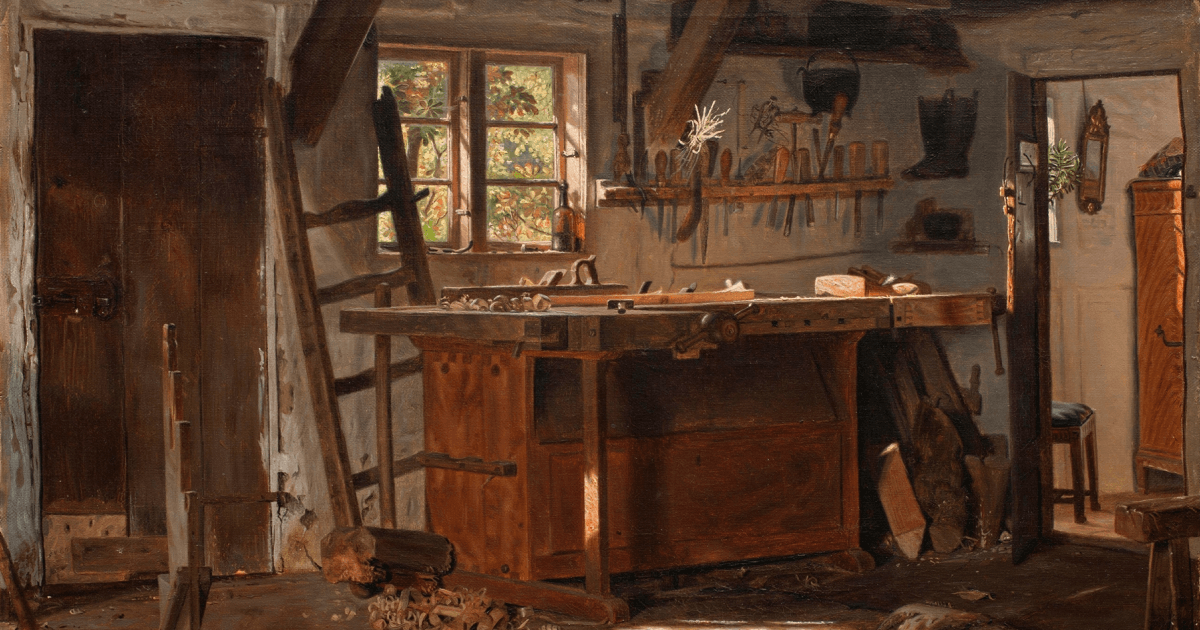
You may know the story of the Loreto nuns in a 19th-century convent in New Mexico who, without a staircase to their gallery, prayed a novena to St Joseph. The story goes that an old man arrived with a donkey and an old toolbox. He asked to be left alone in the church to work and built a remarkable staircase to the gallery, which is still there today.
The staircase is a masterpiece of engineering. It has 33 steps and no central column, which means that the weight distribution across the steps is perfect and the structure secure.
The thing that is most notable, however, is the simplicity of it. The silent St Joseph the Worker, doing something marvellous that is not designed to impress by its aesthetic, but by whom it serves. The most wonderful results are delivered in the quiet and for others, standing the test of time.
It is this silent hard work that defines the Patron of the Universal Church, and all of us who hope to follow his example. As I have grown older, I find myself staring with awe at the churches I visit – the care in the stonework that cannot be seen by the naked eye. The dedication to a project that is an act of devotion and love, which bears, hopefully, no one’s name but that of the saint to whom it is dedicated. Such beauty cannot be built for oneself, and takes the quiet effort of many lifetimes.
I am the father of four boys, and can relate to the idea that they learn by standing with me, working together side by side. My boys take part in projects with me; sometimes we do service together, like gardening or DIY. While we work, I will only speak to them to say three things: “Well done”, “Keep going”, “Let me show you”.
In my presence to them as a father, they wish to know from me that they are part of something, that they are trusted and that they are wanted. I know that if I do not tell them these three things often, the great love and devotion of which they are capable will turn inward and form a wound. I take my time over each offering of a Lego build, and agree to sink investment into robot parts (ill-advised). I let them bring home broken engines to fix.
I am also asking more of them, and I know that this is hard. Men’s hearts are designed to love others, but to do so requires a sort of sacrifice, a giving up of comfort, and that is hard to do; the temptation is always there for us to hope someone else will step in and do it. Edmund Burke understood this well: all it takes for evil to flourish is for good men to do nothing.
But it is easy to believe that we do not have something to offer, and to wish to have someone serve us instead. The children in our house know that if they claim to be bored, they will be given an occupation: “You know what happens to Perrems who say they are bored?” All of a sudden, the child will be very busy at play.
The deeper truth I am asking St Joseph to help me with is the same as Christ’s to the rich young man: to give up serving oneself. The greatest challenge for all of us might be the temptation to wish to be served. It is easier than ever not to learn this, as entertainment surrounds us. Sensible people are attempting to save us from the indignity of temporary items, or things that are built with obsolescence in mind. If you were searching for someone to mend a television, perhaps you would be treated as an oddity; no one can understand why you would not simply discard everything.
If everything in our life is buried within the functions of some computer server, and nothing can be created and maintained by our hands, then perhaps you and I are imprisoned. In the end, without the work of our hands, without our dedication to making something in service and love for others as an act of love for Christ, we will give up on the dignity of work itself.
I say all this knowing full well that many of us benefit from technology, and that it is true that Minecraft has been used by town planners. But it is the case that, although technology can calculate, it cannot inspire. No one looks at a computer design and realises what kind of a man he wishes to be. None of us want to live in a house made of Lego. None of us wish to pray in a square church. It is in humanity, and our natural creativity, always expressed through the work of our hands, that we should place our hope.
It is also in young men. St Joseph’s fatherhood to them is not through words, but in his presence. I am more dedicated to him, as a father figure to me, than I have ever been. How can one be dedicated to someone who does not speak? It is his presence, always with me when I am fixing something, always beside me as I attempt to learn from my mistakes as a father. Silently, he encourages me to show up and to keep working in dedication to my Saviour. This is the ultimate call of our lives, and a call I hope my boys will understand.

.png)