
A priest who played an important role in my spiritual formation used to tell us: “You cannot truly say that you love Jesus if you are not prepared to die for him. Do you want to be a martyr? We should all desire to be one.”
Of course, he was trying to provoke us into reflecting on our spiritual dispositions. In the Catholic tradition, no one seeks martyrdom; indeed, most of the saints who died as martyrs would have insisted that they were unworthy of such an honour. What this priest meant was that martyrdom is not merely a relic of the past, but a reality that remains possible today. Should that moment ever come, would we be ready to choose God above all else?
We often think of martyrs as belonging to the early Church – St Stephen, the Apostles, St Perpetua and St Felicity, or the martyrs of Rome – or as missionaries labouring in distant lands. Depending on which side of the Channel one lives, one might also think of the martyrs of the English Reformation or of the French Revolution. Yet martyrdom is neither confined to ancient history nor relegated to faraway places. It occurred in an ordinary parish church, during a weekday Mass, on 26 July 2016.
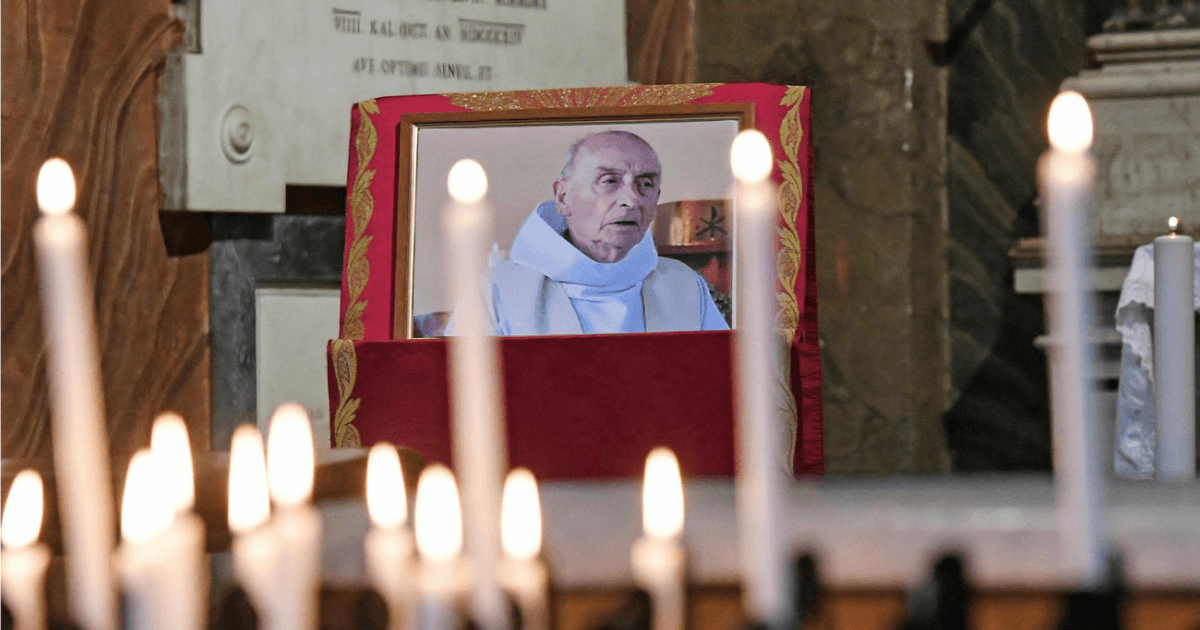
France, Saint-Étienne-du-Rouvray: It is 9.30 on a summer morning. Two men, young Islamists, enter a parish church in Normandy, armed with knives. Within minutes, an 85-year-old priest is forced to kneel before the altar and has his throat cut before three Religious sisters and a small congregation gathered for weekday Mass. His final words are said to have been: “Go away, Satan.” His name was Father Jacques Hamel.
This priest was born in Darnétal, near Rouen, on 30 November 1930, the son of a railway worker. He became an altar server at the age of six and entered the minor seminary when he was fourteen. Ordained to the priesthood for the Archdiocese of Rouen on 30 June 1958, he devoted almost six decades to ministering in various parishes in Normandy. In 2000, he was appointed curé in solidum of Saint-Étienne-du-Rouvray and, after stepping down from responsibility for the parish in 2005, remained there as an assistant priest.
Father Hamel’s murder sent shockwaves through France. It came just a fortnight after the terrorist attack in Nice and only months after the atrocities at the Bataclan. Furthermore, it was the first time in more than two centuries of French history that a priest had been murdered while celebrating Mass, and the first killing carried out by ISIS inside a church in Europe.
Ten years on, Father Hamel’s memory continues to be cherished by many parishioners. One might even say that Saint-Étienne-du-Rouvray has become a place of pilgrimage. Gatherings, commemorations and celebrations bear witness to a shared determination not to forget. His legacy continues to shape hearts and minds, inspiring both the local Church and the wider community. His witness has also inspired the documentary Au nom du père Hamel, Roseline et Nassera, which follows Roseline, Father Hamel’s sister, as she seeks to meet Nassera, the mother of her brother’s killer.
Throughout the film, we witness the gradual relationship that develops between these two wounded women, who find themselves drawn into an unexpected communion. Through their intimate conversations, marked by silence, tears and simple gestures, the documentary reveals a profound encounter shaped by grief, forgiveness and humanity.
Rather than responding to violence with anger, the Church answered with prayer, hope and forgiveness. This was evident in the days immediately following Father Hamel’s death, when Pope Francis repeatedly referred to him as a martyr. The same spirit prevailed at his funeral, throughout the trial of his killers, and during the commemorations that followed, all of which emphasised faith rather than vengeance.
It is equally evident in the programme of events planned to mark the tenth anniversary of his martyrdom this weekend. The Archdiocese of Rouen has organised an entire weekend of commemorations on 25 and 26 July 2026 to mark the tenth anniversary of Father Jacques Hamel’s murder, concluding with a time of prayer at his grave in the cemetery at Bonsecours.
Pope Francis was deeply moved by Father Jacques Hamel’s murder. He publicly referred to him as a martyr and granted a dispensation from the usual five-year waiting period, allowing the cause for his beatification to be opened in April 2017. An 11,000-page dossier was submitted to the Vatican in 2019, and the cause is now proceeding through the customary stages in Rome.
Although no date has been set for a decision, there are strong grounds for the recognition of Father Hamel’s martyrdom. If beatified, it would be on the basis that he was killed in odium fidei – “in hatred of the faith” – the canonical criterion for martyrdom.
The life and death of Father Jacques Hamel remind us that holiness is often found in ordinary, persevering fidelity.
“Father Jacques Hamel will remain for the priests of France a fine example of priestly life. He will remain for Christians the witness of a charity offered to all, a humble and generous servant to the end. His life and his death resonate for our country as a call to fidelity and fraternity, so that evil does not have the last word,” wrote Father Hugues de Woillemont, Secretary General of the French Bishops’ Conference, on 17 March 2022.
Every year, the Church continues to recognise new martyrs. Christians are still being killed for their faith in many places, and Father Hamel’s death brought this reality into the very heart of Western Europe.
Traditionally, the Church has spoken of two forms of martyrdom: red martyrdom, the shedding of one’s blood in witness to Christ, and white martyrdom, the daily dying to self through sacrifice, prayer, charity and perseverance. The latter prepares the heart for the former, should God ever permit such a trial.
If we hope to die for Christ – or, at the very least, to die with him – are we willing to live for him?
Father Jacques Hamel did not seek an extraordinary destiny. He was an ordinary, little-known parish priest. His martyrdom lasted only a few minutes; his preparation for it lasted a lifetime. It was the hidden fidelity of countless ordinary days that enabled him, when the decisive moment came, to remain faithful unto death.
There is a profound providence in the place where Father Hamel met his death: he was offering the Holy Sacrifice of the Mass. The priest who had spent his life at the altar ultimately gave his own life before it.
Day after day, acting in persona Christi, he had pronounced the words: “This is my Body, given for you.” In the end, his own life became conformed to the mystery he had celebrated for nearly 60 years. His death was the final expression of the self-offering that lies at the heart of every Eucharistic celebration.
As we remember Father Hamel’s witness, we might ask ourselves: Would I remain faithful if following Christ came at a real cost? Do I bear witness to my faith when it is unpopular or inconvenient? If the grace of red martyrdom is granted to only a few, am I willing to embrace the white martyrdom of daily self-denial, forgiveness and fidelity by which ordinary Catholics become saints?


.png)