

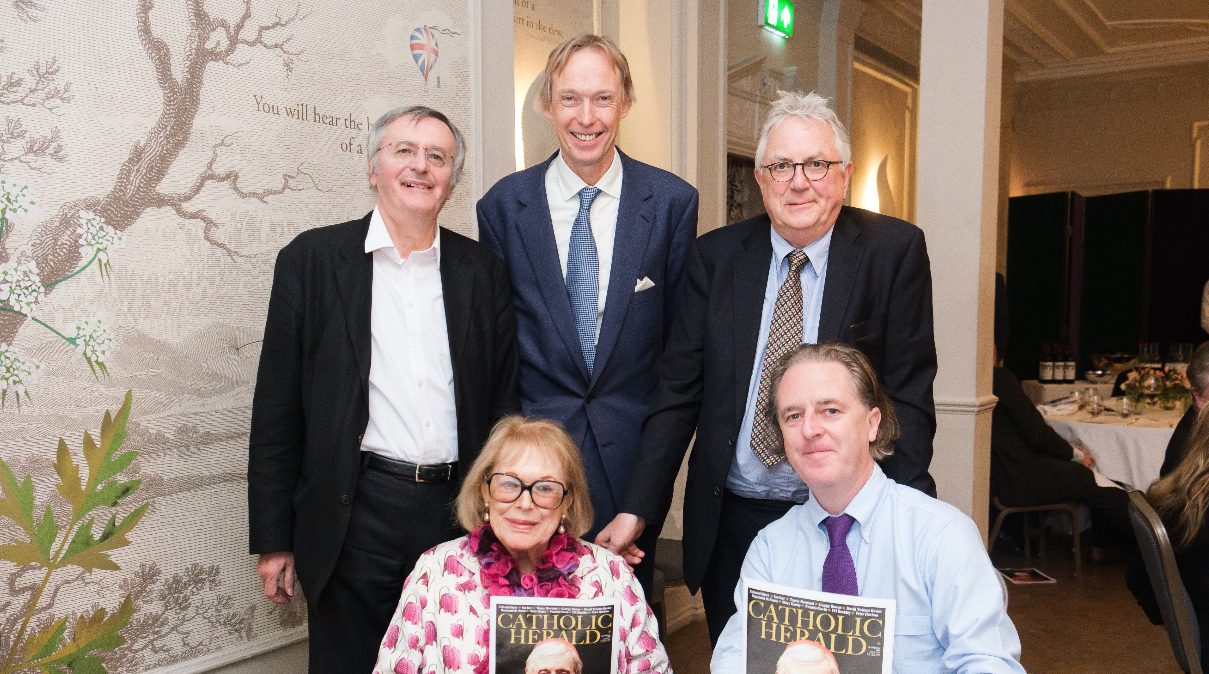
The inaugural Catholic Herald book awards were launched last week at Browns Hotel with Mark Lawson acting as a master of ceremonies. Some last minute juggling of the order in which the awards were presented was necessary when it was noted that Adam Dant, the winner of the 'Best Ilustrated' book category was not in his seat as the 'Brown’s Endive Salad' was passed around the tables. There was an absent place next to the biographer Leanda de Lisle. After it was discovered that Dant had been so inspired by a commission he was working on that he had "forgotten the time," he rushed to Mayfair, and then struggled to find the hotel – arriving only just in time for the award presentation. Dant apologised to the gathered literati saying that he was "only too aware of the irony of winning an award for a book that is a collection of London maps, and then to get lost on the way." Such wit set the tone for the rest of the award acceptance speeches. Travel and Illustrated History Current Affairs Biography Religion and Theology. Dant was the winner of the Travel and Illustrated section with Maps of London and Beyond which Nicky Haslam described as a "work of genius." One map reimagines Shoreditch as New York City, complete with the Statue of Liberty and Central Park. The other nominees were T.J. Clarke, Tom Harper and Helen Hoffner. Lady Antonia Fraser’s The King and the Catholics took the award for History. This "erudite work," in the word of one judge, tells the story of the fight for Catholic Emancipation in parliament in the 1820s. Anyone needing a reminder of its relevance needed merely to look out the window, to see the National Heritage Plaque commemorating Daniel O’Connell over the road. An Irish political leader responsible for the Roman Catholic Relief Act and much discussed in Frasers’s book, he lived in Albemarle Street, opposite the hotel. In her acceptance speech, Lady Antonia said that she would have loved to see the look on the face of her old history teacher on being awarded this prize. Sir Roger Scruton won the Current Affairs prize with Where we are: The state of Britain Now. Always controversial and often brilliant, Roger Scruton’s offering is certainly a book for our tumultuous times and the award was collected by his publisher and friend Robin Baird-Smith of Bloomsbury. James Stourton won the Biography prize with Kenneth Clark: Art, Life, and Civilisation. The award was presented by William Cash who described how Stourton revealed the "human man" who often regarded himself as a fraud or failure – behind the guarded aesthetic façade. "Stourton presents an immaculately made case for a reappraisal of Clark as a serious art scholar and public servant." Jane Glover, Leanda de Lisle and Andrew Roberts were also singled out for their shortlisted books with Roberts’s biography being regarded as a book that stood up for the values of Western Civilization fighting against the forces of evil. Leanda de Lisle presented Charles’s Catholic wife, Queen Henrietta Maria, as a fully rounded woman that stepped away from the stereotype, while Handel was considered a genius for rarely taking more than a month on a work. He may have prospered even better, however, in his own lifetime had he stuck to working in Catholic countries it was noted. John Gray, an atheist, was a controversial winner of the religion and theology category with Seven Types of Atheism. Gray administers a shot of intellectual stimulant to a debate which has been for too long dominated by Richard Dawkins. Cristina Odone, former editor and board member, gave a special thank you to Sir Rocco Forte for providing the use of Brown’s Hotel as a venue. The elegant surroundings elevated the proceedings, and the delicious lunch of Brown’s endive salad, roast chicken and salted caramel tart ensured the event was a foodie triumph (with wines from Tanners) as well as spiritually nourishing. Mark Lawson commiserated the losers by turning to Mark 10:31 – “Many that are first shall be last, and the last first…” Winners and Shortlists below:
1:00 AM
The inaugural Catholic Herald Book Awards
Rafe Jennings

6 min read



Already a subscriber? Sign in
5freearticles every month
Continue reading with a free account. No card needed.
- Five free articles every thirty days, on any device you sign in on
- The Catholic Herald newsletter, every morning
- Subscribe whenever you like for everything: every article and the magazine


subscribe to the catholic herald today
Our best content is exclusively available to our subscribers. Subscribe today and gain instant access to expert analysis, in-depth articles, and thought-provoking insights—anytime, anywhere. Don’t miss out on the conversations that matter most.
Subscribe



