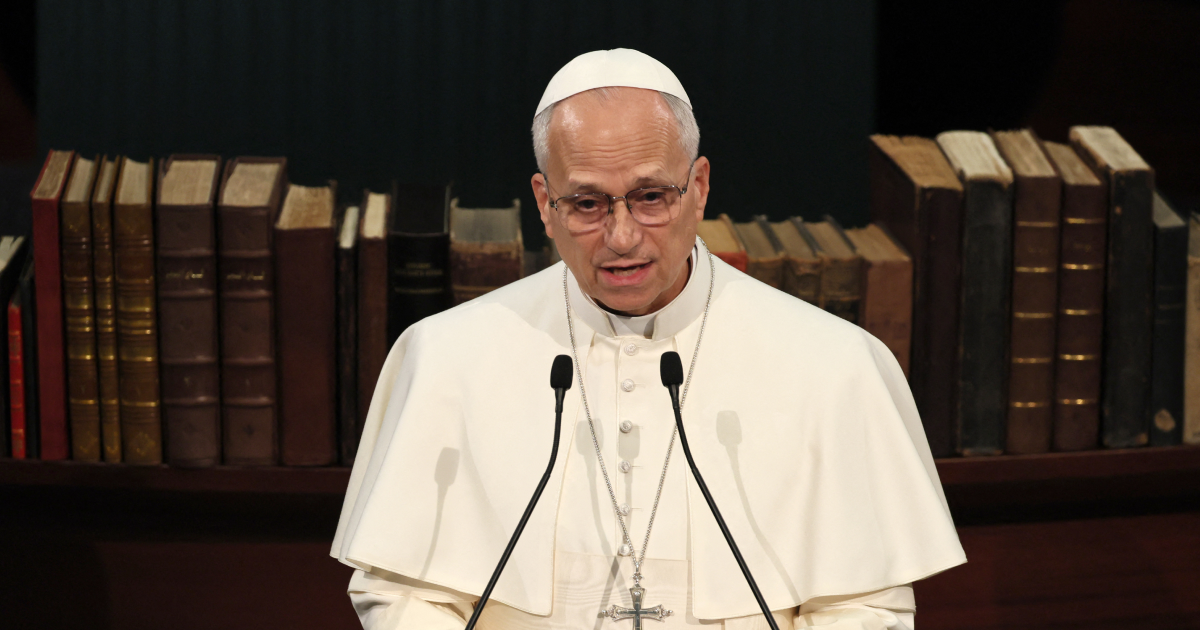


One of the first things Pope Leo said in public after being elected last May was that his choice of name is a deliberate nod to the last Pope Leo, Leo XIII, who reigned from 1878 to 1903, and whose writings, particularly his encyclical Rerum Novarum, laid the foundations of Holy Mother Church’s modern social teaching in response to the industrial revolution. Incidentally, Leo XIII also happens to be the earliest-born person to be captured on video, having been born in 1810; a small but telling detail for a pope often caricatured as being hostile to modernity. In fact, the Church’s relationship with the development of technology has rarely been one of reflexive fear, but rather one of careful scrutiny: asking what the impact of new tools will be on those who must live with them.
This Pontificate, the challenge is not steam engines and factories, but simply a more advanced version of predictive text which nevertheless supposedly has the power to put a large number of people out of work. Artificial intelligence, for all the hype around it, is hardly new. I first encountered it when I was a computer science undergraduate at university over a decade ago, and the ideas behind it have been around since at least the 1980s. It’s not new to the public consciousness either—it was all over the news when chess grandmaster Garry Kasparov lost to IBM’s Deep Blue in 1997. What has changed since then is not the underlying idea, but the sheer scale of computing power available. Faster processors, cheaper storage and vast quantities of data available have transformed what was once only possible in theory into feasible, effective models.
What is being marketed today as “artificial intelligence” is neither artificial nor intelligent in any meaningful sense. When people say they use “an AI”, they most likely are referring to a large language model such as ChatGPT, and the description I gave earlier, an “advanced version of predictive text”, gives the best intuition as to how one should think about it: it is just predicting the best next word in a sequence, given what it has already generated, based on probabilities it acquired from training data. It might be hard to intuit why this has made it so effective at generating essays, or more importantly, code, but it’s hard to really explain that without getting technical or going on at great length. There is an excellent and accessible essay by Steven Wolfram, entitled “What Is ChatGPT Doing … and Why Does It Work?” which is freely available online if you are interested in understanding it a bit better.
But for all this talk of an AI revolution, most large language models are very expensive to run and operate at a staggering loss; they consume massive amounts of computing power and energy, and for the time being are only sustained by venture capital and strategic hope rather than by anything resembling a healthy business model. Some have even speculated that the only sectors in which AI pays for itself are those where cost is no object, such as defence, or those where restraint is minimal, such as digital pornography. Markets have a habit of exposing moral fault-lines long before philosophers do, and when systems scale fastest where responsibility is thinnest, the problem is no longer a technical one, but a moral one.
It is precisely here that Pope Leo’s intervention is likely to begin. The Church has no particular interest in debating whether or not machines can think, but it certainly is concerned about the displacement and quiet delegation of human judgement to machines. This delegation rarely begins with overtly moral questions, but with the outsourcing of increasingly mundane decisions (what to read, what to prioritise, how to organise one’s time) until the habit of judgement itself is weakened. Once discernment is treated as a task to be optimised rather than a responsibility to be exercised, it is no great leap to begin asking machines not only what is efficient, but what ought to be done.
Shortly before Pope Leo’s election, the Vatican released a document titled Antiqua et Nova, on the relationship between artificial intelligence and human intelligence. In it, the Vatican insists that artificial intelligence is not a rival to human intelligence, but rather, a product of it: certainly impressive, but categorically different. That distinction matters, because much of the public anxiety surrounding AI depends on quietly collapsing the two. The Pope has pushed this idea in his own public addresses since his election, and emphasised that technology should never become a substitute for conscience.
For a long time in computer science and moral philosophy, many had adopted a functional view of humans, essentially adopting the view that “humans are more valuable than machines because they can do X, but machines can’t”, and what ‘X’ had to be has changed over time, whether it’s solving maths problems, writing poetry or generating paintings (the latter two are actually easier for machines by the way—the emperor has no clothes!). This is akin to what is usually called the Turing test, after computer scientist Alan Turing: if you engage in a text-chat conversation, can you tell whether there is a human on the other side, or whether the responses are purely machine generated?
Well, it is precisely this functional view of humans that we should reject as Catholics: humans are valuable because they are human, not because of what they can do, but because of what they are: God’s created, ensouled beings with a conscience. It is for this reason that we should not delegate questions of morality to machines. I expect that in his upcoming encyclical Magnifica Humanitas, Pope Leo will emphasise this point, and that in particular he will emphasise the primacy of conscience and personal responsibility.
Thus the real question is not whether machines will become more like us, or whether they have the ability to think (whatever that means), but rather, whether humans might stop taking responsibility for thinking and making their own judgements. Pope Leo’s response will not be to draw lines around technology, but to draw a line beneath it; reminding us all that no system, no matter how sophisticated, can replace human conscience. In that sense, his teaching will stand firmly in continuity with that of his predecessors and the Church’s social tradition: not opposing modernity, but resisting the temptation to surrender the moral burden of being human.