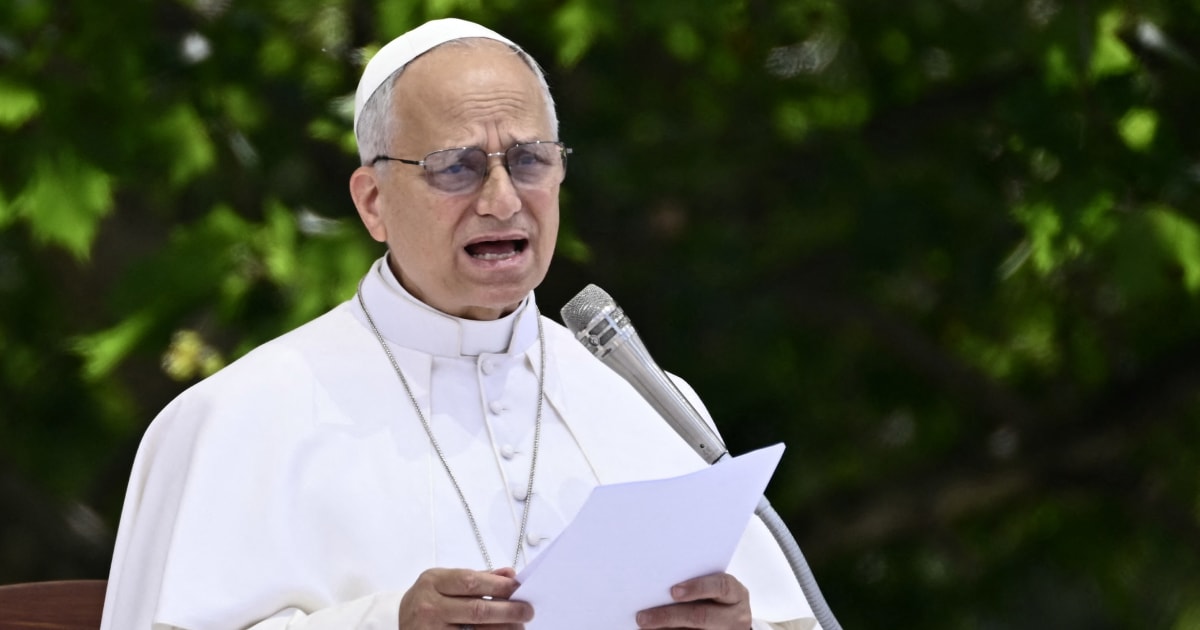

Pope Leo XIV has urged European leaders to confront the continent’s demographic crisis by supporting families, strengthening intergenerational solidarity and defending the dignity of human life.
Addressing members of the European Parliament’s Intergroup on Demography at the Vatican, together with civil and political representatives, the Holy Father warned that Europe risks becoming the “old continent” not only because of its history, but because of its ageing population.
He described declining birth rates and population ageing as “an urgent challenge with practical implications for millions of people and their families”.
The Pope said demographic questions could not be reduced to statistics alone.
“Demographic data are not merely statistics, but speak of fatherhood, motherhood and children,” he said, adding that “children are the future”.
Quoting the late Pope Francis, Pope Leo recalled concerns that Europe was becoming an “old continent” because of its “advancing age”. He also pointed to the social consequences of demographic decline, including what he called the “pandemic of loneliness”.
The Holy Father said authentic and sustainable development depended on solidarity between generations, warning that such a balance was increasingly absent across Europe.
He also reflected on what he described as a weakening of Europe’s Christian roots over recent decades.
The Pope said the rejection of the Christian inspiration that guided the founders of the European institutions had contributed to a “time of drastic sterility”. He said this was not only because many had been “deprived of the right to be born”, but also because younger generations had often failed to receive the material and cultural foundations needed to face the future.
Pope Leo criticised what he called contradictory approaches in some contemporary policies, saying they claimed to support families while at the same time promoting “discrimination against motherhood”, upholding “abortion as a right” and undermining “the very foundation of the desire to start a family”.
At the same time, he expressed gratitude for initiatives and institutions working to support families and demographic renewal.
The Holy Father said the demographic challenge had to be addressed through cooperation among political institutions, academics and civil society.
He described the issue as “a crucial juncture for the anthropological, social and economic future of Europe”, and encouraged dialogue that includes Christians as “an integral part” of civil society.
At the centre of any lasting solution, he said, was the dignity of every person and the fundamental role of the family.
Recalling the teaching of Pope St John Paul II, Pope Leo described the family as “the first and irreplaceable school of social life”, founded upon marriage between a man and a woman.
He added that public policies should strengthen the active participation of families in social, political and cultural life while respecting the principle of subsidiarity, avoiding both excessive state intervention and radical individualism.
Concluding his address, Pope Leo said the Church’s vision did not seek a return to past social models, but proposed enduring principles capable of guiding societies as they confront fundamental questions about human life, society and the future of coming generations.
He highlighted cooperation between the Federation of Catholic Family Associations in Europe and the Commission of the Bishops’ Conferences of the European Union as examples of fruitful collaboration aimed at promoting human dignity and the common good.
“A genuinely human path can be opened for resolving the demographic crisis,” he said, one that is “orientated towards the common good, and the wellbeing of future generations”.
“Only a fresh springtide for the family can transform the winter chill of our ageing populations,” the Pope concluded.