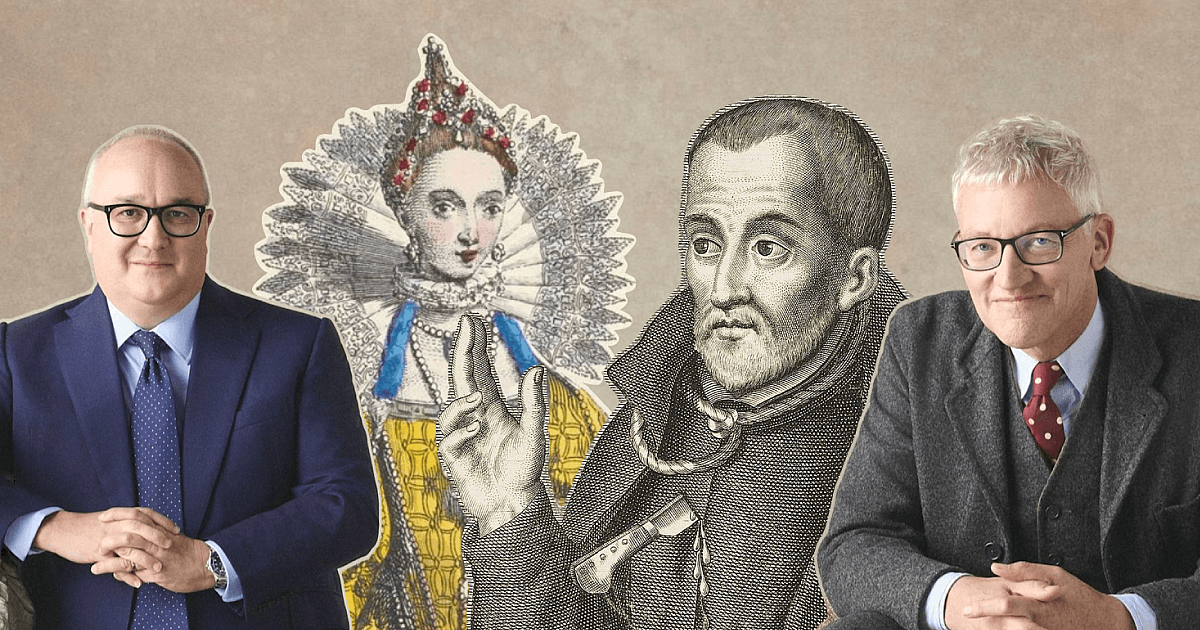
I don’t listen to podcasts – and by “I don’t listen to podcasts”, I mean the only podcast I listen to is Goalhanger’s The Rest Is History. For any history fan, you’d have to be living under a rock not to have heard of the dynamic duo of Tom Holland and Dominic Sandbrook, who bring their formidable learning, a seemingly inexhaustible curiosity and an impish humour to bear on a whole host of historical periods, subjects and personalities – presented for free to their devoted listeners, with special extras for the paid members of their fan club.
The seemingly effortless ease with which they lay out an historical narrative rich with anecdote and absurdity but laced throughout with a pursuit of the essential truth is as remarkable as it is enjoyable. Among the subjects they’ve covered that I’ve enjoyed so far are the Aztecs, the Irish War of Independence, London’s golden age of Boswell and Johnson, Evita’s corpse, Joan of Arc, Custer’s Last Stand at Little Bighorn, the JFK assassination and the implausibly sinister Doctor Valverde, seventh president of the Dominican Republic.
Imagine the surprise in the quiet corner of the world that is Catholic Angledom when these two great giants – the Demosthenes and Thucydides of the podcast world! – turned their attention to examine our struggle against the persecutions unleashed by the tyrant Elizabeth I, the She-Diocletian of England if ever there was one.
Yet so it is: Tom Holland and Dominic Sandbrook have devoted six entire episodes of their illustrious podcast to Elizabeth I vs The Catholics. The Catholics of England stand astonished and humbled to have caught their attention, and happily Tom and Dominic have mostly departed from the tired, clapped-out and plainly false official Protestant version of Elizabeth’s reign that dominated for so long and that still holds out in small pockets like a sole Japanese infantryman on a deserted Pacific island long after his emperor threw in the towel.
No, Foxe’s “martyrs” and the legend of Good Queen Bess don’t cut it for our Tom and Dom, thankfully. They are much fairer and open-minded and even express open admiration for that legend of all legends, Edmund Campion SJ. Nevertheless, there are some assumptions and underlying elements in this otherwise excellent series of podcasts which might be worth shining a little light upon to aid understanding.
In the first episode, Tom points out that Protestantism in England has “very shallow roots” and that outside London and the South East, many people remain “instinctively Catholic”. There were indeed folds of England where prudent Catholic landowners managed to protect the faith of their rural tenants – the Arundells of Wardour, for example. As the historian Dr Stella Wood has pointed out, conformity to the Church of England in some rural areas was the exception rather than the rule.
It was Sir William Cecil – effectively Elizabeth’s prime minister – who ardently crafted the narrative that English Catholics were all traitors and inherently in league with foreign despots. (Never mind the domestic despot he spent his career serving.) At times – alas! – Holland and Sandbrook drink deeply from Cecil’s well of up-to-no-good Cafflicks plotting to bring in their foreign teachings and impose them upon the roast beef of old England.
Yet accepting Tom’s admission that Protestantism had shallow roots during Elizabeth’s reign and that much of the country remained attached to its ancestral religion begs the question: which is the alien ideology here? The faith practised peaceably by the grandparents of almost everyone involved, or the new religion imposed by the heavy hand of royal power?
It is true that the Counter-Reformation – perhaps more accurately the Catholic Reformation – had a strongly international dimension. The English colleges at Douai, Rome, Valladolid and elsewhere played a major role in sustaining Catholic life at home, and Catholic monarchs had their own reasons for fostering and protecting England’s Catholics. But the recusant Catholic of rural Lancashire was not some Communist agent infiltrating 1950s Whitehall. His grandparents had not been recruited by Moscow: they were practising the faith handed down to them almost since the time Augustine reached these shores. To treat Catholic practice itself as the equivalent of allegiance to a foreign power is therefore to assume the very thing that still has to be proved.
Tom and Dominic are on shaky ground when they describe Pope St Pius V’s bull Regnans in Excelsis as a “papal fatwa” that made Elizabeth the legitimate target of assassination. Now, Regnans is one of the trickier matters to deal with and there are very few Catholics today who would argue it was either wise, judicious or constructive. Pius V was one of those saintly pontiffs who effectively gave their entire being over to their sacred office upon accepting the papacy. He was Total Pope – no half measures. And often saints can be incredibly frustrating people to have to deal with.
This unwelcome bull excommunicated Elizabeth, declared her deprived of any right to rule and freed all the subjects of the Crown of England from any rightful obedience to her. But unlike Khomeini’s fatwa against Salman Rushdie – which called upon the writer’s blood to be shed – nowhere does Pius’s bull say “assassinate Elizabeth”. The jump from deposition and release from allegiance to an individual licence to murder is a massive one. Holland and Sandbrook also fail to deal with the softening line that Pius’s successor, Pope Gregory XIII – father of the calendar we use today – issued in 1580, having recognised the disastrous impact of his predecessor’s act.
Regnans undoubtedly made everything worse, but the persecution and coercion against Catholic practice predated the bull by over a decade. The 1559 Act of Uniformity compelled all Englishmen and Englishwomen to attend Protestant services on Sundays and holy days – refusal to do so was punishable. Elizabeth’s regime had made conformity to its new ecclesiastical establishment a legal obligation long before Pius V obliged Catholics to confront the implications of it.
Nor did the English – Catholic or otherwise – take Elizabeth’s power grab lying down. The 1569 Rising of the North sought to depose Elizabeth from the throne they believed she had usurped and replace her with Mary, Queen of Scots, who many felt had a much stronger claim. The active plotters were also part of a larger circle that hoped to marry the Catholic Mary to an English Protestant nobleman and unite England behind Queen Mary II.
As the political and religious conflict intensified, Pius V’s act made an already bad situation markedly worse, while the state progressively deployed the law to transform mere religious dissent into an offence of political treason. Elizabeth’s circle had learned from some of her predecessor Mary I’s missteps: instead of burning dissenters for heresy, they charged them with treachery and being agents of a foreign power.
Our hosts claim it’s equivocation for Jesuits like Edmund Campion to say they are returning to England to minister to souls, but this is the objective and known historical record. Cecil manipulated and abused the offence of treason against priests whose presence in England and activities there were purely spiritual in nature. Changing the meaning of treason to include mere religion turns “They weren’t killed for religion, they were killed for treason” into the greatest equivocation of all.
The case of Robert Southwell SJ illustrates the point. Arraigned at Southwark in 1594 on a charge of treason, he admitted he was a Catholic priest but pleaded not guilty, insisting that he was “a priest but no traytour; nether can anie law make it treason to be a preist”. His Humble Supplication to Her Majesty had likewise urged Elizabeth to end the oppression of Catholics on the grounds that they were not plotting against her.
As Dr Lucy Underwood has pointed out, Southwell’s argument was that if Catholic ordination itself amounted to treason, then St Augustine and most of England’s Christian past would have to be declared treasonous too. Parliament could no more make priesthood treason by declaring it so, Southwell argued, than it could make circles square.
The case of Edmund Campion is where Sandbrook’s “conversion equals subversion” argument really comes undone. To be fair, our hosts show incredible sympathy to the martyr. Anyone who has read Evelyn Waugh’s biography of the man must stand ready to testify to his bravery, intelligence and perseverance in adversity. Dominic claims that since the Pope had excommunicated Elizabeth, no Catholic priest can claim political neutrality. Tom pushes back and says: “Dominic, you absolutely can – and they do!”
Tom is right! Campion’s own famous “Brag” explicitly made clear that he, as a Jesuit heading to care for souls in England, was strictly forbidden to deal with matters of state or politics. Our hosts cite Campion’s own words, “The enterprise is begun… So the faith was planted: So it must be restored”, but add their own gloss that “you restore it by getting rid of the Protestant Jezebel”.
By their own admission, Campion was an admirable and honourable man, but this jest contradicts his clear and explicit assertion about the very nature of his enterprise. His marching orders were clear: administering the sacraments, preaching to the faithful, instructing souls and aiding converts. Scholarly sources examining the 1580-81 Jesuit mission concede its mission was a pastoral rather than a political one.
From there the problem only gets worse. Holland and Sandbrook describe what happens when Campion is captured: false intelligence has been manufactured, illegal torture is deployed and Campion is repeatedly given the rack until he cannot even use his own hand to write. All the proceedings turn on the question of whether Campion’s mission is political, but – irrespective of his actual guilt or innocence – there’s never any doubt about what the verdict will be. Modern legal-historical scholarship is fairly clear: Underwood describes Campion as having been convicted on fabricated charges of plotting Elizabeth’s murder.
If Campion is transparent that his instructions forbid politics, if his mission’s actual activity is preaching and administering the sacraments, if the agents of the law are forced to employ torture and fabricate the evidence used to convict him – at what point are we finally allowed to conclude that he was killed merely for being a Catholic priest?
None of this is to deny that Cardinal Allen, Robert Persons and other exiles eventually embraced foreign intervention and Elizabeth’s removal: of that – Tom and Dominic are quite right – there is no doubt. The more revealing story is how the persecutions unleashed by Elizabeth’s regime helped turn its own propaganda into a partial reality. Cecil’s handling of legislation, manipulations of justice and deployment of torture and execution helped seal off hopes of living a peaceful Catholic life in the land that for centuries had fostered the faith. No wonder some Catholics eventually concluded the only option left was Elizabeth’s violent overthrow.
But what emerged later cannot be used as proof that Cecil was right all along, still less that Campion was a proto-emissary for the Armada. The real question is not whether any Catholics plotted against Elizabeth but whether every priest and recusant can be folded into a single monstrous conspiracy against the realm. To do so would be to grant Cecil his most enduring victory: persuading posterity that men convicted on fabricated evidence were indeed somehow guilty.
Holland and Sandbrook have come closer than almost any other popular historians to escaping that trap but, having brought Campion so sympathetically before their vast audience, they might well grant him the final courtesy of trusting the evidence and believing him.


.png)