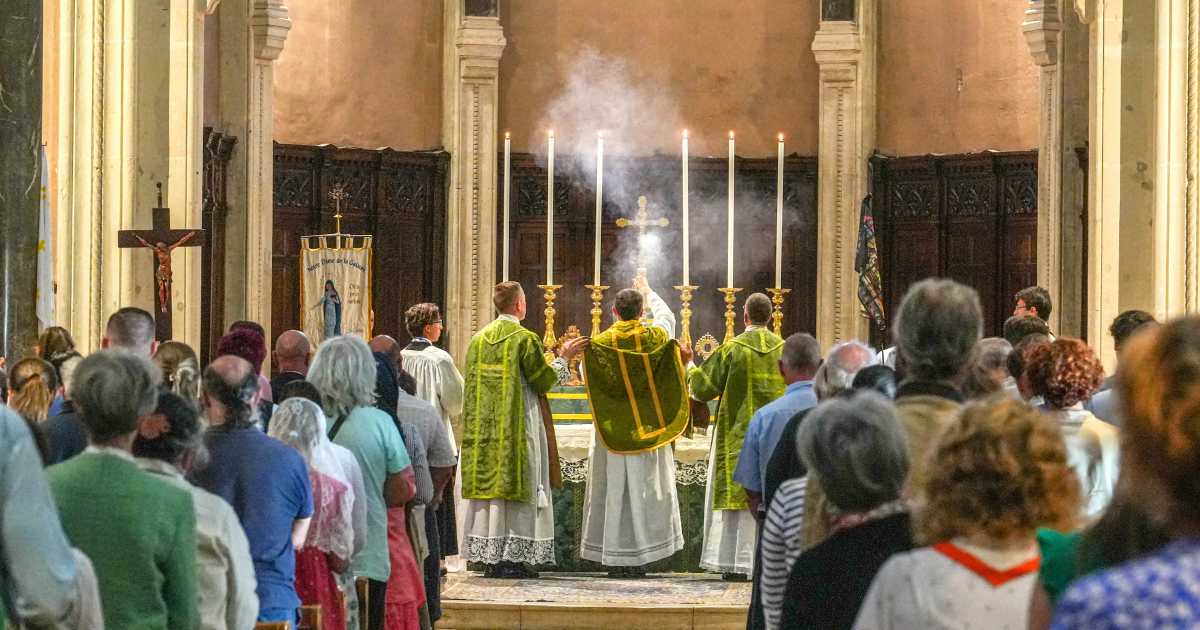


The little world of the Traditional Mass has had to come to grips with the news, albeit long anticipated, that the Society of St Pius X (SSPX) will ordain – or in the traditional terminology which they prefer, “consecrate” – bishops on July 1. It is the feast of the Precious Blood, though only in the pre-Vatican II calendar.
The SSPX was founded to train priests in a traditional way, and this included the use of the older 1962 Latin Mass. The Society was officially suppressed in 1975, but its founder, the tough-minded retired French missionary archbishop Marcel Lefebvre, simply carried on. Discussions to bring the Society, and its increasingly far-flung network of Mass centres, back into good canonical standing failed, and the now elderly archbishop ensured the long-term survival of his foundation by consecrating four bishops in 1988, without papal mandate. He died in 1991, and two of these bishops have now also died, so there is a certain inevitability in the Society’s desire to consecrate some more.
The consecrations of 1988 created an earthquake. The consecrating bishops (the archbishop was assisted by the Brazilian Bishop Castro Mayer), and the new bishops, were excommunicated. A dozen Society priests and a score of seminarians distanced themselves from this event and appealed to Pope St John Paul II for house room: they became the Fraternity of St Peter, with the privilege of celebrating the Traditional Mass in good standing with Rome. Other priestly associations and religious communities followed the same path. The Pope promulgated an Apostolic Letter, Ecclesia Dei, which combined a condemnation of the SSPX with the establishment of a new legal framework for the celebration of the Traditional Mass in dioceses around the world. Bishops were urged to be “generous” in granting permission for it; desire for it was called a “rightful aspiration”. In this way many of the concessions on offer to the SSPX were made available to a newly strengthened traditionalist movement within the mainstream.
Events seem destined to repeat themselves. Once again the SSPX has been engaged in talks aimed at regularisation, and once again their leadership is conscious that the clock is ticking down on their ability to consecrate new bishops on their own, as their existing ones age. No one has been able to explain exactly what, of the things Catholics are actually bound to believe, the SSPX officially rejects, but they score badly on post-Vatican II vibes. The Holy See might be content for them to adopt a vaguely worded statement of faith, but the SSPX leadership want to use this opportunity to get the Vatican itself to make a clear affirmation of traditional theological positions, which it is very reluctant to do.
Another problem, however, is simply one of mutual trust. Whatever assurances Pope Leo might be giving the Society about future policy towards the Traditional Mass, recent history has taught us all a painful lesson in how easily such policies can be reversed. On the other hand, if the SSPX continues to have its own bishops, perhaps in an Ordinariate structure, they would retain the ability to go back into an “irregular” situation the moment the Holy See does something they do not like.
This was the sticking point in negotiations back in 1988. Pope St John Paul II agreed to there being a bishop or two to serve the traditional movement, but their appointment would be in the hands of Rome, and the Pope neither formally accepted Lefebvre’s candidates nor announced his own. The ability to withhold priestly ordinations is a key practical power Rome has over religious orders, and not to be given up lightly, but this drastic sanction has been overused, usually against conservatives. The most famous case was that of the ill-fated Franciscans of the Immaculate, but small Ecclesia Dei bodies have also suffered, such as the Sons of the Most Holy Redeemer, and the Benedictines of Silverstream in Ireland and Saint-Benoît in France. After Pope Francis initiated his campaign against the Traditional Mass in 2021, it was widely assumed that this blunderbuss would be applied to the priestly institutes established under, or reconciled to, the Holy See after 1988, though as things worked out this never happened. The problem, nevertheless, has certainly not escaped the notice of the SSPX.
What is needed is a period of calm to re-establish mutual trust. This was, indeed, one of the goals of Pope Benedict XVI’s liberation of the Traditional Mass in 2007. That was followed by closer cooperation over the disciplining of the Society’s problem priests, talks, and low-key SSPX usage of official shrines and Roman basilicas. Pope Francis followed this up, giving Society priests official authorisation to hear confessions, and a way for them to register weddings with the local diocese. Tragically, what is left of this policy after Pope Francis’ sudden about-face on the Traditional Mass five years ago is likely to be obliterated by the official reaction to the episcopal consecrations scheduled for July.
Another consequence we can look forward to – in fact, this has already started – is a renewed attempt by inveterate enemies of the Traditional Mass to castigate those supporters of the Traditional Mass who have taken the thorny path of seeking or remaining in good standing with Rome as crypto-schismatics, along with the SSPX. These “Ecclesia Dei” Catholics can expect equal and opposite criticisms from supporters of the SSPX for not throwing in their lot with them.
We traditional Catholics who are united in obedience to our bishops and the Holy Father would gladly endure these attacks if the ultimate goal of reconciliation were served. The first step must be the restoration of a truly friendly official attitude towards the ancient Mass. If Pope Leo did this, he would be following the example not only of Pope Benedict, but of Pope St John Paul II, and even Pope Francis for most of his reign. As Pope Benedict remarked, this is worth doing, in fact not only for the sake of the SSPX, but for the good of the whole Church, because this liturgy is a “treasure” for the Church. That, after all, is why so many are prepared to suffer for it.