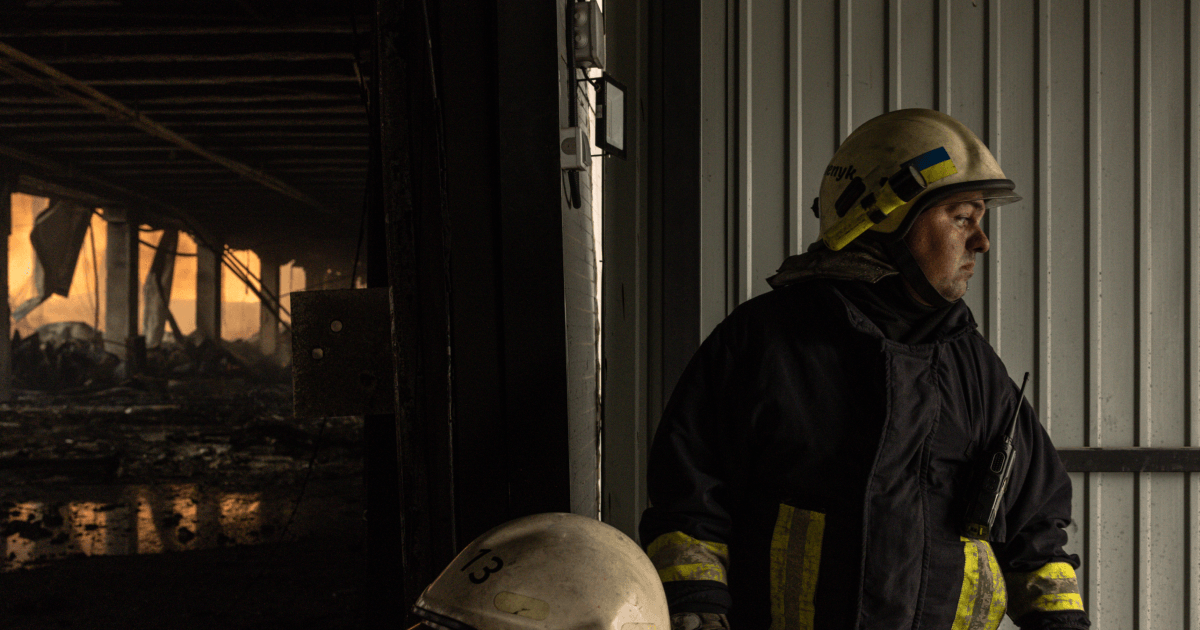
This week, Ukraine marked 35 years of its independence, the fifth Independence Day since the Russian invasion. Major Archbishop Sviatoslav Shevchuk of the Ukrainian Greek Catholic Church spent the night in an air-raid shelter.
He told Vatican News that “unfortunately the number of drones and missiles being launched over our heads is increasing. Lately, each month has become bloodier than the one before.” The United Nations monitoring mission recorded July as the bloodiest month the war has seen since March 2022. In July, 437 civilians were killed and 2,610 were wounded. It was the highest number of children killed or wounded since April 2022.
“The other day a bus was struck in the city of Kherson,” he said. “Not only the people travelling on that bus were killed, but also people who happened to be nearby. It is obvious that the operator of that drone could see the people he was killing.”
The increasing episodes prompted Pope Leo XIV this month to renew his appeal for the targeting of civilians to cease. “War only breeds more war and causes immense suffering,” he stressed. “It is time to stop the spiral of violence and make room for diplomacy and dialogue, paving the way for peace.”
The comments came following a widely shared video of a Russian drone hunting a street vendor in the Kherson region, part of a trend that has been referred to as a “human safari”. The man survived the attack but sustained multiple shrapnel wounds, a concussion, and trauma.
The dire situation leads the Ukrainian Church to reflect on the anniversary with trepidation. But Archbishop Sviatoslav noted that celebrating it meant “first and foremost, thanking the Lord for the gift of freedom, of which the independent Ukrainian state is the guarantor.”
Emphasising that love of one’s homeland cannot turn into idolatry of the state, he nonetheless noted that a state “governed by the rule of law is an important instrument for protecting human dignity, freedom, the common good, and the people's right to life.” “Love for one's homeland is not hatred of others; rather, it is the willingness to assume responsibility for one's people and to serve them,” he said.
“Therefore, for us, this day commemorating Ukrainian independence is a day of prayer and reflection on how, today, we must not only defend our freedom but also positively build our future.”
The day was also cause for looking back. Having lived under a communist state, the archbishop recalled that “we understood that freedom does not simply mean the possibility of being free externally. We understood that freedom is a spiritual and moral category.”
He continued: “I remember that even in the Soviet Union, we Catholic Christians who lived underground were freer than the communist leaders, because we carried this freedom of the children of God in our hearts.” Then, when communism did collapse, they were able to “transmit this inner freedom that we had carried within us into the context of Ukrainian civil society.”
July 19 marked the 35th anniversary of the restoration of the structures of the Latin Rite Church in Ukraine. Secretary for Relations with States Archbishop Richard Gallagher attended the celebrations at the National Shrine of Our Lady of the Holy Scapular in Berdychiv. On Independence Day, he began his diplomatic mission to Moscow to seek an end to the war.
The following day, he met with Russian Foreign Minister Sergey Lavrov. In the press conference afterwards, he said the war “must end” and that “the longer the conflict continues, the more difficult it will be to arrive at an adequate resolution while the sufferings of the population continue to increase”.
“The most important issue,” he emphasised, “remains the need to achieve peace. Every day that the war continues creates new victims, exacerbates the divergences between the peoples involved, and renders future reconciliation ever more difficult. It is therefore urgent and necessary to end and to look beyond the conflict in order to ensure that the future memory of past wrongs does not become a prison nor that present sufferings become a legacy of hatred.”
As the war becomes, somehow, even uglier, fears of the conflict becoming multi-generational become ever more prescient. The conflict ultimately began in early 2014 – more than 12 years ago – with the Russian occupation and annexation of Crimea. From there, its support for separatists in the Donbas would ferment a simmering but deadly tension between the two nations before Moscow would invade in 2022.
“Since then, the Ukrainian people have endured suffering on a scale that is difficult to comprehend,” said Bishop Kenneth Nowakowski of the Ukrainian Eparchy of the Holy Family of London. “Families have been separated, homes and communities destroyed, and countless lives lost. Yet Ukraine continues to resist.”
“Its soldiers, volunteers, doctors, teachers, priests, parents and young people have shown extraordinary courage and determination. They have defended not only their land, but also their freedom, their dignity and their right to decide their own future. Their struggle has come at an immense human cost, and we must never forget the sacrifices that have been made,” he said.
The commemoration was one of sadness, but the archbishop also emphasised hope. “Christian hope is not the belief that difficulties will simply disappear; it is the trust that evil and injustice will not have the final word,” he said.
He concluded: “May the day come when the people of Ukraine can once again build their future in freedom, prosperity and peace, and when their children and grandchildren can look back on these difficult years knowing that the sacrifices of their parents and grandparents were not in vain.”
As European leaders conclude their meeting in Kyiv to look for more ways to support Ukraine, rumours continue to circulate that, after Russia’s elections in September, Moscow may implement another wave of conscription. The exchange of strikes between the two nations will likely continue for the foreseeable future, if not rise as the deadlock hardens. In the meantime, civilians will have to shelter where they can or flee when they must.