


The Vatican has published the visual and pastoral themes of Pope Leo XIV’s forthcoming African journey.
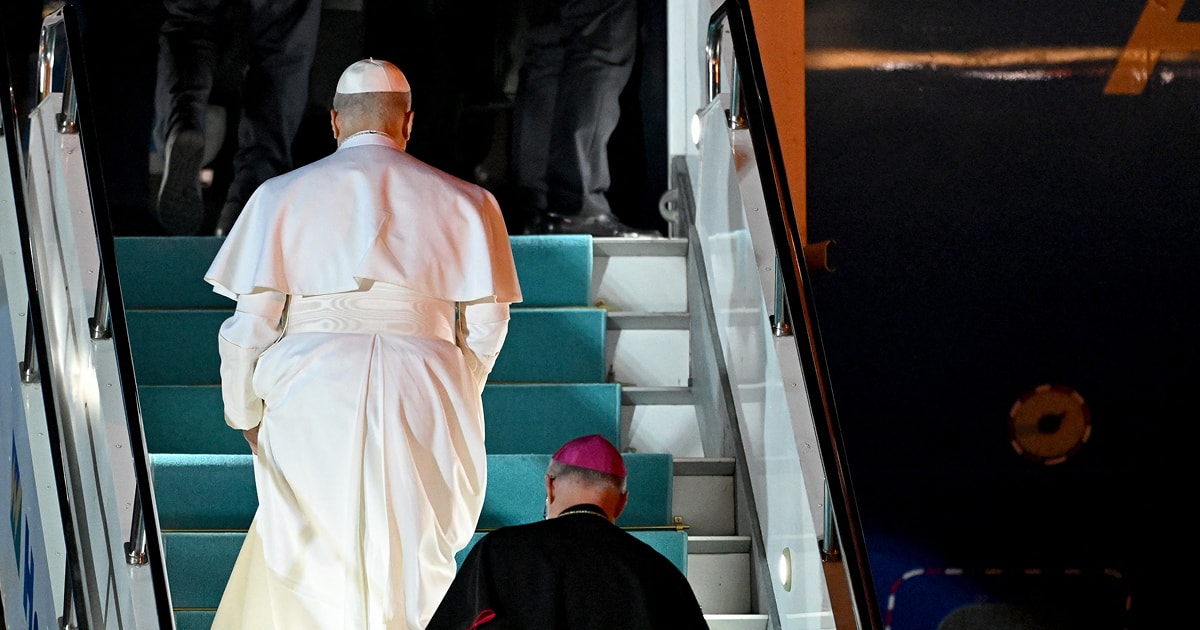
The Apostolic Journey, scheduled for April 13–23, will take the Pope to Algeria, Cameroon, Angola and Equatorial Guinea, marking his third foreign visit since the start of his pontificate. It follows his 2025 trip to Türkiye and Lebanon and comes just weeks after a planned visit to Monaco.
In Algeria, where Christians form a small minority within a predominantly Muslim society, the imagery of two doves drinking from a shared cup is paired with the ancient Chi Rho symbol and the colours of the national flag.
The accompanying motto, rendered in Arabic, Amazigh and French, translates as “Peace be with you”, echoing both the Gospel greeting of the risen Christ and the common Islamic salutation.
That emphasis is reinforced by the Pope’s programme in Algiers, where he will visit the Great Mosque before addressing the Catholic community at the Basilica of Our Lady of Africa. The inclusion of a visit to Annaba, ancient Hippo and the see of St Augustine of Hippo, adds a historical dimension, reminding observers that this region was once a centre of Latin Christianity long before it became predominantly Muslim.
In Cameroon, the tone shifts from interreligious dialogue to ecclesial unity. The logo places an open Bible beneath the outline of the nation, with a crucifix rising from its pages and a dove radiating light at its centre. The motto, drawn from the Gospel of John, “May they all be one”, aligns closely with the Pope’s episcopal motto, suggesting that this leg of the journey will focus on unity within a Church facing both rapid growth and local tensions.
The schedule reflects this. The Pope will meet political authorities in Yaoundé and travel to Bamenda, a region affected by conflict, where he is expected to take part in a meeting for peace. He will celebrate Mass in multiple cities, visit an orphanage and address academics, indicating a pastoral approach that moves between high-level diplomacy and local engagement.
Angola’s logo, by contrast, is more overtly historical and national in tone. Dominated by red hues recalling past bloodshed, it incorporates symbols of labour, natural life and the Eucharist, presenting a vision of a nation marked by suffering yet oriented towards renewal. The motto describes the Pope as a “pilgrim of hope, reconciliation, and peace”, language that resonates in a country still living with the legacy of a civil war that ended in 2002.
Here again, the programme mirrors the symbolism. The Pope will celebrate Mass in Kilamba, pray the rosary at the Marian shrine of Muxima, a site of deep popular devotion, and visit a nursing home in Saurimo.
In Equatorial Guinea, the final leg of the journey, the imagery becomes more explicitly Christological. A golden cross dominates the logo, with representations of the nation and the family placed at its centre. Beneath it appears a figure in a boat, recalling the arrival of the first missionaries by sea some 170 years ago. The motto presents Christ as the light guiding the country towards a future of hope.
The Pope’s itinerary here includes meetings with political authorities, cultural figures and bishops, as well as visits to a psychiatric hospital, a prison and a memorial commemorating victims of a 2021 explosion.
The Pope’s journey to Africa will be his longest international trip so far. The Church in Africa has seen significant growth over the past century, with one in five Catholics now living on the continent. During the 20th century, the number of Catholics in Sub-Saharan Africa grew by 6,708 per cent, and between 2023 and 2024 the number of Catholics on the continent increased by almost 10 million. The total number of African ordinations surpassed Europe for the first time in 2019, and the continent is training around 34,000 priests in its major seminaries, accounting for about 31 per cent of seminarians globally.