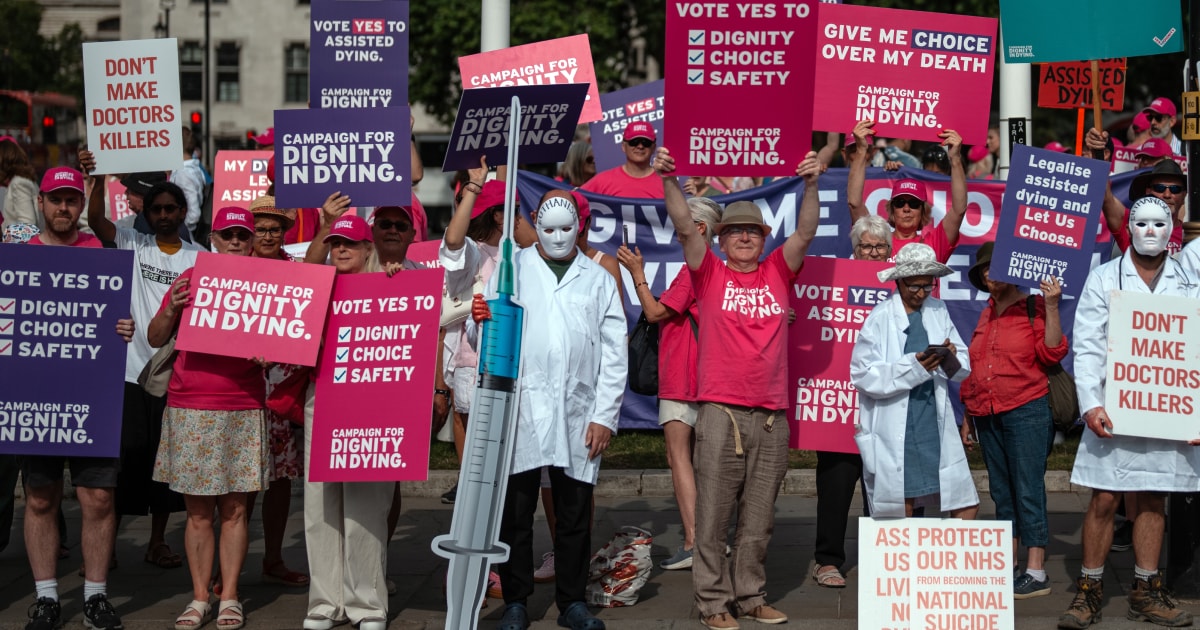



The assisted suicide Bill has been widely pronounced dead by commentators after it was revealed that it will “almost certainly” run out of time in the House of Lords and will not become law, after the Government Chief Whip in the Lords confirmed that the Government will not commit any further time to the Bill.
Private Members’ Bills, like the Terminally Ill Adults (End of Life) Bill, are debated on Fridays. Despite seven additional sitting Fridays being granted for the Bill before Christmas, on top of the seven already scheduled, even the team behind the Bill now expects it to fail.

Assisted suicide campaigners have repeatedly claimed that just seven peers have been blocking the Bill by tabling numerous amendments. A new analysis by Right To Life UK’s public affairs team has, however, stated that this claim presents a misleading picture of the situation in the House of Lords.
The analysis states that nearly 80 peers have so far tabled or signed amendments highlighting concerns with the Bill and that 131 peers have either spoken against the Bill or signed amendments raising concerns during its passage through the Lords. This is significant because the Bill’s supporters are seeking to persuade MPs to revive it in the next parliamentary session and force it through using the Parliament Acts, arguing that a small number of peers have inappropriately blocked its passage.
The analysis argues that this claim is untrue. A total of 131 peers opposing a Bill is an unusually high number, particularly one in which debates are reserved for Fridays, when peers are often not expected to be in Parliament. The Bill has not yet completed Committee Stage or reached Report Stage or Third Reading. In addition to these 131 peers, it is likely that more will speak during future sittings and it is known that others are opposed. Some have spoken in the media or raised concerns through written parliamentary questions.
Contrary to claims by the Bill’s supporters, the number of peers opposing the Bill by speaking against it or signing amendments raising concerns is among the highest recorded for a Bill in the House of Lords, even before the Bill has completed Committee Stage. Those peers include members appointed because of expertise in relevant areas, including a former President of the Royal College of Psychiatrists and President of the British Medical Association, the former chief executive of NHS England, a professor of palliative medicine, peers living with disabilities and legal experts, including a former Attorney General and a former President of the Family Division of the High Court.
This number of peers has subjected the Bill to detailed scrutiny due to what opponents describe as flaws and a lack of adequate safeguards. Despite claims to the contrary, there has been no filibuster. According to Nikki da Costa, former Director of Legislative Affairs at 10 Downing Street, the average speech length has been under five minutes. Experts have also stated that peers have no obligation to return a Private Members’ Bill to the Lords.
A recent poll published by More in Common indicates that a majority of the public does not support bypassing the House of Lords to force the Bill through, as would occur if the Parliament Acts were invoked in the next parliamentary session, as Lord Falconer has suggested.
Despite the polling including leading questions in favour of the Bill, 54 per cent of those surveyed thought the Bill should either not return or would have to pass both Houses again, whereas 46 per cent thought it should bypass the House of Lords. The polling showed that majorities of both men and women, and voters of every major political party, did not support bypassing the Lords.
The polling also indicated that those who strongly support legalising assisted suicide remain at 28 per cent of the public, compared with 32 per cent in November 2024.
The release of the polling follows campaigning from assisted suicide lobby group Dignity in Dying to build support for using the Parliament Acts to reintroduce Kim Leadbeater’s Bill in the next parliamentary session and bypass the House of Lords.
Using the Parliament Acts to bypass House of Lords scrutiny of a Private Members’ Bill would be politically contentious and unprecedented. It would be the first time the Parliament Acts had been used for a Private Members’ Bill.
Another poll found that 70 per cent of respondents who expressed a view believe peers should be able to vote against a Private Members’ Bill if they believe it would harm vulnerable people. The House of Lords Constitution Committee and the Hansard Society have confirmed that peers are constitutionally free to reject the Bill. As it is not a Government Bill and was not included in any party election manifesto, there is no convention requiring the Lords to pass it.
Former Home Secretary Suella Braverman described the development as “very good news”, a view echoed by columnist and broadcaster Sonia Sodha. Scottish Conservative MP John Lamont welcomed the announcement, saying the Bill “was not properly considered and lacked support from the Royal Colleges and organisations representing disabled people”. He added that support should instead be given to improve palliative care.
Conservative life peer Toby Young said he was “relieved” that the Government had “pulled the plug” on the Bill. Writing for The Telegraph, Young added that in the House of Lords “the only way to win is by reaching out across the floor and forming alliances. [Lord] Falconer is more of a demolition expert than a bridge builder”.
Alisdair Hungerford-Morgan, chief executive of Right To Life UK, said: “The assisted suicide Bill is now dead in this parliamentary session and mortally wounded beyond. Despite spin from the pro-assisted suicide lobby, the Bill is not failing because of a determined filibuster by a select few. This is a misleading and dishonest myth. Rather, it is failing because it is a badly drafted piece of legislation and, after appropriate and necessary scrutiny, peers have determined that the Bill would not be safe or workable.”
He added: “Using the Parliament Acts to bypass House of Lords scrutiny of a Private Members’ Bill would be unprecedented and wholly inappropriate. The Parliament Acts have never been used to force through a Private Members’ Bill before.
“Any talk of using the Parliament Acts to force this Bill into law must now be put to rest. Parliament now has the opportunity to drop this divisive and flawed Bill and instead to work collectively to ensure better quality palliative and end-of-life care is available for all.”
This article was originally published by Right To Life UK and is republished with permission. Read the original version of this article here.