

I have always loved books. My late mother’s copy of the Diary of St Faustina, dog-eared and crammed with prayers and devotional cards, is cherished on my bedside table. The last thing my father wrote was a dedication to my daughters on the title page of Sixty Saints for Girls. It was a book he had planned to give them since they were babies. He also gave a breviary to my nephew, who has recently rediscovered his Catholic faith. The gift of a book can go a long way, as it is something that contains great ideas in a distinct, long-lasting form.
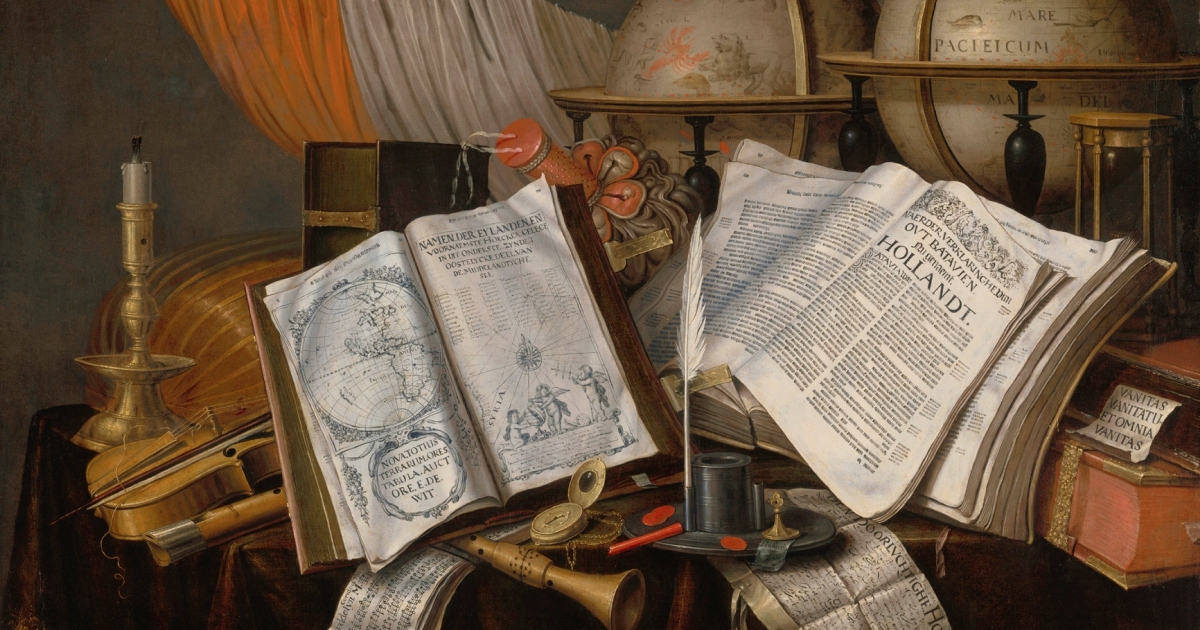
I worked in the book-publishing industry at a time when the digital world, driven by the internet marketplace and excitement over digital devices, seemed to signal the imminent demise of the physical book. At the turn of this century, I recall an engineer saying, as many did then, that publishing and books would be finished because of the development of the digital screen. It seemed to him that books would soon be unnecessary and that my work at the time, selling foreign editions of physical books for my London publisher, would be rendered defunct. What he failed to appreciate was that the ideal piece of engineering already existed in the printed book.
I say nothing against technology, which has, in theory, made reading more accessible to many. Nor should everyone have the heart for Tolstoy or Joyce unabridged. (I confess that I have never made it through Ulysses.) We might also admit that simply hearing the Sermon on the Mount, without reading the entirety of scripture, can be enough to bring about great transformation.
The challenge, if there is one, is not that we may digitise, summarise or abbreviate anything; it is our temptation to make the whole process of reading and engaging with it “easier” by rendering the book into pixels only – which takes it from us entirely.
Now, none of us would think that a mere digital library, which you may have been subjected to in a school of some sort, is the same as a well-thumbed volume that may be kept for generations. It means more to receive a handwritten letter than an email. It is rather tragic that the Danish postal service, in a terrible moment of surrender, has now ceased even to deliver letters.
Without physical books, we begin to think that life can be made easier with only a digital device. The promise, in those years when this began, was that we could deliver information and connection to all humanity. What has come about, however, is a lack of real things and tangible connection to anyone.
In truth, our desire to touch something real is at the heart of the power of the book as a created thing, along with anything else of value. I remember attending an exhibition on the subject of RMS Titanic years ago, at the end of which patrons were allowed to touch a portion of the original hull. The awe that one feels in such a moment, if one can feel it, is a precursor to that divine awe we have the great privilege of feeling at Mass in the presence of the Eucharist.
There can be no substitute for the Real Presence. I am sure I am not the only one who finds themselves somewhat devastated, on Holy Saturday, to walk into the church and know that the Lord is not present in the tabernacle. My children, like seven solemn ducklings, will whisper down the line, “The tabernacle is empty!” This shocking irregularity is sometimes too much for the toddler, who has been brought up to say “hi” to Jesus and who cannot yet comprehend the deep joy of Easter that we are all anticipating.
Our intense dissatisfaction with the lack of real things is bound to drive us to Christ, though, which is greatly encouraging. We feel, as we should, that the merely virtual does not lead us to human flourishing as much as the physical world might. This can now be understood through the collapse in reading among the young, for example, even with every book more easily available to them and digital readers surrounding them.
Time and common sense are now revealing what we should have known, at least with regard to books. Without the slow, painful idea that the heavy tome, the Bible or the great novel is worth preserving, we find ourselves without them, seeing them only as part of an endless series of items. If they are the best and most adequate pieces of civilisation we have, then, in losing them, we find ourselves at odds with civilisation itself.
We should be greatly encouraged, then, by the continued existence of books in their weighty and contentious physical form, giving us the chance to touch and read what is real in all its complexity. It is reading and, most probably, purchasing a Bible – not some form of new media – that has been credited by many young Catholic converts in France as the greatest influence on their decision to join the Church. Sales of the Bible have increased greatly in that country and, I would imagine, elsewhere in the West.
This is a reminder that, in the end, we will come to our senses and, speaking as Catholics, return to the truest thing of all. He is there in every tabernacle, waiting for us to realise that He is what we have always desired. It is a shame that it might take us so long to accept the painful, slow and steady idea that improvements are not always necessary and that tradition is merited and hard-earned.
But accept it we must. With books, the most popular and cherished among them will always be desired in physical form. Andy Weir, author of The Martian, simply put the book on a personal website for years before it grew sufficiently popular for publishers to take it on, turning it into the physical book his audience really wanted.
Now, if the physical copy of Tolkien’s Letters – highly recommended – or a copy of The Odyssey or the Catechism is something you wish for, you will want to have it in physical form. The terrifying idea is not that you should have to wend your way down the river of the long books of your forebears; it is that you will never discover what they lived and died for. It can be understood through reading.
Actually reading, though, is what takes up time and has no guarantee of any great rewards. In our household, replete with some willing and unwilling readers, we offer payment for the completion of finished books – £20 for 20 books, should you wish to know the rates.
You might now accuse us of shameful bribery and of reducing a love of reading to mere transactions. Indeed, you would be right, but then we must live by faith, must we not? There are times in our own lives, even as we encounter Christ, when we simply have to say ex opere operato. The reluctant readers who have undergone our bribery have become avid readers, and we find ourselves in a new stage, struggling to keep up with the demand for new-to-us literature.
I have learnt to appreciate St Faustina by having my mother’s book next to me. It is something real that allows me to connect with the complexity and humanity of another person. It is something real that connects me, I hope, to something deeper, which is true.