December 21, 2025
December 20, 2025

Beyond dialogue: What still divides Rome and the Orthodox East

Min read
share

“It’s very hard to criticise someone you fundamentally carry a great deal of admiration for,” I told a friend inquiring into Christianity several months ago.

This old friend, only recently made an orphan in his twenties, was not long thereafter drawn to Christ and conversion (one is led to wonder if Christ’s promise in Jn 14:18 doesn’t also have a literal meaning). The words I just described were my response to his question about Eastern Orthodoxy.

Though this friend is now nearing the completion of his journey to Catholicism, taking RCIA classes as he prepares for baptism and confirmation, he was for a time captivated by the splendour, rigour, mysticality, depth and antiquity of the Orthodox tradition. This mirrors my own experience. Before my own conversion, I was not immune to the aesthetic and spiritual charms of the Eastern Christian world. 

I’m still enamoured by them, as I think most Christians ought to be. Theirs is an inheritance rich in great devotional, musical and artistic treasures. These are Apostolic Christians, with real bishops, real priests, real sacraments and Apostolic lineage, who have preserved important practices from Christian antiquity, doing so often significantly more reliably than by Catholics today.

And yet, neither my friend nor I became Orthodox. Needless to say there were significant reasons for this. If we had simply wanted to attend enchanted liturgies and which feel reliably serious rather than frivolous as some worship can feel in the modern day, perhaps we would have become Orthodox. But looking at our own lives and at the dire state of the contemporary world around us – we decided that truth was more important. That this is not a time for comforting fictions.

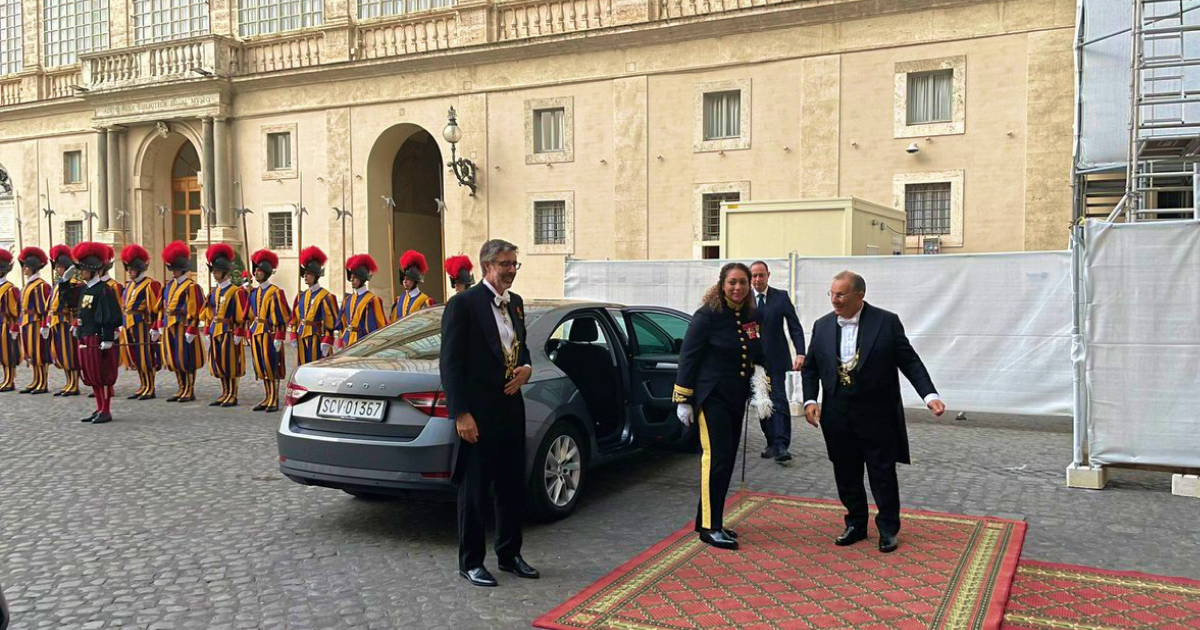
So in the wake of Pope Leo XIV’s recent 27-30 November meeting with Ecumenical Patriarch Bartholomew I of Constantinople, leader of the Orthodox communion, where both senior prelates expressed their desire to advance the causes of religious unity and ecumenism, Christians ought to reconsider the East-West schism.  

This was a schism which was healed once. Before the Fall of Constantinople, at the Council of Florence the East-West schism was actually, finally mended. The Byzantine Emperor Constantine XI and all the hierarchy present at the council ceded to it. They recognised the supremacy of Rome and shortly before Constantine XI died – disappearing on the battlefield – the emperor received Holy Communion from a (Western) Catholic bishop. 

Today, as demographic, spiritual and sociological existential threats assail the remnants of Christendom from within and without – and war ravages the borders of the Latin West with Orthodox Russia – comforting fictions must again be dispelled. Only both sides addressing this question honestly can hope to unite us in truth.  

Despite both Pope Leo and Patriarch Bartholomew’s declared approval that “dialogue” has progressed between the two major bodies of Christians, they identified "significant theological barriers” and “stumbling blocks” which remain obstacles to reunion. Bartholomew mentioned specifically the Fillioque and [papal] infallibility. 

And this is just it. On paper, the East-West rupture appears to hinge on doctrine. But the pages of history tell a different story. 

Two realities in particular complicate the standard narrative: the details of the squabbles during the centuries preceding the schism, and the actions of the Byzantine Empire’s final religious and political leadership at the Council of Florence. 

To understand the rivalry between Rome and Constantinople, one must begin with origins. Rome was the capital of the empire into which Christ was born. Constantinople, by contrast, did not yet exist. Byzantium was then a minor Greek settlement on the Bosporus. As Christianity spread across the Mediterranean world, its most prominent communities arose in cities of consequence and traced their authority to Apostolic foundations.

From the earliest records, three sees stood pre-eminent: Rome, Antioch and Alexandria. Rome and Antioch traced their episcopal lineage to St Peter; Alexandria to St Mark. Each was ruled by a leading bishop. 

Only later, following Constantine’s conversion and the relocation of the imperial capital, did Constantinople rise to prominence. Alongside Jerusalem, it was added to what became known as the pentarchy – the five principal episcopal sees of Christendom.

This arrangement is often invoked to resist papal supremacy, as though it reflected an egalitarian structure at the Church’s summit. It did not. Far from being harmonious, the pentarchal era was marked by rivalry, jurisdictional conflict and repeated appeals to Rome as a final arbiter.

Readers may not be aware, but the phrase primus inter pares, or “first among equals”, which is often used to describe the supposed position of Rome in relation to the other sees of the pentarchy, is a wholly anachronistic term. Despite its ancient sounding Latin, it appears nowhere in patristic documents dealing with Christian matters and was not used in this sense in antiquity. Its application to ecclesial questions is instead owed to the revisionist scholarship of William Wake, the Anglican Archbishop of Canterbury, in the seventeenth century. What possible motivation he might have had for resisting Roman authority, we can only wonder.

During the disputes and power struggles throughout the first centuries of the Church’s life, the worst offender (when it comes to brotherly infighting) was the new Roman capital. Constantinople consistently sought to raise its ecclesiastical standing to match its political importance. After repeated attempts to do so, antagonising the other patriarchates, Constantinople attempted to claim only second place – never first. 

This culminated at the Council of Chalcedon and with canon 28, which claimed Constantinople to be in “rank next after” Rome, while above Antioch, Alexandria and Jerusalem. 

Rome rejected the canon. So too did other ancient sees, and its promulgation precipitated lasting fractures, particularly with the Egyptian and Syriac Churches, who could no longer tolerate Greek domination. The justification for Constantinople’s claim rested largely on imperial status – a rationale difficult to sustain once the empire itself fell. 

During Constantinople’s iconoclast controversy, mobs frightened by Islam’s rapid expansion and paranoid that its successes were a result of divine punishment for Christian idolatry stormed through the city seeking to destroy sacred images. The mobs enjoyed, at various stages, support from the Byzantine royalty and hierarchy. Once again, it was Rome that stepped in to correct its Eastern neighbour.  

As we can see, Rome’s primacy was acknowledged from the earliest centuries. Bishops across the Christian world frequently appealed to Rome as a final arbiter; Rome intervened in disputes and deposed bishops even among the pentarchy; no equivalent authority flowed in the opposite direction. 

Theological disputes, meanwhile, were often less decisive than later polemics suggest. The Filioque – the doctrine that the Holy Spirit proceeds from the Father and the Son – had precedents in the early Church and was explicitly present in Western creeds well before the schism, including the earliest Anglo-Saxon formulations of the Nicene Creed. 

Nothing in the original formulation of the Creed excluded it. It is scripturally grounded and was not regarded as Church-dividing for centuries. By contrast, later doctrinal developments on the Orthodox side, such as the Palamite theology of the Holy Trinity being divided into nebulously-defined “essences” and “energies”, were introductions comparatively far more novel, introduced unilaterally in the East without ecumenical assent.

None of this proved insurmountable by the time the Council of Florence was convoked in the 15th century. In 1439, facing the existential threat of Ottoman expansion, the Byzantine Emperor Constantine XI and the assembled Eastern hierarchy formally accepted reunion with Rome. They recognised papal supremacy and resolved doctrinal disputes. 

The union was real, solemn and ratified. Whatever later rhetoric suggests, the Orthodox ceded without theological confusion, in conscious acknowledgement of historical reality. 

Constantine XI himself sealed that unity with his life. Shortly before the fall of Constantinople in 1453, he received Holy Communion from a Latin Catholic bishop and then led a final charge against the Ottoman onslaught from the crumbling Theodosian Walls – doing so as a Greek monarch and Roman Christian in a mended schism. 

The Empire of Byzantium, the glory of the Orthodox world – and the basis of its authority – died as it was born: reconciled to Petrine authority in Rome. This is simply fact, not triumphalism (and an important historical detail that I would encourage Orthodox Christians to contemplate with the lens of providence).

That union, however, did not endure, while Christians must confront the fact its collapse owed less to theology than to geopolitics. 

Ottoman rule intervened sharply and actively cemented the schism – keen as it was to prevent a united Christendom being better able to resist its Islamic power on two fronts. The sultans installed compliant patriarchs and restricted contact with Rome, finding a divided Christianity easier to manage. Over time, separation hardened into identity. What had been an ecclesiastical rupture became a civilisational one.

This is regrettable, because more than a few observant Catholics will readily confess that the West needs the East. It is to be hoped that the fair minded among the Orthodox may also cede that the East also seems to need the West.   

My friend and convert that I mentioned earlier, in the midst of his discernment once showed me a talk by Fulton Sheen. The archbishop observed that the West often appears to want Christ without the Cross, while the East – knowing suffering all too well, not least under the repressive atheistic hand of the Soviet Union – often seems to have the Cross without Christ. This contrast can be overstated – but it touches upon a broader truth. 

The Catholic tradition knows asceticism no less than Orthodoxy. The Carthusians, living in near-total silence and buried in unmarked graves, are hardly spiritual lightweights. The Western mystical tradition – from Teresa of Avila to John of the Cross – rivals anything produced in the East. Candlemas in the old rite, or the Rorate Mass in the haunting reverential darkness of Advent, dispels the myth that Catholicism lacks enchantment.

Still, it is true that Western spirituality has, at times, drifted into floweriness and sentimentality. From Renaissance and Baroque excess, the West emphasised joy and light – legitimately, yet sometimes, one can’t help thinking, perhaps a little too much for a fallen world and for a religion that orbits the agonised torture and death of the Son of God in human flesh. Orthodox critics have not unfoundedly blamed these Catholic tendencies for the subsequent “sin-can’t-affect-my-salvation” spirituality of Martin Luther.  

Another critique they level is that the West has suffered a tendency to intellectualise the faith too much – while the Orthodox East was content to remain in imaginative mystery. This Western habit led to the rationalistic doctrines of John Calvin, it is argued.

Once again, there may be some truth here. Take transubstantiation, for example. Though they do not disagree with the fundamentals – namely that upon a sacerdotal consecration a host becomes the body and blood of Christ – the Orthodox world resists St Thomas Aquinas’s efforts to explain how this occurs. 

Orthodox claim that understanding this process is less important than accepting it. The West responds, reasonably, that love seeks understanding and that God did not endow us with functioning senses and a rational intellect capable of grasping the truth for nothing.

The East has also retained a bracing sobriety and caution that has healthily prevented it from embracing any contemporary utopian or sexual heresies. Though it has to be said this sober caution has often been at the cost of missionary energy, while at times lapsing into severity and misery when over done. 

While Catholicism sent missionaries to every corner of the earth – converting millions in east Asia and an entire continent in the Americas – missionary successes from the Orthodox have been limited. For much of its history, dominated by Islamic occupation, Orthodoxy became insular and inward-looking, often bound to nation and state. 

So despite my praise for Orthodoxy, the reader must understand that I am not trying to establish any equivalence between the Catholic and Orthodox Churches – nor is my praise of their treasures and what they get right a suggestion that our Catholic tradition is impoverished or inherently deficient without such Eastern charms. 

The Catholic Church would certainly be enriched and fortified against heretical humanistic excesses by the welcome presence of Eastern, formerly Orthodox, wisdom. (One cannot imagine, for example, Pope Francis being elected in a marginal conclave that contained a large number of Russian cardinals.)  

Still, the Catholic Church has managed to be the most doctrinally conservative institution as well as the greatest evangelistic missionary force the world has ever seen. 

Her intellectualism and philosophy, far from being a hindrance, is the shield which protected – and continues to protect – the Church from compromise on issues such as life, marriage and sexuality. Meanwhile Orthodox teaching has become hazardously ambiguous on contraception and divorce (the latter of which it can permit up to three times).

The Eastern Church needs the Western Church, and the West could very much do with the East. With Europe under siege, witnessing demographic collapse as Christians face replacement, and with resurgent conflicts on the borders of the Mediterranean and the emerging red dragon in the Far East, this reality grows harder to ignore. 

The war in Ukraine has exposed the tragedy of Christian peoples locked in fratricidal conflict at a moment when their civilisations are in decline. The consequences of the East-West schism are – theologically, politically, humanly – disastrous.

Both sides will need to swallow their pride. Orthodox concerns about Western moral laxity are not unfounded. Yet Rome, for all the failings of her representatives, has conquered in a miraculous manner – converting continents, staying free from Islamic or political domination, unwaveringly preserving doctrine, remaining recognisably herself – vindicating Christ’s promise that Peter would be the holder of the keys, the rock which Satan would never surmount.

Constantinople ought to remember that both at Chalcedon and in the final words of her last great emperor, she once humbly bowed to Roman supremacy. Theological differences were resolvable then – they can be once more.  

Finally, a closing perspective that may help Orthodox Christians come to this conclusion and which comes from one of their own: from the intense, bearded, iconically Russian countenance of that esteemed intellectual of the late 19th century, Vladimir Soloviev. The poet-theologian, philosopher and literary writer – he was a close friend of Fyodor Dostoyevsky and Leo Tolstoy – concluded that:

“No amount of argument can overcome the evidence for the fact that apart from Rome there only exist national churches such as the Armenian or the Greek Church, state churches such as the Russian or Anglican, or else sects founded by individuals such as the Lutherans, the Calvinists, the Irvingites, and so forth.

“The Roman Catholic Church is the only Church that is neither a national church, nor a state church, nor a sect founded by a man; it is the only Church in the world which maintains and asserts the principle of universal social unity against individual egoism and national particularism; it is the only Church which maintains and asserts the freedom of the spiritual power against the absolutism of the state; in a word, it is the only Church against which the gates of Hades have not prevailed.”

So to my admirable Orthodox friends I would urge: the Ottomans are gone and you are free. But the enemies are once again at the gates. Remember what you once knew but have since forgotten.
“It’s very hard to criticise someone you fundamentally carry a great deal of admiration for,” I told a friend inquiring into Christianity several months ago.

This old friend, only recently made an orphan in his twenties, was not long thereafter drawn to Christ and conversion (one is led to wonder if Christ’s promise in Jn 14:18 doesn’t also have a literal meaning). The words I just described were my response to his question about Eastern Orthodoxy.

Though this friend is now nearing the completion of his journey to Catholicism, taking RCIA classes as he prepares for baptism and confirmation, he was for a time captivated by the splendour, rigour, mysticality, depth and antiquity of the Orthodox tradition. This mirrors my own experience. Before my own conversion, I was not immune to the aesthetic and spiritual charms of the Eastern Christian world. 

I’m still enamoured by them, as I think most Christians ought to be. Theirs is an inheritance rich in great devotional, musical and artistic treasures. These are Apostolic Christians, with real bishops, real priests, real sacraments and Apostolic lineage, who have preserved important practices from Christian antiquity, doing so often significantly more reliably than by Catholics today.

And yet, neither my friend nor I became Orthodox. Needless to say there were significant reasons for this. If we had simply wanted to attend enchanted liturgies and which feel reliably serious rather than frivolous as some worship can feel in the modern day, perhaps we would have become Orthodox. But looking at our own lives and at the dire state of the contemporary world around us – we decided that truth was more important. That this is not a time for comforting fictions.

So in the wake of Pope Leo XIV’s recent 27-30 November meeting with Ecumenical Patriarch Bartholomew I of Constantinople, leader of the Orthodox communion, where both senior prelates expressed their desire to advance the causes of religious unity and ecumenism, Christians ought to reconsider the East-West schism.  

This was a schism which was healed once. Before the Fall of Constantinople, at the Council of Florence the East-West schism was actually, finally mended. The Byzantine Emperor Constantine XI and all the hierarchy present at the council ceded to it. They recognised the supremacy of Rome and shortly before Constantine XI died – disappearing on the battlefield – the emperor received Holy Communion from a (Western) Catholic bishop. 

Today, as demographic, spiritual and sociological existential threats assail the remnants of Christendom from within and without – and war ravages the borders of the Latin West with Orthodox Russia – comforting fictions must again be dispelled. Only both sides addressing this question honestly can hope to unite us in truth.  

Despite both Pope Leo and Patriarch Bartholomew’s declared approval that “dialogue” has progressed between the two major bodies of Christians, they identified "significant theological barriers” and “stumbling blocks” which remain obstacles to reunion. Bartholomew mentioned specifically the Fillioque and [papal] infallibility. 

And this is just it. On paper, the East-West rupture appears to hinge on doctrine. But the pages of history tell a different story. 

Two realities in particular complicate the standard narrative: the details of the squabbles during the centuries preceding the schism, and the actions of the Byzantine Empire’s final religious and political leadership at the Council of Florence. 

To understand the rivalry between Rome and Constantinople, one must begin with origins. Rome was the capital of the empire into which Christ was born. Constantinople, by contrast, did not yet exist. Byzantium was then a minor Greek settlement on the Bosporus. As Christianity spread across the Mediterranean world, its most prominent communities arose in cities of consequence and traced their authority to Apostolic foundations.

From the earliest records, three sees stood pre-eminent: Rome, Antioch and Alexandria. Rome and Antioch traced their episcopal lineage to St Peter; Alexandria to St Mark. Each was ruled by a leading bishop. 

Only later, following Constantine’s conversion and the relocation of the imperial capital, did Constantinople rise to prominence. Alongside Jerusalem, it was added to what became known as the pentarchy – the five principal episcopal sees of Christendom.

This arrangement is often invoked to resist papal supremacy, as though it reflected an egalitarian structure at the Church’s summit. It did not. Far from being harmonious, the pentarchal era was marked by rivalry, jurisdictional conflict and repeated appeals to Rome as a final arbiter.

Readers may not be aware, but the phrase primus inter pares, or “first among equals”, which is often used to describe the supposed position of Rome in relation to the other sees of the pentarchy, is a wholly anachronistic term. Despite its ancient sounding Latin, it appears nowhere in patristic documents dealing with Christian matters and was not used in this sense in antiquity. Its application to ecclesial questions is instead owed to the revisionist scholarship of William Wake, the Anglican Archbishop of Canterbury, in the seventeenth century. What possible motivation he might have had for resisting Roman authority, we can only wonder.

During the disputes and power struggles throughout the first centuries of the Church’s life, the worst offender (when it comes to brotherly infighting) was the new Roman capital. Constantinople consistently sought to raise its ecclesiastical standing to match its political importance. After repeated attempts to do so, antagonising the other patriarchates, Constantinople attempted to claim only second place – never first. 

This culminated at the Council of Chalcedon and with canon 28, which claimed Constantinople to be in “rank next after” Rome, while above Antioch, Alexandria and Jerusalem. 

Rome rejected the canon. So too did other ancient sees, and its promulgation precipitated lasting fractures, particularly with the Egyptian and Syriac Churches, who could no longer tolerate Greek domination. The justification for Constantinople’s claim rested largely on imperial status – a rationale difficult to sustain once the empire itself fell. 

During Constantinople’s iconoclast controversy, mobs frightened by Islam’s rapid expansion and paranoid that its successes were a result of divine punishment for Christian idolatry stormed through the city seeking to destroy sacred images. The mobs enjoyed, at various stages, support from the Byzantine royalty and hierarchy. Once again, it was Rome that stepped in to correct its Eastern neighbour.  

As we can see, Rome’s primacy was acknowledged from the earliest centuries. Bishops across the Christian world frequently appealed to Rome as a final arbiter; Rome intervened in disputes and deposed bishops even among the pentarchy; no equivalent authority flowed in the opposite direction. 

Theological disputes, meanwhile, were often less decisive than later polemics suggest. The Filioque – the doctrine that the Holy Spirit proceeds from the Father and the Son – had precedents in the early Church and was explicitly present in Western creeds well before the schism, including the earliest Anglo-Saxon formulations of the Nicene Creed. 

Nothing in the original formulation of the Creed excluded it. It is scripturally grounded and was not regarded as Church-dividing for centuries. By contrast, later doctrinal developments on the Orthodox side, such as the Palamite theology of the Holy Trinity being divided into nebulously-defined “essences” and “energies”, were introductions comparatively far more novel, introduced unilaterally in the East without ecumenical assent.

None of this proved insurmountable by the time the Council of Florence was convoked in the 15th century. In 1439, facing the existential threat of Ottoman expansion, the Byzantine Emperor Constantine XI and the assembled Eastern hierarchy formally accepted reunion with Rome. They recognised papal supremacy and resolved doctrinal disputes. 

The union was real, solemn and ratified. Whatever later rhetoric suggests, the Orthodox ceded without theological confusion, in conscious acknowledgement of historical reality. 

Constantine XI himself sealed that unity with his life. Shortly before the fall of Constantinople in 1453, he received Holy Communion from a Latin Catholic bishop and then led a final charge against the Ottoman onslaught from the crumbling Theodosian Walls – doing so as a Greek monarch and Roman Christian in a mended schism. 

The Empire of Byzantium, the glory of the Orthodox world – and the basis of its authority – died as it was born: reconciled to Petrine authority in Rome. This is simply fact, not triumphalism (and an important historical detail that I would encourage Orthodox Christians to contemplate with the lens of providence).

That union, however, did not endure, while Christians must confront the fact its collapse owed less to theology than to geopolitics. 

Ottoman rule intervened sharply and actively cemented the schism – keen as it was to prevent a united Christendom being better able to resist its Islamic power on two fronts. The sultans installed compliant patriarchs and restricted contact with Rome, finding a divided Christianity easier to manage. Over time, separation hardened into identity. What had been an ecclesiastical rupture became a civilisational one.

This is regrettable, because more than a few observant Catholics will readily confess that the West needs the East. It is to be hoped that the fair minded among the Orthodox may also cede that the East also seems to need the West.   

My friend and convert that I mentioned earlier, in the midst of his discernment once showed me a talk by Fulton Sheen. The archbishop observed that the West often appears to want Christ without the Cross, while the East – knowing suffering all too well, not least under the repressive atheistic hand of the Soviet Union – often seems to have the Cross without Christ. This contrast can be overstated – but it touches upon a broader truth. 

The Catholic tradition knows asceticism no less than Orthodoxy. The Carthusians, living in near-total silence and buried in unmarked graves, are hardly spiritual lightweights. The Western mystical tradition – from Teresa of Avila to John of the Cross – rivals anything produced in the East. Candlemas in the old rite, or the Rorate Mass in the haunting reverential darkness of Advent, dispels the myth that Catholicism lacks enchantment.

Still, it is true that Western spirituality has, at times, drifted into floweriness and sentimentality. From Renaissance and Baroque excess, the West emphasised joy and light – legitimately, yet sometimes, one can’t help thinking, perhaps a little too much for a fallen world and for a religion that orbits the agonised torture and death of the Son of God in human flesh. Orthodox critics have not unfoundedly blamed these Catholic tendencies for the subsequent “sin-can’t-affect-my-salvation” spirituality of Martin Luther.  

Another critique they level is that the West has suffered a tendency to intellectualise the faith too much – while the Orthodox East was content to remain in imaginative mystery. This Western habit led to the rationalistic doctrines of John Calvin, it is argued.

Once again, there may be some truth here. Take transubstantiation, for example. Though they do not disagree with the fundamentals – namely that upon a sacerdotal consecration a host becomes the body and blood of Christ – the Orthodox world resists St Thomas Aquinas’s efforts to explain how this occurs. 

Orthodox claim that understanding this process is less important than accepting it. The West responds, reasonably, that love seeks understanding and that God did not endow us with functioning senses and a rational intellect capable of grasping the truth for nothing.

The East has also retained a bracing sobriety and caution that has healthily prevented it from embracing any contemporary utopian or sexual heresies. Though it has to be said this sober caution has often been at the cost of missionary energy, while at times lapsing into severity and misery when over done. 

While Catholicism sent missionaries to every corner of the earth – converting millions in east Asia and an entire continent in the Americas – missionary successes from the Orthodox have been limited. For much of its history, dominated by Islamic occupation, Orthodoxy became insular and inward-looking, often bound to nation and state. 

So despite my praise for Orthodoxy, the reader must understand that I am not trying to establish any equivalence between the Catholic and Orthodox Churches – nor is my praise of their treasures and what they get right a suggestion that our Catholic tradition is impoverished or inherently deficient without such Eastern charms. 

The Catholic Church would certainly be enriched and fortified against heretical humanistic excesses by the welcome presence of Eastern, formerly Orthodox, wisdom. (One cannot imagine, for example, Pope Francis being elected in a marginal conclave that contained a large number of Russian cardinals.)  

Still, the Catholic Church has managed to be the most doctrinally conservative institution as well as the greatest evangelistic missionary force the world has ever seen. 

Her intellectualism and philosophy, far from being a hindrance, is the shield which protected – and continues to protect – the Church from compromise on issues such as life, marriage and sexuality. Meanwhile Orthodox teaching has become hazardously ambiguous on contraception and divorce (the latter of which it can permit up to three times).

The Eastern Church needs the Western Church, and the West could very much do with the East. With Europe under siege, witnessing demographic collapse as Christians face replacement, and with resurgent conflicts on the borders of the Mediterranean and the emerging red dragon in the Far East, this reality grows harder to ignore. 

The war in Ukraine has exposed the tragedy of Christian peoples locked in fratricidal conflict at a moment when their civilisations are in decline. The consequences of the East-West schism are – theologically, politically, humanly – disastrous.

Both sides will need to swallow their pride. Orthodox concerns about Western moral laxity are not unfounded. Yet Rome, for all the failings of her representatives, has conquered in a miraculous manner – converting continents, staying free from Islamic or political domination, unwaveringly preserving doctrine, remaining recognisably herself – vindicating Christ’s promise that Peter would be the holder of the keys, the rock which Satan would never surmount.

Constantinople ought to remember that both at Chalcedon and in the final words of her last great emperor, she once humbly bowed to Roman supremacy. Theological differences were resolvable then – they can be once more.  

Finally, a closing perspective that may help Orthodox Christians come to this conclusion and which comes from one of their own: from the intense, bearded, iconically Russian countenance of that esteemed intellectual of the late 19th century, Vladimir Soloviev. The poet-theologian, philosopher and literary writer – he was a close friend of Fyodor Dostoyevsky and Leo Tolstoy – concluded that:

“No amount of argument can overcome the evidence for the fact that apart from Rome there only exist national churches such as the Armenian or the Greek Church, state churches such as the Russian or Anglican, or else sects founded by individuals such as the Lutherans, the Calvinists, the Irvingites, and so forth.

“The Roman Catholic Church is the only Church that is neither a national church, nor a state church, nor a sect founded by a man; it is the only Church in the world which maintains and asserts the principle of universal social unity against individual egoism and national particularism; it is the only Church which maintains and asserts the freedom of the spiritual power against the absolutism of the state; in a word, it is the only Church against which the gates of Hades have not prevailed.”

So to my admirable Orthodox friends I would urge: the Ottomans are gone and you are free. But the enemies are once again at the gates. Remember what you once knew but have since forgotten.
share

subscribe to the catholic herald today

Our best content is exclusively available to our subscribers. Subscribe today and gain instant access to expert analysis, in-depth articles, and thought-provoking insights—anytime, anywhere. Don’t miss out on the conversations that matter most.
Subscribe