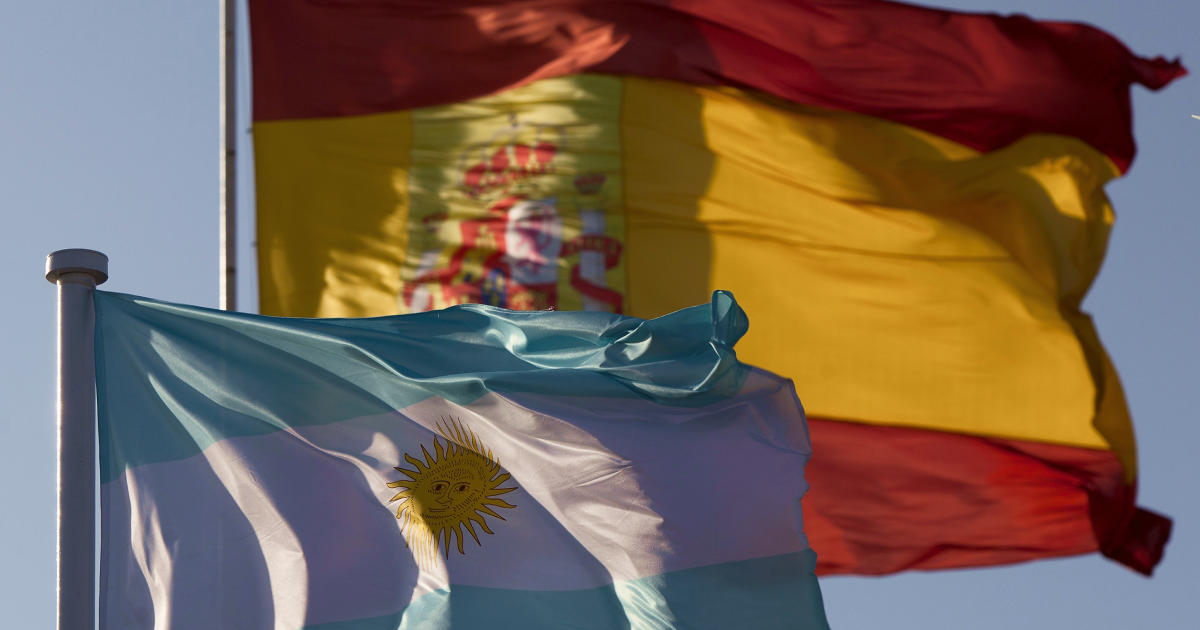



Spain and Argentina are going head to head in the final match of the World Cup to determine which is the best football team on the face of the planet. Argentina arrive as the reigning champions, having also won each of their seven matches in the tournament so far – including a gruelling victory over England. They have three World Cups under their belt, whereas Spain – despite a formidable sporting record – have only managed one victory in the final so far.
But let’s posit another contest between these two great nations. Tonight’s match will settle which is the better star of soccer – but which of these two would carry off the World Cup of Catholicism?
Argentina enter as strong favourites. Nearly two-thirds of all Argentines describe themselves as Catholic – compared to just over half of Spaniards. The country has given the Church a recent Pope – the first from the Americas – and it remains a culture in which Catholicism, in some shape or form, acts as part of the ordinary vocabulary of national life.
The Catholic Church is present in Argentina’s hospitals and charitable institutions and in schools and universities – although a 2017 Supreme Court ruling held that any religious instruction in state schools can only take place outside the regular hours of education. The Church is physically present in every community in the republic, from the rarefied circles of Buenos Aires to the tiniest provincial town on the Pampas. Priests and bishops remain figures of public life whose interventions are reported and debated beyond the confines of the Catholic faithful.
There is also a tradition of popular piety in Argentina, evidenced by the large number of devoted pilgrims who visit the Shrine of Our Lady of Luján or the Sanctuary of San Cayetano in Liniers.
Even the Argentine constitution, in its second article, declares that the government “upholds the Roman Catholic Apostolic faith”. The meaning of this has changed over the 173 years since it was first adopted, but, lodged as it is so early in the republic’s fundamental law, it is clear the framers regarded the Catholic Church not as a mere voluntary association of citizens but as part of the structure of Argentina itself.
In Spain, meanwhile, 56 per cent of Spaniards call themselves Catholic – but of those, just one in five describe themselves as practising. The decline within my lifetime has been sharp: 40 years ago, nine out of 10 Catholics were practising. The Spanish constitution merely requires the state to “maintain appropriate relations of cooperation with the Catholic Church”.
Does Argentina win the match, then? We need to examine Spain more closely before sending the cup to the southern hemisphere.
Spain is not simply a country where Catholicism may or may not be practised: it is a country that has been forged by the fire of the Catholic Faith. The old towns of Spain are gathered around their churches, their streets broadening into a plaza before their façades, roads leading outward to hermitages, monasteries and shrines. This pattern repeats itself across Castile and Andalusia, Galicia and Aragón, from the smallest village chapel to the more prodigious bulk of Santiago, Burgos, Toledo or Seville.
Even the Spanish year is Catholic: Holy Week is not merely observed but played out in public, with processions whose routes have been worn into the streets over centuries. Confraternities maintain their devotions, families inherit their places and entire cities rearrange themselves around the events of the Passion. Corpus Christi, Epiphany, patronal feasts and innumerable local devotions continue to order public time even for those who would never think of themselves as particularly devout.
Then think of the rich treasury that is the saints of Spain. Dominic, Ignatius Loyola, Francis Xavier, Teresa of Ávila, John of the Cross, Isidore of Seville, John of Ávila and Josemaría Escrivá would constitute an intimidating national team in any age. Spain received the Faith, preserved it and generated forms of sanctity, spirituality and apostolic zeal which in turn transformed the universal Church.
And the art! Spain’s painters rendered that Faith visible. Zurbarán gave weight and texture to the habits of monks, Murillo painted the Immaculate Virgin as though Heaven had broken through the clouds above Seville, and El Greco stretched the human form towards eternity. Her architects built cathedrals that appear not just to occupy the earth but to command it. Even Gaudí, working in an age already tempted to discard Christianity, produced in the Sagrada Família a building whose every surface attempts to confess the Creed.
Argentina inherited its part in this immense civilisation and made something vigorous and distinctively Argentine of it – but it was Spain where this civilisation was forged. Remove Catholicism from Argentine history and there is still much that remains readily identifiable: the pampas and the gaucho, tango and Peronism, the great waves of Italian migration, football and the endless arguments of Buenos Aires.
Delete Catholicism from Spain, on the other hand, and the entire country becomes difficult to explain. The Reconquista, the monarchy, Columbus’s discovery of America, the architecture of its cities, the names of its streets, the rhythm of its year, its painting, poetry and music – all these would become just fragments detached from their source. Even Spanish anti-clericalism, so vehement and so recurrent, is incomprehensible except as a rebellion against something once felt to be omnipresent.
Tradition, Chesterton reminded us, is the democracy of the dead, and nations are not solely judged by the opinions or behaviour of their present inhabitants. They are composed of the long gone as well as the living, of inherited landscapes and unchosen memories, of habits whose origins have been forgotten and buildings whose meaning survives the faith of those who pass beneath them.
Argentina is indeed a great Catholic nation, but Spain is a Catholic civilisation.