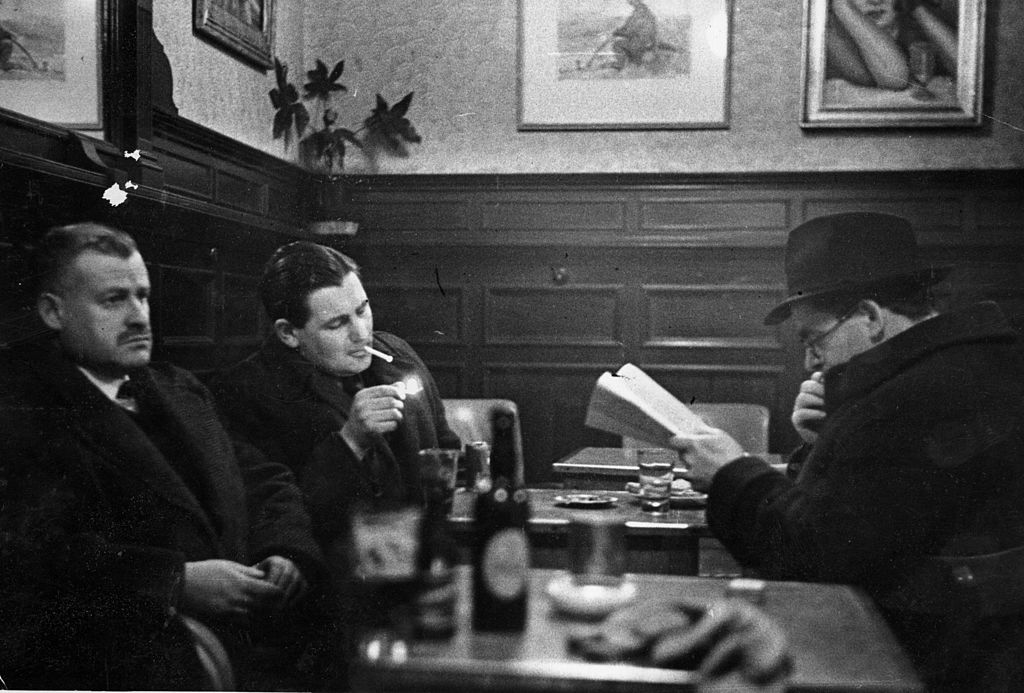


Irish novelist Francis MacManus (C), with Irish writer, broadcaster and Abbey Theatre director, Robert Farren (R) at the Palace Bar in Dublin, April 1942. (Haywood Magee/Picture Post/Hulton Archive/Getty Images)
Deep into his long poem ‘Lough Derg’, Patrick Kavanagh ventures the line: “All Ireland that froze for want of Europe”. Like many great lines of modern poetry, it is a compacted puzzle that will never be fully solved, but it resonates all the same. Its taut construction memorably evinces one strand of Irish historical exceptionalism: the country’s cutting off from the European mainstream and the unfortunate consequences of this. There was a certain inevitability that Ireland - with its island location on the ragged periphery of the continent, which the Roman Empire failed to reach; with a language from outside the Germanic, Slavonic and Romance families; and with its independently developed codes of law - would, in the words of the historian Richard Killeen, be “in Europe, but not always of it”; that a certain amount of cultural peculiarity would prevail. Then the centuries rolled in, bringing their punishments and curtailments. Christianization took place peacefully and productively, but after came the hugely destructive Viking raids and incursions, the enormous Norman land-grab beginning in the twelfth century, and then, deadliest of all, the Reformation and its aftermath. The Irish paid a heavy price, over and over, for resisting -- uniquely in Europe -- the cuius regio, eius religio formula: ‘whose realm, his religion’. While Ireland, in its land-of-saints-and-scholars-days, may well have been, as Ludwig Bieler put it, a harbinger of the Middle Ages, her chair at the ensuing banquets of European civilization went largely empty and unnoticed. No doubt some of Ireland’s trials were self-inflicted, the products of chronic factionalism and disorganization, of a seeming preference for what Seán Ó’Faoláin diagnosed as “dispersion and disconnexion”. This, Ó’Faoláin thought, set the Irish up to be eclipsed by other more “imperially minded peoples” who “fulfilled their genius magnificently through a corporate technique of living”. Even the lasting establishment in the sixteenth century of an Irish university -- the University of Dublin, with its one college of the Holy and Undivided Trinity -- did not really improve things. Soon enough Trinity College came to exclude most of the Irish from its precincts, through imposing obligations on students to attend Anglican services and to receive Holy Communion according to the Anglican rite. Fellows of the college had to take an oath against Popery. In the meantime, Irish clergy educated on the European mainland returned not so much to spread the light of knowledge, but to join the grim, attritional tussle for the nation’s soul. More disasters followed. The Penal Laws -- in the words of Edmund Burke, a “machine of wise and deliberate contrivance, as well fitted for the oppression, impoverishment, and degradation of a people, and the debasement in them of human nature itself, as ever proceeded from the perverted ingenuity of man” -- imposed all manner of forfeitures, penalties, disabilities and humiliations on the Catholic majority. And then, the nadir: mass starvation and complete social breakdown in the mid-nineteenth century, triggering tidal waves of emigration (though little of it to continental Europe). Irish society was, in the words of the Catholic bishop John MacHale writing to the British Prime Minister, Earl Grey, “completely unhinged”. Alexis de Tocqueville visiting in the 1830s saw misery such as he did not imagine existed in the world: