
February 12, 2026

'A haunting glimpse of what we lost': Virgin and Child returns to England after 600 years

Staff Reporter
More
No items found.
Related
Min read
share

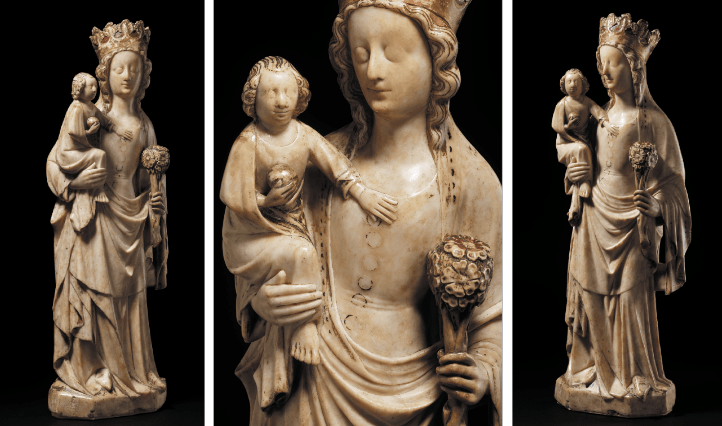
A medieval Virgin and Child that survived the ravages of the Reformation has returned to England for the first time in 600 years.

The alabaster statue, thought to have been made around 1350 in the Midlands, is hailed as a masterpiece and is now on display at the British Museum.

Historian Tom Holland described it as “a haunting glimpse of what we lost”.

Lloyd de Beer, co-curator of the medieval collection at the museum, told the Guardian: “When you look at an object like this and think what it has endured, it is so moving. If the British Museum exists for nothing else, it exists for this.”
The history of the statue is uncertain. For many years it was kept at a Benedictine monastery in St-Truiden, Belgium. It is unclear if it had been purchased before the Reformation or smuggled out during it. Officials at the British Museum suggest the former is more likely.

The abbey was suppressed and plundered by French Revolutionary forces in 1794 but the statue somehow survived.

It was exhibited in Brussels 70 years later and has been in the hands of private collectors ever since.

De Beer said: “We have placed the new statue in a gallery next to the South Cerney head and foot, broken from another statue, so that visitors can see what happened to most of these works.

“It also stands near a French Virgin and Child in ivory, so we can show it is just as sophisticated a piece. English alabaster sculpture has had a bad rap until now, because there was an element of mass production to some of the later work. Here, though, we can see the skill of a real work of art.”

A medieval Virgin and Child that survived the ravages of the Reformation has returned to England for the first time in 600 years.

The alabaster statue, thought to have been made around 1350 in the Midlands, is hailed as a masterpiece and is now on display at the British Museum.

Historian Tom Holland described it as “a haunting glimpse of what we lost”.

Lloyd de Beer, co-curator of the medieval collection at the museum, told the Guardian: “When you look at an object like this and think what it has endured, it is so moving. If the British Museum exists for nothing else, it exists for this.”
The history of the statue is uncertain. For many years it was kept at a Benedictine monastery in St-Truiden, Belgium. It is unclear if it had been purchased before the Reformation or smuggled out during it. Officials at the British Museum suggest the former is more likely.

The abbey was suppressed and plundered by French Revolutionary forces in 1794 but the statue somehow survived.

It was exhibited in Brussels 70 years later and has been in the hands of private collectors ever since.

De Beer said: “We have placed the new statue in a gallery next to the South Cerney head and foot, broken from another statue, so that visitors can see what happened to most of these works.

“It also stands near a French Virgin and Child in ivory, so we can show it is just as sophisticated a piece. English alabaster sculpture has had a bad rap until now, because there was an element of mass production to some of the later work. Here, though, we can see the skill of a real work of art.”

subscribe to
the catholic herald

Continue reading your article with a subscription.
Read 5 articles with our free plan.
Subscribe

subscribe to the catholic herald today

Our best content is exclusively available to our subscribers. Subscribe today and gain instant access to expert analysis, in-depth articles, and thought-provoking insights—anytime, anywhere. Don’t miss out on the conversations that matter most.
Subscribe