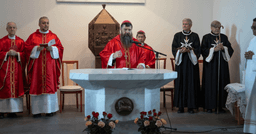
Earl Alfred Boyea Jr never wanted to be a bishop. ‘No, I did not,’ he says with a wry smile, recalling the day his modest ambitions were overturned. It was Sunday, July 14, 2002.
‘I was up north visiting my parents. I was on a break from seminary work when my bishop, Cardinal Maida of Detroit, called me on the phone. I first thought, “Okay, what did I do now?” but instead he said: “The Holy Father has named you a bishop. Do you accept?” Well, I did not know you could say “no”!’
And so Mgr Earl Boyea, rector of the Pontifical College Josephinum in Ohio, became an auxiliary bishop of Detroit in Michigan and then, six years later, bishop of the neighbouring Diocese of Lansing.
This month, Bishop Boyea of Lansing turns 75 and, as stipulated by Canon Law, tenders his resignation to Pope Leo XIV. Whoever succeeds to the see of Lansing will inherit a diocese in notably good health. Across the Diocese of Lansing, the number of converts and adult baptisms is at a 20-year high, with 940 new Catholics received at Easter. Sunday Mass attendance across the diocese has risen year on year since 2020, with last year seeing a 6.5 per cent increase in pew counts and growth in 52 of its 72 parishes. The medium-sized diocese has 29 seminarians, with last year’s ordination class the largest in nearly half a century.
Meanwhile, diocesan schools have adopted a more traditional Catholic liberal arts curriculum, coinciding with an increase in enrolment of more than 10 per cent – approximately 600 students – over the past six years.
As one of Bishop Boyea’s closest collaborators recently remarked on these developments: ‘Aslan is on the move.’
‘I put most of these things down to God,’ says Bishop Boyea, ‘and to our parishes which, frankly, have been in good shape for many, many years because we have such great priests. I am so incredibly proud of our presbyterate.’
What else might explain the evident vitality of the Diocese of Lansing?
By his own admission, Bishop Boyea brought ‘no particular agenda’ to his role in 2008 beyond the goal of ‘helping everybody to get to heaven’. The encouragement of others across the diocese, however, led him to see the value of a more defined approach to evangelisation. The result was a pastoral letter published on Holy Thursday 2012. Its central theme is captured in its eight-word title: Go and Announce the Gospel of the Lord.
‘I worked very hard to put together what is, admittedly, a rather long letter which draws upon Pope Benedict’s threefold vision for evangelisation: How do we build up the “household of faith” – meaning practising Catholics? How do we reach out to “the lost sheep”, those Catholics who, sadly, have left our Church? And thirdly, how do we engage and evangelise contemporary society, the modern-day “Court of the Gentiles”?’
‘Those three things were very important to me. If we are going to be evangelisers, that is where we have got to look. And so that letter has really been at the heart of everything we have been doing since 2012.’
‘I actually think that pastoral letter changed everything – but in ways we did not necessarily expect,’ says Craig Pohl, who this month concluded 13 years as director of new evangelisation for the Diocese of Lansing.
‘Nearly all our parishes have experienced an increase in the number of lay people who are, if you like, intentional disciples of Jesus Christ,’ he explains. ‘But where that becomes most significant is when that core number reaches a tipping point, I would say, of about 15 to 20 per cent of all parishioners. It is then that the internal culture of the parish shifts from maintenance to mission.’
The Covid-19 pandemic also played a role. Attendance at Sunday Mass has almost returned to pre-pandemic levels, but, says Mr Pohl, it is not simply a restoration of the previous status quo.
‘From all that our parishes have told me, the Covid pandemic seemed to accelerate an existing trajectory of decline in numbers, but who has returned since is interesting – the increased number of converts we all know about. Much more numerous, but less noticed, are the Catholics, especially families, who have embraced a more intentional and fervent practice of the faith. It is wonderful to witness.’
Despite the demands of episcopal life, the foundation of Bishop Boyea’s daily routine has remained unchanged throughout his 18 years in Lansing. ‘I get up and say Mass each morning and then, after that, I have an hour of prayer. During that time, I meditate upon the readings of the day, I also try to read a chapter of Sacred Scripture and then spend some quiet time giving thanks for all the things that took place the previous day.’
As he submits his resignation to Pope Leo XIV, Bishop Boyea admits uncertainty about what lies ahead. ‘I have not the foggiest idea,’ he says with a laugh. ‘I know I will be going from 90 miles an hour to zero in one day – and then we will see where God leads me in all of this.’
David Kerr is a former senior broadcast journalist with BBC News who is now Director of Communications with the Diocese of Lansing.
(Photographs courtesy of the Diocese of Lansing)