

What do racism, climate change, immigration and fuel costs all have in common? They have all sparked protests in Ireland over the past five years. In April, a nationwide protest about the price and taxation of fuel quickly morphed into a blockade of ports and fuel refineries that led to half of Ireland’s 1,500 fuel stations running dry and threatened to shut down the country. Ireland is once again in a rush to catch up with our fellow western nations, such that protest is increasingly the primary language of our politics, both for the Left and the Right. No one seems happy with the status quo, each protest being an expression of the division, disunity and anger that increasingly characterises the political scene in the West. Despite the efforts of politicians and policy experts to come to grips with why this is the case, one of the few world leaders who truly has an answer is our own Pope Leo XIV.
In a post on X/Twitter on April 18, Pope Leo outlined the deep roots of our present upheaval, writing: ‘Faith does not separate the spiritual from the social. It gives Christians the strength to interact with the world and to respond to the needs of others, especially the weakest. What is needed for the salvation of a community is a communal commitment, which integrates the spiritual and moral dimensions of the Gospel in the heart of local institutions and structures, making them instruments for the common good, not places of conflict, self-interest, or sterile struggles.’
Leo’s comments are a good summary of the weakness of our present status quo: liberalism, with its claim to neutrality between different conceptions of the good towards which man is directed. But as liberalism has no unifying vision, our local institutions and structures can be no more than a locus of conflict and self-interest, different groups vying for a certain bottom line of economic prosperity and political power. There is no way of discerning if one is right or wrong; it is all about ‘what is in it for me?’
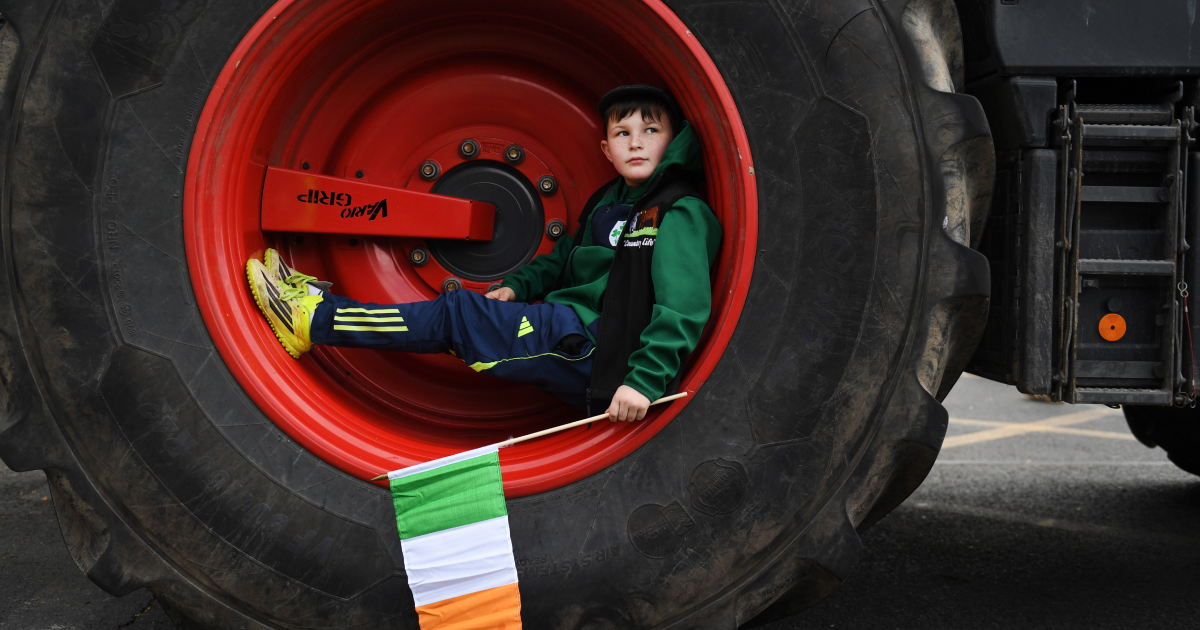
Ireland’s recent protests are an example of this. On April 7, truck and bus drivers, farmers and related groups brought the country to a standstill in protest against the cost of fuel, railing against what they perceived as government inaction and high taxes. The protesters blocked the main roads in the country and blockaded ports and oil refineries so successfully that, by the end of the protest a week later, almost half of Ireland’s 1,500 fuel stations had run dry and we were in danger of turning away ships carrying oil.
What was notable about the protest was how, despite the extreme measures implemented, the country largely supported them. What began as a protest against fuel costs quickly morphed into a wider expression of grievance against government mismanagement and disgruntlement at the state of the nation. Polls and commentary online suggested that the protests were as much an expression of wider dissatisfaction with the status quo. To take two examples: one poll in a premier weekend paper, The Sunday Independent, highlighted the degree of frustration directed at the government, with 46 per cent saying the government was to blame for the protests and just 28 per cent blaming the war in Iran and 24 per cent blaming the protesters; and a post went viral on X/Twitter and Substack in which Prof Sinead O’Sullivan analysed the degree to which government mismanagement was negatively impacting people’s lives in Ireland.
While these analyses emerged as the protests went on, it was clear that the protesters themselves were not proposing an alternative vision of the good life or reflecting on the principles needed to improve our way of living in Ireland. With confused demands, no obvious leadership structure and extreme tactics, it was an expression of frustration and anger bubbling up and fading away without resolution. This protest is not an isolated occurrence in Ireland or in the West more broadly. As with the UK and America, for instance, Ireland has seen a steady uptick in protests and riots amid a growing sense of social unease and disunity. The protests come from all sides, Left and Right, conservative and liberal alike. No one is happy, no one is content, no one believes we are moving in the right direction, or even if there is a right direction.
But while the protesters and commentators in Ireland and the West view the unease through the prism of policy, law, governance and institutions, the unrest will not be solved by new policy, because the unrest we see on the streets is the expression of a spiritual sickness, the hunger of the mind for a new ideal, for the good which liberalism denies the existence of.
That is because the insatiable hunger of the mind for an ideal is not being met. This presents a danger greater even than lust for material goods, as outlined by the English Dominican Fr Victor White (1902–1960). In a pamphlet on St Thomas Aquinas’ advice on studying, Fr White warned that ‘the unrestrained, undirected lust of the mind is still more devouring, more destructive, more calamitous than the unrestrained, undirected lust of the flesh’. This is a provocative idea, given that the received critique of our modern society is its unbridled lust for material goods.
What drives that lust, I would argue, is a vacuum of ideals. Another 20th-century Catholic thinker, former civil servant Frank Duff, wrote in the 1960s that no matter what policy governments or interested bodies introduce, they will fail if they leave ‘the right chords’ untouched. By the right chords he means the things of the spirit, the love of the mind and heart, the expression of a soul. Instead, societies believe the ‘bloodless approach’, as Duff calls it, of mass solutions through social policies, economic policies, education policies, etc, will save the world. But after attempting this approach, as we have been doing since at least the Second World War, we find that ‘in the main people have continued on in their wilful, selfish way… The stirrings of idealism have been effectively put to sleep… the community does no more than survive in convulsions’.
Surviving in convulsions – this might just summarise these dying days of post-WWII liberalism. What might be born out of it? If the world heeds Pope Leo, it will be a society that reintegrates the social and spiritual, that revitalises local communities by reintroducing the ‘spiritual and moral dimensions of the Gospel’. This begins, as Frank Duff argues, with each individual heart, attempting to stir in them an idealism that lifts man above self-interest, into a true appreciation for his family, his community, his nation and the world.