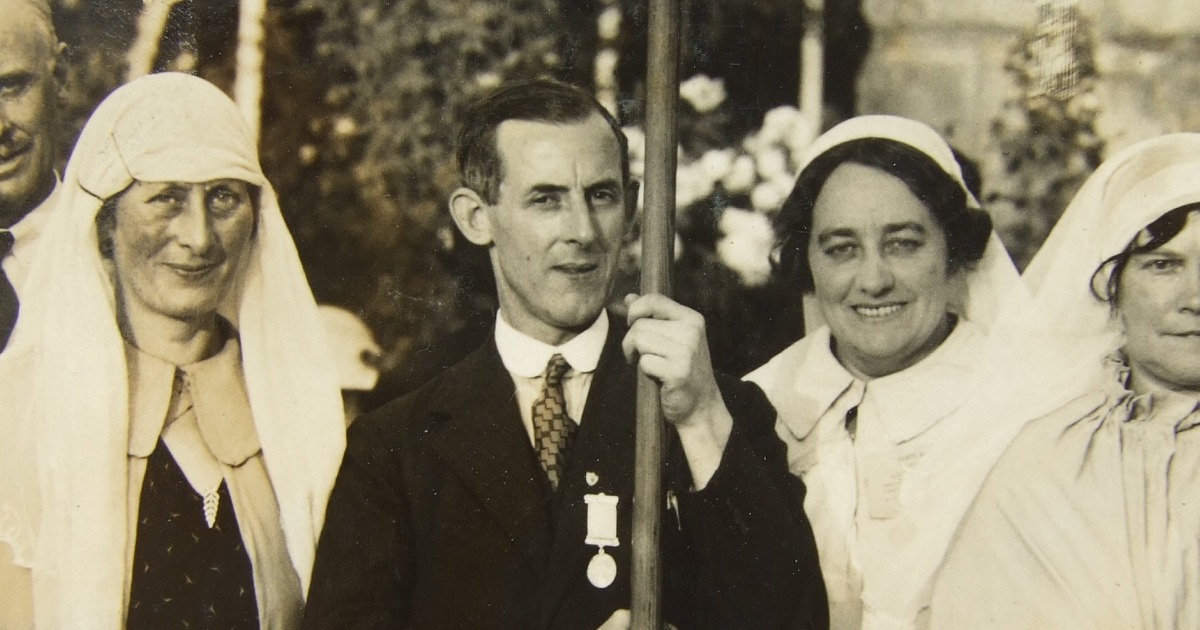


As the Catholic Church in the western world detects signs of a ‘quiet revival’ in religious interest, the question arises of how we harness this potential to win souls for Christ. If we want to find some answers, we should look to the life of Ireland’s great evangeliser – and I don’t mean St Patrick. I refer to one of the Church’s most prolific evangelisers of the 20th century, Servant of God Frank Duff (1889-1980). At a time when the Church was evangelically inert and the world in revolt against it, Duff recognised the urgency of the apostolic life, carried out in the spirit of Mary, both to renew the faith of the Church and to fulfil Christ’s final instruction – to go and preach the good news to the world.
When he died, Duff was hailed as ‘the Irishman of the century’, and his funeral was attended by national and international dignitaries, as well as thousands of ordinary men and women. Through his brief career as a civil servant – he retired at 45 and became the longest state pensioner in Irish history – Duff came to mix with some of the key men of the foundation of the Irish state, including Michael Collins and Éamon de Valera. His impact on Irish life was massive, but is now largely unacknowledged. One small example: why is Dublin the only European capital without a red-light district? Because Duff and the members of his lay apostolate, the Legion of Mary, worked tirelessly to save women trapped in sex slavery. But the mark Duff left on Irish life is nothing compared to the influence he was to have on tens of millions of souls, through his personal outreach and through the Legion.
Sanctity was always high on Duff’s mind. His first published words in 1916, when he was just 27 years old, were akin to a mission statement. ‘In the heart of every right-thinking Catholic, God has implanted the desire to become a saint,’ he wrote in the pamphlet Can We Be Saints? ‘Yet few make a serious attempt to realise the ambition.’ Duff made it his life’s goal not only to be a saint himself, but to activate in others, particularly the laity, the earnest desire for sanctity.
The Legion of Mary came about almost accidentally, the fruit of Duff’s love for St Louis-Marie de Montfort’s True Devotion to Mary. Although he was sceptical of de Montfort at first, he quickly recognised the clarity of the great saint’s thought on the centrality of Mary. From then on, Duff was to be Mary’s most devoted and caring son, seeking to extend her maternal reach to the whole world. De Montfort predicted a Marian army, and when Duff and a few others met to discuss True Devotion to Mary, they did not realise that they were being marshalled. From that small gathering on September 7, 1921, the Legion spread rapidly, first around Ireland, before going international less than a decade later; today it has more than four million active members worldwide. With its dual focus on sanctifying its members and reaching every soul for Christ with Mary, it has been an engine of conversion for more than 100 years.
But why was Duff so effective? The answer is rather old-fashioned: because he did his duty as a loving son to the fullest extent, following Mary’s guidance with perfect obedience. This is not the answer that we are likely to be seeking – I can’t imagine bishops’ conferences announcing as their master plan that every Catholic should ‘do their duty’ as sons of Mary. But for Duff the key to sanctity was having the mind of Mary. He wrote that ‘we must so unite ourselves to her that we enter into every aspect of her life’, most especially her motherhood of souls.
How to respond to the ‘quiet revival’, then, is no mystery; it requires no new ways or radical messaging. The key is to ‘seek out and talk to every soul’ in the spirit of Mary and love of Our Lord, with the aim of presenting the Faith to the whole world. The Church has spent at least the past 60 years being distracted by the temptation to amend its message to fit the modern age, substituting a policy of ‘out-Marxing Marx’ for a religious approach, as Duff wrote in 1973. ‘The childishness of this should be evident. To hope to convert by keeping religion in the background and talking social science and radicalism is just senseless.’
For Duff, the Second Vatican Council was an important moment for the Church, not because it was radical, but because it got back to basics, insisting on the urgency of apostleship and emphasising that all apostleship is an extension of Mary’s motherhood of the Mystical Body. We must recover this true spirit of Vatican II to incarnate Mary’s maternal care by venturing out and putting our best foot forward – by which Duff means Mary and her beloved son Jesus, the essential truths of the Faith. We must go to meet the people hungering for Christ with humility, charity and a dose of humour. If we ever doubt the urgency of our mission, call to mind Duff’s words, delivered in the 1950s: ‘Today every heart is a seething pot; every man is a problem which if left to himself will fester and corrupt others.’
Just as a corrupt heart spreads corruption, so too a heart full of love can overflow into the lives of others if we only give it a chance. ‘Everyone must pour himself into another soul’ – though old-fashioned, time-consuming and potentially dangerous, this is the only way, and Frank Duff’s life and works are evidence of its efficacy. We must place ourselves in Mary’s hands as instruments and, so long as she finds a capacity to receive, ‘then she is able to give’, wrote Duff. ‘And of course her giving increases our capacity, so that there is progressive growth. If we go on to the point of offering her a sacrificial co-operation she will be enabled to respond according to her own measure. She will take hold of our gift and swell it out to the dimension of her motherhood.’