We in the Ordinariate have been celebrating. Fifteen years ago, on January 15, 2011, the Ordinariate of Our Lady of Walsingham was erected. The announcement was made at the end of the Mass in which, in a packed Westminster Cathedral, Keith Newton, Andrew Burnham and John Broadhurst were ordained to the sacred priesthood. All three had been serving bishops in the Church of England: two as Provincial Episcopal Visitors serving Richborough and Ebbsfleet respectively, and Broadhurst as Bishop of Fulham in the Diocese of London. Now they were the first priests of the Ordinariate, and Fr (later Mgr) Keith Newton had been named as the first Ordinary.
Heady days. Those of us who formed the first wave of clergy offering ourselves for service in this new structure did so with excitement and just a little fear: some described it as like jumping off a diving board into an empty swimming pool, hoping that it would be filled before hitting the concrete.
Fifteen years on, and after a cordial meeting of the three Ordinaries in Rome – the high point of which was an audience with the Holy Father – a document was released, the fruit of their reflections on the lived experience of the Ordinariates, identifying common elements of their shared heritage and ecclesial ethos. Important elements included service to the poor (a particular pastoral emphasis of historic Anglo-Catholicism), evangelisation through beauty, and preaching rooted in Scripture and Tradition. These are just some of the treasures that the Ordinariates seek to share with the rest of the universal Church.
It is a great joy to know that the mission and work of the Ordinariates are valued and supported so wholeheartedly by Rome, and that what we have to offer is regarded as of enduring value to the mission of the universal Church.
Sadly, however, an unseemly row has erupted. Rumours have been circulating in the blogosphere that the bishops, having met with Cardinal Roche, the Prefect of the Dicastery for Divine Worship (they had not), had instructed their clergy that priests were not to act liturgically as deacons or subdeacons, but rather to concelebrate at all Masses. In turn, some have responded by saying that concelebration is not part of the patrimony of the Ordinariates.
What is true is that the bishops have sought to clarify that Divine Worship: The Missal is governed by the norms of the General Instruction of the Roman Missal. While it may incorporate elements previously associated with the Extraordinary Form of the Roman Rite, including the Prayers at the Foot of the Altar, the older form of the offertory rite and the Last Gospel, this does not mean that the missal is the old rite in English. It is an iteration of the Novus Ordo Missae, and yet arguably embodies precisely that mutual enrichment between the two forms of the Roman Rite for which Pope Emeritus Benedict XVI hoped when he promulgated Summorum Pontificum.
Suddenly the debate is focusing not on what Anglican patrimony is, but rather what it is not.
So, to concelebrate or not to concelebrate? Let us step back for a moment.
One of the features of Anglo-Catholicism in the UK over recent decades was that many, if not most, of its clergy embraced the liturgical reforms of the Second Vatican Council. This stemmed not from a desire to ‘ape Rome’, as it was often said, but from a hope – which reached its high point with the visit of Pope St John Paul II to the UK in 1982 – that unity, real, visible, sacramental unity, was finally within reach. Many Catholic-minded clergy therefore took to the Roman Missal, or a form of liturgy very close to it. This embrace was a gentle one: the buildings did not ring to the merry sound of sledgehammers and masonry saws as sanctuaries were remodelled, altars brought forward and fixtures and fittings, paid for by the sacrificial giving of parishioners past, broken up and discarded. Reorderings were minimal, often involving a movable altar, and left everything else, including high altars, in place. It was minimally invasive surgery. Additionally, many clergy, liturgically minded souls that they were, studied the provisions of the General Instruction of the Roman Missal closely, resulting in liturgy that was both dignified and well ordered.
As to concelebration, that too began making its appearance, most notably at the Anglican shrine of Walsingham in the late 1970s and 80s, and especially at the National Pilgrimage which takes place in May each year. To Anglo-Catholic clergy in the UK, such occasions were expressions of priestly fraternity and collegiality.
Then, however, events overtook the Church of England. When the General Synod voted to enable the ordination of women to the priesthood in November 1992, it marked a moment when the Catholic wing of the Church of England began to refashion itself. It had to. With the establishment of the Provincial Episcopal Visitors – those ‘flying bishops’ – and the see of Fulham in the Diocese of London, groups of clergy associated with those bishops would meet together, pray together and, above all, gather at Chrism Masses to renew their priestly promises.
In other words, these gatherings were no longer merely fraternal or collegial. They were ecclesial. This was the means by which a sufficient number of clergy were so formed by their desire and longing for Catholic unity that, when Pope Emeritus Benedict XVI’s invitation came, they responded so wholeheartedly and immediately.
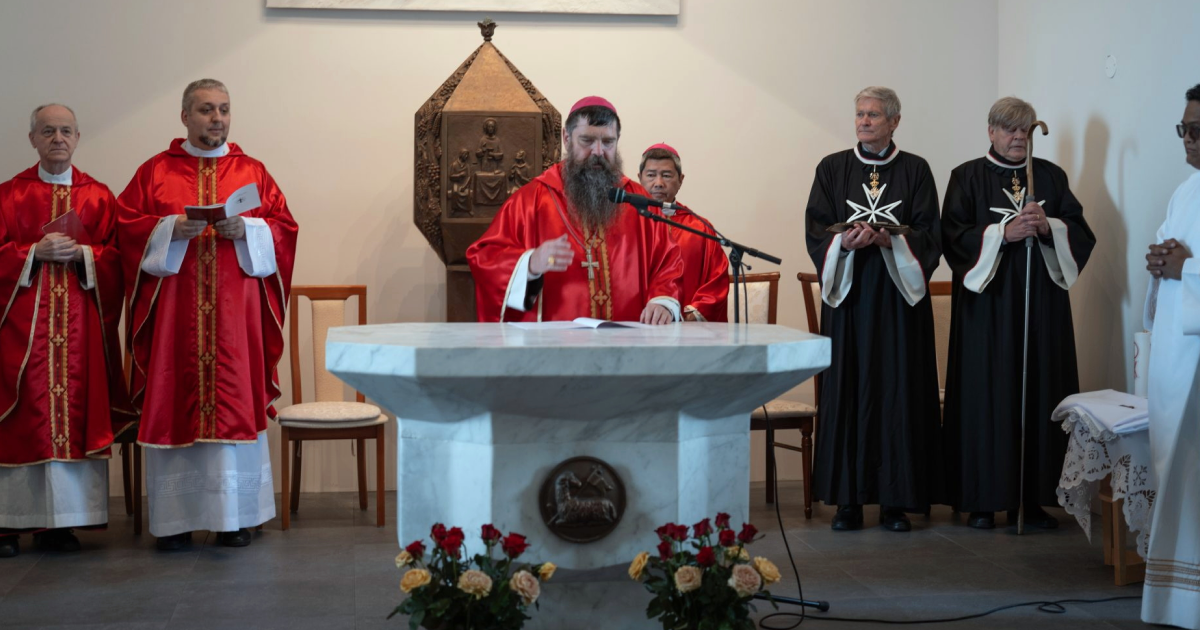
Concelebration part of the patrimony? Yes, but not compulsory, and the priest retains the right to celebrate Mass individually.
As far as the issue of priests acting as deacons or subdeacons is concerned, I have a great deal of sympathy for the argument that, once a deacon, always a deacon. I see no harm in the idea that priests remind themselves that they are servants; that, lurking under the years of celebrating Mass, there was once a man in a dalmatic whose purpose was to assist, to proclaim the Gospel and to be second fiddle. Egos need to be kept in check, and acting down is as good a way as any to do this.
That said, the bishops are encouraging us to continue to celebrate the Ordinariate Use in obedience to the rubrics of the missal. Part of the charism of the Ordinariate is evangelisation through beauty. Thankfully, the liturgy of Divine Worship: The Missal gives us the means to do this, and when celebrated faithfully and nobly, it makes Christ known and draws people to him.
And that is what we are here to do.