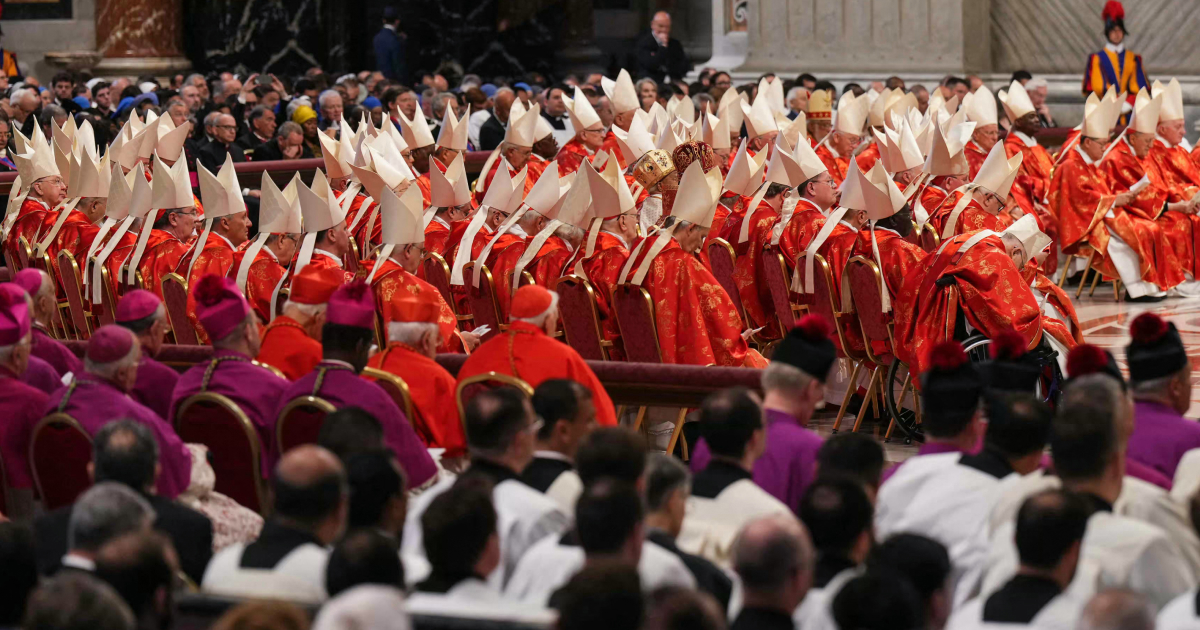


The human structure of the Catholic Church has historically assumed the image of whatever empire it finds itself in. Under Rome, it adopted the structures of the Roman Empire. Cardinals, dioceses, provinces, holdovers from imperial governance. Under feudalism, bishops became like feudal lords.
Today’s empire is the bureaucratic nation-state, and the Church, ever adaptive, has taken on its trappings with remarkable enthusiasm. We have diocesan offices that rival mid-sized government agencies. We have policies, procedures, compliance protocols and approval processes for virtually everything. We have, God help us, endless committees. The question is whether this has made us better at our actual job.
I was a high school youth minister for four years. When I was asked to run Confirmation for the first time, I experienced the full weight of the Church’s bureaucratic apparatus.
Up to that point, my ministry was relational. High school youth ministry is mostly voluntary, so most of the young people are there because they want to be, and they are personally seeking. Then I was asked to take over Confirmation preparation and had to deal with that dreadful word, ‘requirements’.
In an effort to force young people to remain Catholic, parishes often saddle their confirmandi with a list of requirements to complete before they receive the sacrament. The stated purpose is ‘formation’, but the result is usually reinforcement of the belief that Confirmation is ‘graduating from Church’.
The process of filling out checklists and service hour forms to convince the Church to do one of the seven things it was instituted to do would have struck the Apostles as absurd, but it is the form of our empire. We fill out forms to be reviewed and rubber-stamped by bureaucrats. That is what our Church has become.
It begins from a good place. The Church needs some kind of structure to keep track of people, so it creates a process. Evangelisation becomes bureaucratic when the Church puts the process over her people. A baptised teen in a state of grace who prays daily does not need 20 service hours to earn Confirmation. He is owed the sacrament by virtue of his Baptism. Delaying the sacrament only delays the grace he needs to live the Christian life well.
A pastor or catechist who knows the people best ought to be the one making the decision. Unfortunately, the policies and procedures are typically set by diocesan offices or former Church staff who are too far removed from the person to apply the policies properly.
The result is a system that empowers bureaucrats to enforce rules but disempowers pastors from making prudential decisions. A youth minister develops an unconventional formation strategy that fits his specific community – but it is not an approved programme, so it gets squashed from above. It may have been effective, but it was not in line with policy.
This is the essential error of bureaucracy: it replaces laws, which reflect the natural order and aim at justice, with policies, which reflect institutional self-preservation and aim at compliance. The bureaucrat asks, ‘Is this in accordance with procedure?’ The pastor asks, ‘Is this good for the soul in front of me?’ These are not the same question.
Ironically, the Church’s own social doctrine condemns this approach. Pius XI, in Quadragesimo Anno, articulated the principle of subsidiarity: ‘It is an injustice and at the same time a grave evil and disturbance of right order to assign to a greater and higher association what lesser and subordinate organisations can do.’ The supreme authority, he argued, ought to let subordinate groups handle matters of lesser importance so it can focus on what only it can do.
He was referring to the state, but the principle applies with equal force to the Church itself. The goods of the Church are best applied at the lowest level possible: the family first, then the parish second. The diocese exists to support parishes and families, not to dictate to them. A parent or a pastor who knows the children can make better decisions about their formation than a diocesan employee who has never met them.
Subsidiarity is not libertarianism. The diocese has a legitimate role – coordination, doctrinal oversight, support – but ‘support’ is the operative word. The bishop’s job is to ensure his pastors have what they need to teach, sanctify and govern their parishes. It is not to create an approval process for grace.
The best Confirmation formation I ever witnessed happened when the priest simply knew the young people. He watched them grow up. He talked to their parents. When it came time for Confirmation, he did not need a checklist to tell him whether they were ready. He knew.
That is not scalable, the bureaucrats will say. And they are right, it is not. But the Church does not scale like a franchise. It spreads like fire, person to person, relationship to relationship.
The higher orders of the Church must evaluate their processes and policies and ask if they serve the lower. Are families and pastors empowered to make decisions when it comes to evangelising and dispensing grace?
It would be a shame if at the Second Coming, we had to explain to the Lord that our love for policy prevented our duty to His Great Commission.