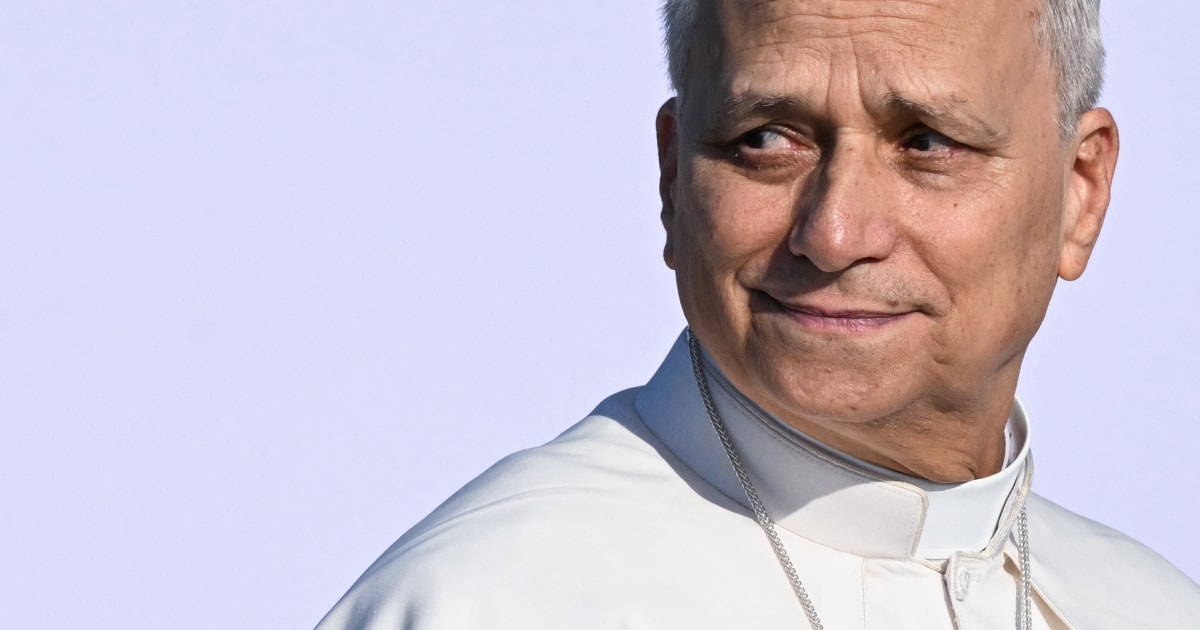



This week Pope Leo, on a flight back from Equatorial Guinea, told reporters that “we tend to think that when the Church is talking about morality, that the only issue of morality is sexual. And in reality, I believe there are much greater, more important issues, such as justice, equality, freedom of men and women, freedom of religion, that would all take priority before that particular issue”.
These remarks were made in the context of rejecting the idea that homosexual couples should receive formalised blessings from the Church. The Pope pointed out, perhaps significantly, that general blessings at the end of Mass are intended for everyone.

It is a peculiar feature of our culture that those outside the Catholic Church often appear acutely aware of the Church’s negative prescriptions on sexuality, if not the positive message they serve. Yet such matters are rarely mentioned at Mass, to which the Church hopes eventually to welcome those currently outside it.
There are many ways of getting it wrong when it comes to sexual ethics. An over-emphasis on this area can certainly express a crabbed view of morality which neglects wider and more complex issues in the name of a simpler set of prohibitions. Doubtless the Catholic commentator who last week condemned on radio Pope Leo’s bold reiteration and application of Church teaching on war, suggesting instead that Donald Trump’s moral anarchy made him worthy of a peace prize, is perfectly sound on sexual ethics.
Yet over-emphasis on sexual ethics is scarcely the major problem of our current time. For it is precisely the removal of sex from its proper context, and the treatment of sexual pleasure as an unalloyed good to which we have a “right”, which is distorting morality and therefore ourselves in fundamental ways. To separate sex from marital and family community and to treat it as though it could be an end in itself is to deny sexual acts their moral weight, implied precisely by their connection with those fundamental goods. If we act in this way we are engaged in extreme denials of community, and most especially the family, without which we cannot truly appreciate what the common good might be.
One advantage of taking the family structure seriously is that, as a model for society, it protects against the extremes of individualism and collectivism through its attention to the person. And it is a particularly powerful model, because the experience of the child is naturally and appropriately rooted in the love of parents.
As the Church herself puts it in the Compendium to the Catechism, “love declares to the child that even before his existence, as a subject of love in his own right, his presence was implied and somehow at least tacitly acknowledged in the hope and mystery of the parents’ own love”.
The family is a form of friendship and as such is a part – in fact, an absolutely crucial constituent – of society. The family is a natural or fundamental “group unit”: the very first human society and the foundation for society. It is in this sense “pre-political” and is grounded in basic human needs. It is through being a child in a family that we come to understand what justice is and what it requires, for the family protects against deracinated conceptions of justice which threaten the common good.
St Augustine wisely pronounced, in regard to liberty, that a man has as many masters as he has vices. In other words, self-control – and for him, God’s grace – are needed so that we may be freed from the vice-like grip of vices, including sexual vices. The new dispensation turned such a thought on its head by condemning emotions such as shame or guilt in the sexual realm as themselves enemies of sexual self-realisation and “freedom”.
Max Scheler, who struggled with chastity, was right to suggest that resentment arises in opposition to this particular virtue and can result in the entrenching of a series of anti-values opposed to it. These “anti-values” then begin to motivate actions – in this case the assertion of “sexual freedom” which ignores what erotic love truly demands of us.
Given the profound importance of sexual acts, we should neither minimise sexual sin nor deny its uniqueness. Sexual sin often involves taking pleasure in sinful activity where the pleasure is deeply woven into the sinful experience itself. In this it is unlike, say, other injustices where the pleasure of the sin is not usually to the fore except in the most depraved. This can result in a special kind of moral poisoning which can permeate our inner life and threaten the stability of the family and therefore the entire community. A society which has lost sight of the telos of sex and erotic love is one that is undermining its very roots.
In light of the horrors of our current world and the politics that go with it, it is not surprising that emphasis is given to other areas of morality which are threatened at this time. But these wars and injustices which surround us are ultimately the result of disordered lives. Lives can be disordered in various ways – but the disorder of lives that fail to honour the virtue of chastity will result, and has resulted, in the disfigurement of the social order which, if not addressed, will result in more injustice.
When Our Lady of Fatima warned of the horrors of an upcoming 20th-century war, she also told the seer Jacinta that “More souls go to Hell because of sins of the flesh than for any other reason.” A society which relegates the sexual to a lower tier, minimising the moral weight of sexual sin and the distinctive sense of moral pollution it brings, is one that will never be able to resist the many other temptations to other unjust – or simply self-destructive – human actions.
Dr Anthony McCarthy is the author of Ethical Sex and director of the Bios Centre. He is writing in a personal capacity.