


The ongoing discourse around the Iran war has led to a striking turn of events in which conservatives are demanding total separation of church and state, and liberals are professing with Boniface VIII that all creatures must be subject to the Roman Pontiff. The poor integralists probably feel more politically homeless than ever.
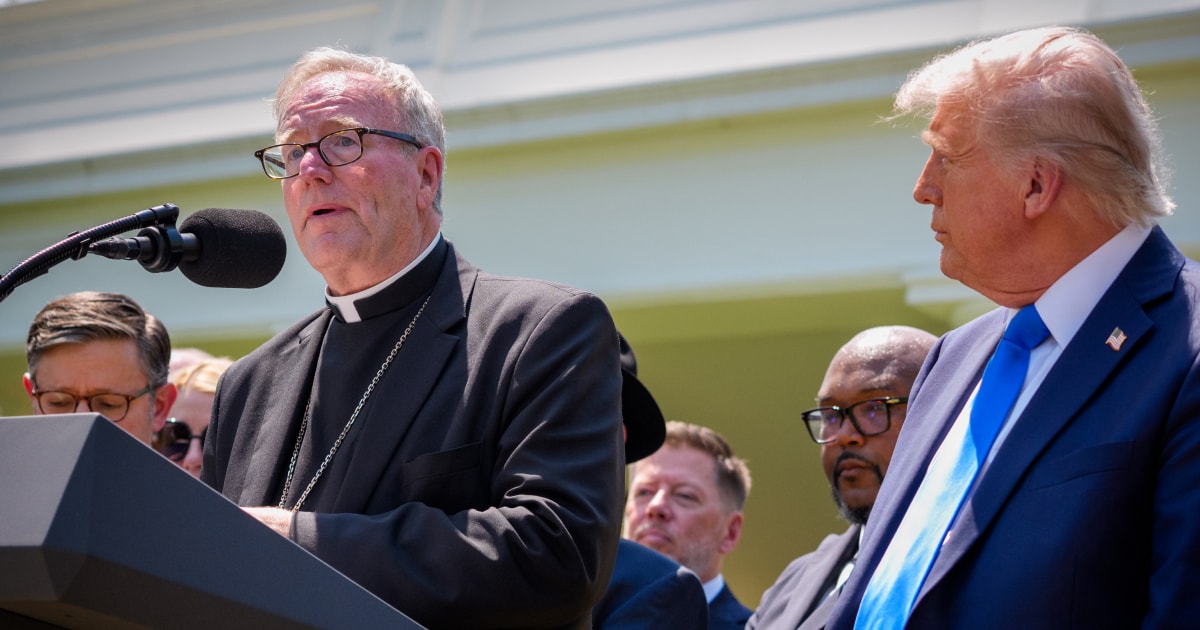
Recently, Bishop Robert Barron released a statement that attempted to reconcile these two sides, to defend both the Pope’s statements and the president’s foreign policy. This kind of reconciliation is, of course, not allowed in our national conversation and was met with derision. He is being called by some a traitor and by others a toadie. To be both simultaneously is a difficult feat to pull off. I am impressed!
His statement does fail in one respect, though, and it has nothing to do with loyalty to Leo or Trump. Barron formulates Church–state relations in a way that bolsters the liberal understanding of separation of church and state.
Barron’s key insight is into how the Church articulates its just war doctrine. He describes it as a series of questions and answers in which the Church asks, for example, ‘Is this war the last resort?’ and the state provides an answer to that question in practical policy. One would think this was ripped directly from Thomas Jefferson’s Letter to the Danbury Baptists. Barron’s formulation is similar to those who claim the state has no competency in matters of religion and the Church no competency in matters of the state.
Perhaps I am misunderstanding Barron. He likely knows this. The idea that there are two ‘spheres’ or ‘lanes’, one in which the Church operates and one in which the state operates, is more proper to classical liberalism than Catholic thought. There are two swords, but they are united like the body and soul, not a dualist ‘ghost in the machine’.
The Church is at the same time temporal and spiritual. All her members, Pope and president alike, are competent to discern truth, whether that truth is about temporal or eternal things. The real division is not Church and state, but the City of Man and the City of God. Insofar as leaders act virtuously, they are in the City of God. In their vice, they belong to the City of Man.
Barron’s formula seems to render the Church incapable of judging acts as good or evil. The Church is responsible for forming consciences, including those of our political leaders, but if she asks only questions and gives no positive instruction, she cannot adequately do so. Barron said Leo’s job is to call for peace, and I agree. But the Church cannot, in practice, only preach peace as a matter of policy. In principle, she preaches peace, but in practice there is ‘a time for war’, peace being the end goal of a just war.
Many are taking Leo’s calls for peace as foreign policy advice – end the war now – rather than the articulation of a general principle. It seems those people want the Pope to have the power to demand that we lay down our arms. But the power to lay down arms comes with the power to call for them to be taken up. The two swords cut both ways. It is hard to imagine a liberal being content with the Pope having the power to call to arms.
Contrary to what Barron said, the Church does have a role in specifically correcting the actions of world leaders, not merely asking questions and proposing principles. Contrary to what is said by opponents of the Iran war, the Pope is not tasked with personally making those corrections.
It is American hubris that insists our top guy is in contact with the Church’s top guy. However, it was Ambrose, with Pope Siricius, who had Emperor Theodosius do penance for the massacre at Thessalonica in AD 390. The local ordinary should make the correction, since he likely has more information and better access to the nation’s leaders than the Pope himself.
Barron is right in saying it is not Pope Leo’s job. It would take a superhuman intellect to understand every kerfuffle in the world and apply Catholic principles to each. That task instead falls at the feet of a bishop. I say ‘a bishop’ because I grow tired of these joint statements from bishops’ conferences. Acts of correction by committee do little except provide cannon fodder for the media. In the same vein, television interviews are equally unhelpful. What is needed, if just war is violated, is personal correction – as a father corrects his son.
For correction to be effective, it has to be a real conversation, not a one-time question and answer. The bishop says, ‘This is unjust.’ The leader responds. If the leader says, ‘No, you are missing classified intelligence that changes the calculation,’ then fine. That is an honest exchange. But that is not what has been happening. The response from the administration has been: ‘Stay in your lane. Remain in the spiritual sphere.’ That response is only possible within Barron’s framework. If the Church only asks questions and the state only answers them, then ‘mind your business’ is a perfectly valid reply.
If the war is unjust, someone should go to the administration and speak to whoever will listen. I do not know which bishop should do that. Perhaps the Archbishop of Washington, or the Archbishop for the Military Services, or, given his position on the Commission for Religious Liberty, perhaps Barron himself.
The fact remains that our leaders are receiving advice from someone on the justice of the war. If the war is unjust, the Catholic Church alone has the right and responsibility to act and to correct. We cannot merely ask questions.


.jpg)