

It has become almost a reflex in public discourse to claim that the Catholic position on immigration is simple: ‘welcome the stranger’, and do so generously.
This is not the Church’s teaching. It is a partial reading of it, frankly a soppy one. The Catholic tradition does indeed command generosity towards the stranger. But it also affirms something just as real, and now widely ignored: the right – and duty – of nations to preserve themselves, and of governments to act first for the good of their own people. When these principles are applied to present circumstances, the conclusion is difficult to avoid: current patterns of immigration in much of the West are not serving the common good and ought to be curtailed.
In arguments on immigration, people often cite Leviticus 19:34 – ‘Love them as yourself, for you were foreigners in Egypt’ – as well as the Catechism: ‘The more prosperous nations are obliged, to the extent they are able, to welcome the foreigner…’ (CCC 2241)
These lines are frequently quoted. What is less often quoted is what follows: ‘Political authorities, for the sake of the common good… may make the exercise of the right to immigrate subject to various juridical conditions.’ (CCC 2241) Thus, the right to immigrate is not absolute. It exists only within the limits imposed by the common good of the receiving society. The Church does not teach indiscriminate openness. It teaches ordered, limited and prudent immigration.
To understand why this matters, one must be clear about what a nation is. Modern political language often treats nations as little more than administrative zones or economic systems. But the Catholic tradition sees them as something far more substantial: a ‘nation’, from the Latin word natio, meaning ‘a people’, is precisely that, a people: a shared inheritance of language, culture, memory and ways of life. It is something that develops organically over time and cannot be replaced or reconstructed at will.
Pope St John Paul II reaffirmed this understanding of a nation in his encyclical Centesimus Annus. From this follows a principle that should be obvious, but is now often treated as controversial: governments exist to serve their own people first.
This is not a denial of universal charity. It is a recognition of political reality. Authority is exercised over a particular people, and it carries with it a particular responsibility. A government that fails to secure the conditions necessary for the flourishing of its own citizens – social cohesion, cultural stability, public order – has failed in its primary duty.
The Catechism does not instruct states to maximise migration. It instructs them to regulate it, precisely ‘for the sake of the common good’. The implication is straightforward: if immigration harms the common good, it must be limited. Even recent remarks by Pope Leo XIV, prior to his election, reflect a more sober tone than is often assumed. Speaking of migration in the context of Lampedusa, he described it plainly as ‘a huge problem… a problem worldwide’, while insisting that any response must still treat migrants with respect.
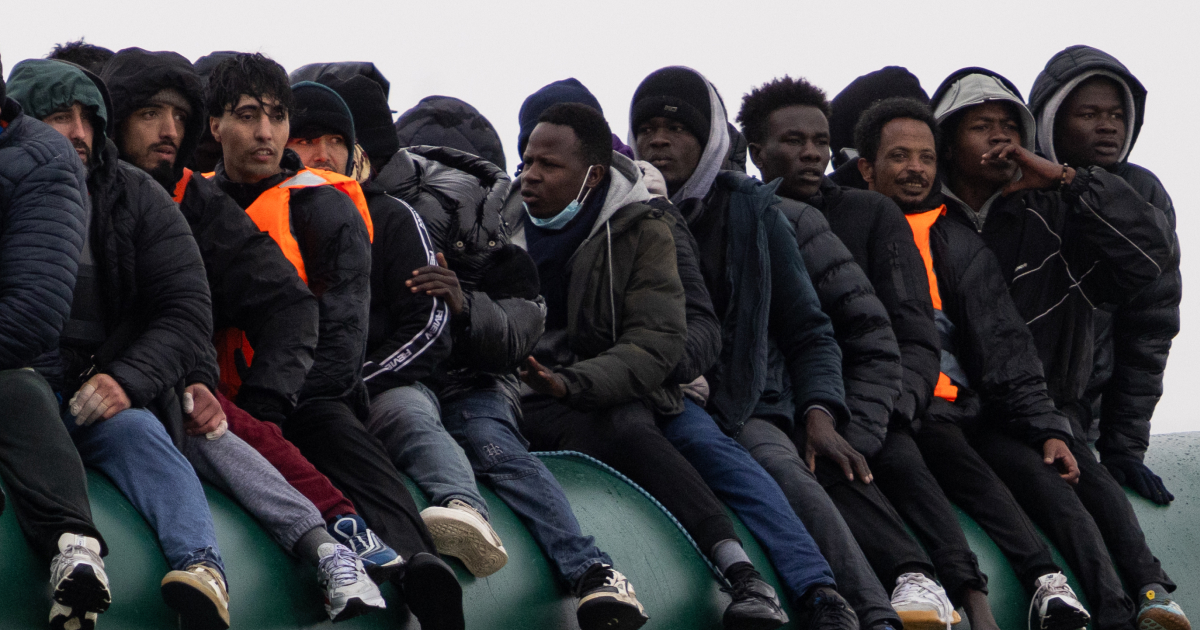
At this point, one must speak plainly: what is occurring in many Western countries today is not gradual, manageable migration. It is large-scale, rapid and culturally discontinuous. Cities change within decades, shared norms weaken. Public life becomes more fragmented. In some cases, parallel communities emerge with limited connection to the historical culture of the nation. These are not theoretical concerns. They are observable realities.
Yet there is a marked reluctance to discuss them honestly. Cultural reflections on the consequences of mass migration – such as Jean Raspail’s The Camp of the Saints, which has recently been banned from Amazon in the United States – are often dismissed rather than engaged with.
There is, then, a balance to be struck. On the one hand, wealthy nations cannot ignore genuine human suffering or close themselves off entirely from those in need. On the other hand, they are not morally obliged to dissolve themselves in the process. A political community has duties outward – but also inward, to its own members, especially the most vulnerable. To deny this is not generosity; it is a refusal to take political life seriously.
An honest assessment must acknowledge that large-scale, rapid immigration poses real challenges to social cohesion. Integration is not automatic. It requires time, shared norms and a willingness – on the part of newcomers as well as hosts – to enter into a common life. When migration occurs at a scale that outpaces this process, fragmentation is the predictable result. The Church’s concern for solidarity cannot be reduced to a simple endorsement of policies that risk undermining it.
The deeper issue, perhaps, is the loss of confidence in the idea of the nation itself. If a country is seen merely as an administrative unit or an economic opportunity, then of course borders appear arbitrary. But if it is understood as a living community – formed over generations, sustained by shared habits and beliefs – then its preservation becomes a matter of justice, not preference.
Catholic teaching does not offer a technocratic blueprint for immigration policy. It does, however, provide principles: the dignity of every person, the reality of nations as living communities, and the primacy of the common good. These are not abstract ideals – they are meant to be applied.
Applied to present circumstances, they point in a clear direction. When immigration occurs at a scale that fragments social life, weakens cultural continuity and erodes the conditions necessary for a people to sustain itself, it cannot be justified by appeals to charity alone. Charity does not require a nation to accept policies that undermine its own existence.
A Catholic, taking these principles seriously, may therefore conclude that such policies ought to be opposed. Not out of hostility towards the stranger, but out of a duty towards the people to whom one belongs, and for whose good political authority exists.
To insist on limits, in such circumstances, is not to depart from the Church’s teaching. It is to follow it through to its conclusion.