
I need hardly remind you that Emily Brontë was not a Catholic, nor was she particularly fond of us. We have inherited no writing from her year teaching young ladies in Brussels, but her refusal to return there while her sister Charlotte did suggests she despised the spell. If Emily did not hate the foreignness of what her elder sister termed the “Romish system”, she was far from charmed by it. It’s no surprise then that the sole novel she produced before her death, aged just 30, has become synonymous with the mystical, windswept moors adjacent to the West Yorkshire home she so hated to be away from.
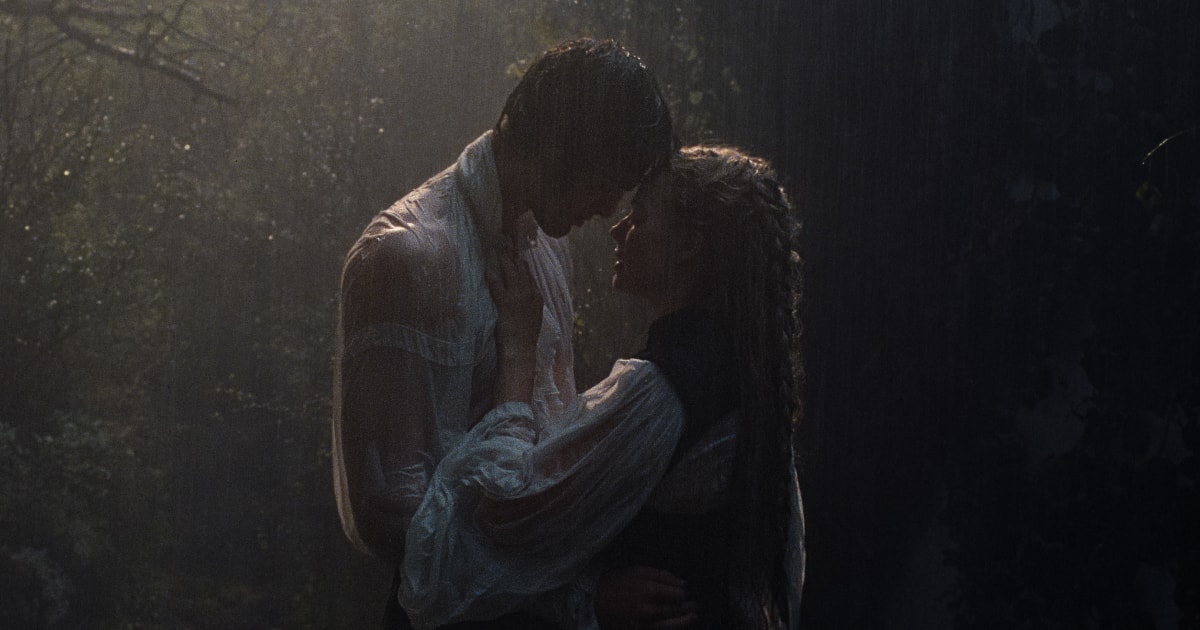
Emerald Fennell’s new film adaptation of this classic – inspired by her half-remembered teenage encounter with it – does not so much take liberties with Brontë’s material as indulge in full-scaled libertinism. Fennell hasn’t just edited Wuthering Heights – she’s murdered it, and like some deranged criminal is now wearing its skin as a mask.
In Fennell’s hands, Cathy and Heathcliff are sexual deviants (despite not sharing so much as a kiss in the novel) we are instructed to empathise with as courageous, if irritating, warriors against the meddling of their puritanical peers. The same Hollywood that revels in pornography, violence and sexual gratuity seeks to rebrand the fictional man Brontë terms “devil” and “tempter” in the name of “romance”. Many a Heights reader has stumbled into this well-decorated trap, wrongly observing it to be a bleak, neo-pagan spiritual desert in which revenge and all its trappings are glorified.
My chosen cinema’s litter-strewn seating and babble of tourist teenagers scrolling Instagram throughout were the perfect warm-up for the on-screen savagery. How could this post-pubescent man and woman care so much about each other if extramarital sex were not assumed as their “reward”? While she is already pregnant with her husband’s child, Margot Robbie’s Cathy, kitted out like a Münchnerin at Oktoberfest, parades across damp heather and crawls into the back seat of her carriage for quick encounters – no thought of eternity ever passing between her ears.
Indeed, the Soviet-style amnesia about any consequences is what makes Fennell’s take beyond redemption: in her Heights, the half-glittering, half-gruesome mortal plane is the only one its characters inhabit. The novel opens with the naive outsider Mr Lockwood moving up from London, encountering an older Heathcliff and eventually gathering exactly what this glum corner of countryside has been subject to, but Fennell’s adaptation is bookended by Cathy’s mortality (give or take a few minutes of grieving from others). She does not allow us to see Heathcliff’s death, his refusal to repent and his depraved desire to reunite with Cathy’s terrified, childish ghost.
The writer depicted Cathy drifting between Good and Evil on her deathbed but Fennell only shows us physical ravings deprived of their context. While their Anglican clergyman father mocked Purgatory as a Papist superstition – it is mentioned more than once in the novel – the Brontë sisters were certainly intimate with the works of Methodist cleric John Wesley. Despite his fierce Protestantism, Wesley admitted that there were “intermediate states” between heaven and hell and it was the “duty” of Christians to pray for those in them. Brontë’s Cathy is clearly lingering in such a spiritual state which Heathcliff has abandoned entirely. So far as Fennell is concerned, Cathy lives, sins and dies, and that’s the end of it.
There’s also something warped about Fennell degrading Isabella Linton from perhaps the bravest and most sympathetic character in the novel to a morally lobotomised oddity delighting in humiliating perversions. After wedding Jacob Elordi’s swaggering Heathcliff, Isabella winks and grins at a visitor who finds her chained to the fireplace, barking like a dog and slurping food from her husband’s palm. Brontë’s Isabella, like all of us, errs. But she quickly regrets her misguided attraction to Heathcliff, describing her flight from “the infernal regions” of his house as akin to “a soul escaped from purgatory”. Edgar Linton is just as disserved: Brontë’s churchgoing “gentle master” who loves his wife and later daughter dearly is transformed here into a witless, gaudy cuckold.
Apart from Cathy’s obsession and Isabella’s sycophancy, Fennell’s Heathcliff is entirely unloved. Brontë’s Heathcliff, by contrast, is adopted by the charitable Mr Earnshaw, only later to be abused and reduced from brother to servant by Cathy’s brother Hindley – a character Fennell omits altogether – whom he in turn entices into addiction and gambling. Where Brontë’s “devilish” Heathcliff rejects the Christian charity once shown to him, and suffers the consequences, Fennell’s protagonist is never offered such charity at all.
Significantly, Fennell’s Cathy leaves no surviving child, whereas Brontë’s Cathy, Heathcliff and Hindley all have offspring. Heathcliff raises his late rival’s son, Hareton, attempting to corrupt him through atheism and ignorance. Yet when we take our leave of their story, Cathy’s daughter is tentatively courting him, a union that stands in deliberate contrast to their parents’ transgressions. Deprived of this glimmer of Christian hope and forgiveness, Fennell’s imitation remains precisely that.
Nor does Fennell put Brontë’s glorious poetry to good use. Indeed, I could count on one hand the number of scenes that precisely quote dialogue from the novel, and fewer still that wield it wisely. Heathcliff declares about Cathy “I cannot live without my soul,” while Cathy complains that if she died and went to heaven it would “not feel like her home” if he were not with her. They have become one another’s idols, and suffer for it, but Fennell’s surrounding jabberings would have us believe their torment is due to unjust forces forbidding their love, not their own decisions.
Brontë’s story is at once more enchanting and more moral. Fennell’s sterile, soapy sexcapade will be quickly forgotten, while Brontë’s genius never will, at least while men roam this Earth. Still, if this lavish charade encourages at least a few viewers to interrogate the original novel and its deep Christian themes, perhaps it has served some upright purpose.