




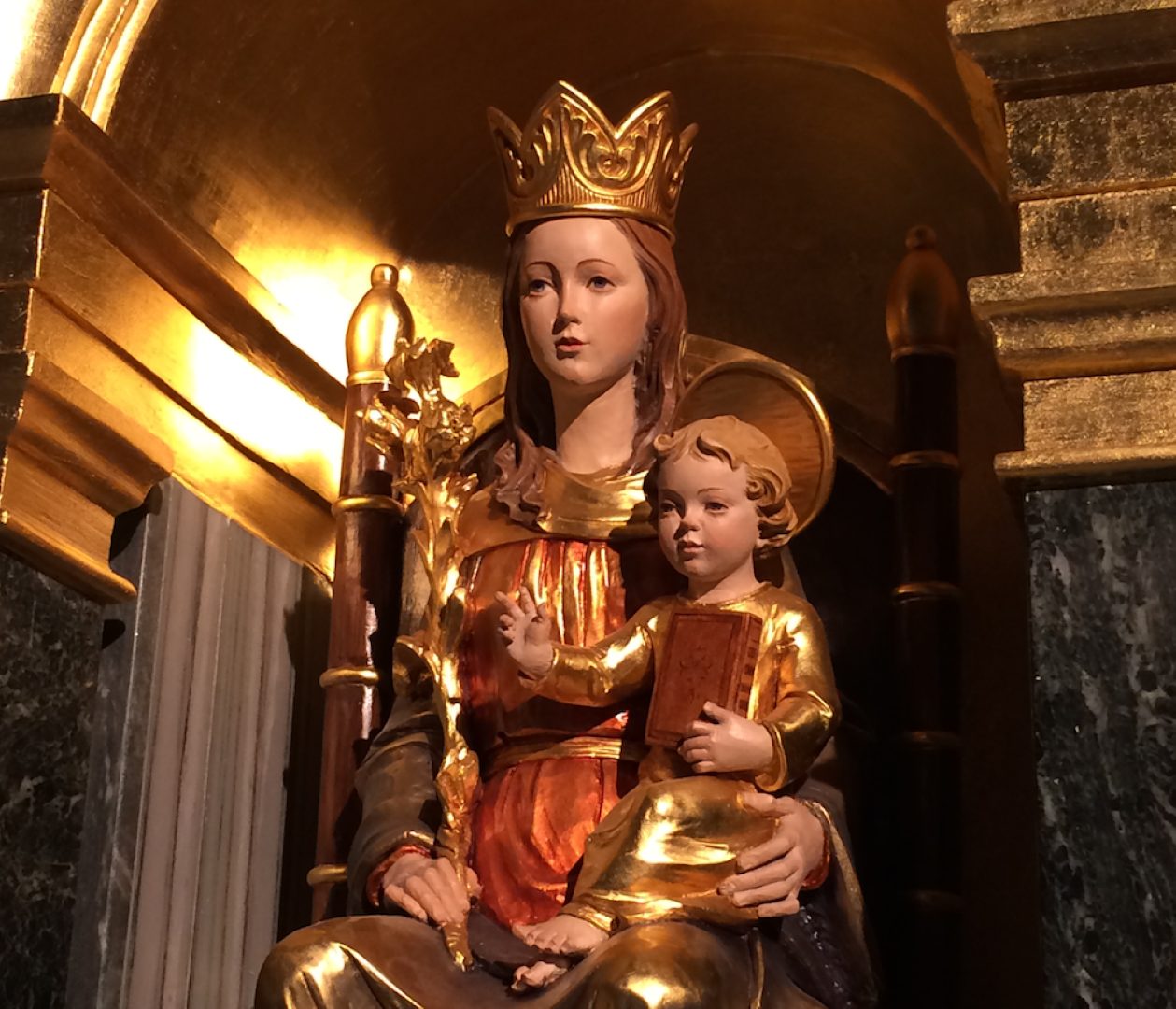
Recently I had the good fortune to visit the church of Corpus Christi in Maiden Lane, in the heart of London. The church is between the Strand and the Covent Garden piazza, and I suppose a lot of people might miss it, which is a pity. Back in the day, not so very long ago, when the Catholic faith was more or less illegal in this country, Mass was only openly said in embassy chapels, and Covent Garden was the site of the Portuguese Chapel, as it was called. Here people could freely go to Mass (the same situation pertains today in Saudi Arabia, where the only Catholic church in the country is situated inside the Italian Embassy.) Indeed, the Portuguese Chapel became quite a fashionable place, and even Protestants went to hear its choir. It was here that “the Portuguese hymn” first became popular, the Christmas carol that we know nowadays as Adeste, Fideles, or Come all ye Faithful. Or so the story goes, for the facts are a little obscure. The parish of Maiden Lane has an excellent website, which makes no mention of this at all, so I may be completely mistaken. The present structure is currently undergoing restoration, which means that layers of paint are being scraped off to reveal the handsome Victorian brickwork below. This is still a work in progress, but the results are already very promising. But what struck me most of all is the recently refurbished and redecorated Lady Chapel, which provides London with a wondrous new space for worship. Enthroned above the altar is Our Lady of Walsingham, the Virgin of these shores, the one to whom England belongs as of right. Above the altar is the inscription: Dos tua Virgo pia haec est, quaere leges O Maria, meaning “This is your dowry, O faithful Virgin, therefore, rule over it, O Mary.” The creation of such a fine chapel, which must have involved considerable effort and resources, reminds us that devotion to the Blessed Virgin is such a central part of Catholicism, and particularly of English Catholicism. And if England is the dowry of Mary, then we ought all to behave as her subjects. What a long way we have to go! The inscription is a reminder of the sentiments contained in the prayer for England used at Benediction, which is attributed to Cardinal Wiseman:
12:20 PM
A wondrous new space for worship in London
The refurbished Lady Chapel at Corpus Christi, near Covent Garden, reminds us that devotion to the Blessed Virgin is a central part of English Catholicism
Fr Alexander Lucie-Smith

3 min read



Already a subscriber? Sign in
5freearticles every month
Continue reading with a free account. No card needed.
- Five free articles every thirty days, on any device you sign in on
- The Catholic Herald newsletter, every morning
- Subscribe whenever you like for everything: every article and the magazine
Related articles
 Newsroom
Church leaders urge Drumcree dialogue: ‘Too much is at stake’
The Catholic and Church of Ireland Archbishops of Armagh have urged a renewed commitment to peace and reconciliation amid the Drumcree stand-off
Corrie Douglas-Young Newsroom
Thousands of Irish children to join global Rosary campaign
Corrie Douglas-Young Newsroom
TikTok priest urges young people to stand with persecuted Christians
Nathalie Raffray Newsroom
Baby born at 25 weeks reunites with neonatologist two years after leaving hospital
The Catholic Herald Newsroom
Joe Biden honoured by Planned Parenthood after defending abortion rights
Christine Rousselle
subscribe to the catholic herald today
Our best content is exclusively available to our subscribers. Subscribe today and gain instant access to expert analysis, in-depth articles, and thought-provoking insights—anytime, anywhere. Don’t miss out on the conversations that matter most.
Subscribe



