



It is not often that an abbot wakes to find a hole smashed through the wall of his abbey. Even rarer, I should think, that the hole is smashed through on the orders of the local mayor. This, however, was the scene that greeted Fr Rudolf Anzelm Fejes, abbot of the Premonstratensian canons in Oradea, this spring, as just the latest dramatic episode in a long-running dispute between one of Romania’s oldest Catholic foundations and the city authorities.
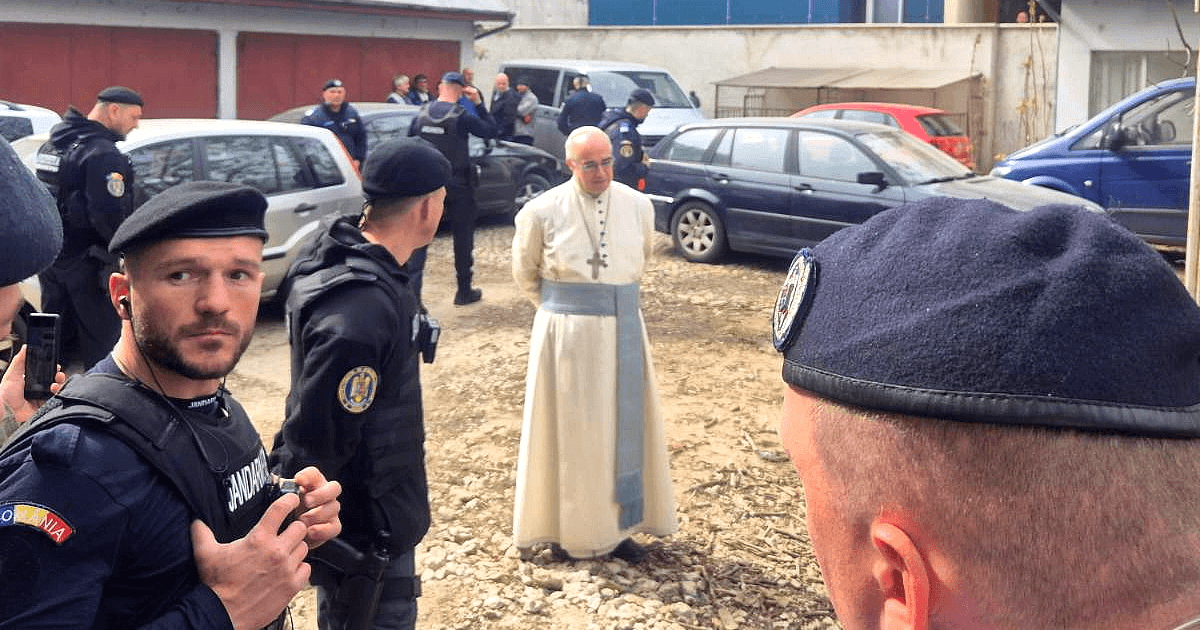
The incident saw municipal workers – accompanied by gendarmes – break through part of the monastery complex which the Premonstratensians insist belongs to the Church and forms part of a religious presence in the city stretching back almost nine centuries.

For Abbot Fejes, however, the dispute is about far more than bricks and mortar. “What is at stake is not a building,” he said in a recent interview with the Hungarian newspaper Magyar Nemzet. “What is at stake is that the organs of a democratic state are reaching back to a set of tools perfected by the party-state: violence hidden behind the appearance of legality.”
The Premonstratensian presence in Oradea (known in Hungarian as Nagyvárad) dates back to around 1130, having only been founded by St Norbert in France a decade earlier. Over the centuries its canons founded schools, exercised civic and judicial functions, cared for souls and helped shape the religious and cultural life of the city – today the ninth most populous in Romania.
That long history lies at the heart of the present controversy. The church and sacristy are part of a larger baroque monastic complex, the majority of which is now given over to a state school that was formerly run by the Norbertines and originally built by the Jesuits.
Oradea lies in Transylvania, a region that was formerly part of Hungary and dominated by ethnic Hungarians but became part of Romania in the aftermath of the First World War. Located just over six miles from the Hungarian border, Oradea’s population is one-fifth Hungarian in ethnic origin, even if less than a tenth of the city is Catholic.
The Holy See and the Kingdom of Romania agreed a concordat in 1927 that guaranteed freedom of religion for Romania’s Catholics, many of whom came from the country’s large ethnic minorities, and secured the Church’s right to existing properties. That concordat was unilaterally abrogated by Romania’s communist government in 1948.
Historic tension between the Romanian majority and Hungarian and German minorities since Transylvania was united to Romania only adds a further layer of complication to the dispute over the ownership of the canons’ property.
The abbot argues that the proceedings nominally directed against him personally are, in reality, aimed at removing the order from its historic seat.
“Formally, the eviction procedure is directed against me,” he said. “But the real goal is to acquire inalienable ecclesiastical property. They are using me as a tool to make what stands behind me accessible.”
He points to what he regards as a contradiction in the authorities’ position. If the Premonstratensians have held no rights over the property for decades, as some now contend, then how, he asks, was he canonically elected superior in 1999 and recognised both by Church authorities and the Romanian state? “The superior of an institution of pontifical right is not a tenant,” he told Magyar Nemzet. “My canonical installation is inseparable from the institution and from its place.”
Current Romanian law, he notes, defines sacred property as inalienable and imprescriptible. He also points to a recent communication from Romania’s Secretariat for Religious Affairs which, he says, reaffirmed that principle during the course of the proceedings.
The dispute reached its most dramatic point on April 14 when officials arrived at the monastery accompanied by armed gendarmes. Recalling the scene, Abbot Fejes said his thoughts turned not to legal arguments but to an English example: St Thomas More. “Standing there at the altar on April 14, facing gendarmes, I thought of the words of St Thomas More: ‘I am the king’s good servant – but God’s first.’”
The abbot insists he is not seeking confrontation. Rather, he sees himself as fulfilling the obligations imposed by his office and his vows. “If the Good Lord has measured out for me that I should be taken away from the altar by armed gendarmes, then I must accept that as well.”
He compares the tactics employed against the community to methods long familiar in Church history, whereby institutions are weakened through legal, administrative and financial pressure rather than direct confiscation.
“If something cannot be taken openly because the law protects it, then power works around it: municipal and state harassment, financial strangulation, isolation, false narratives – until the person grows exhausted and leaves voluntarily.” His response is unequivocal: “But I will not leave.”
During the attempted enforcement action, many of the Catholic faithful remained at the church for hours, praying not only for Abbot Fejes but also for those responsible for ordering it. For the abbot, this act of witness revealed something deeper than a dispute over the possession of property. If the Norbertines are removed, he argues, Oradea would be deprived of a living part of its own identity. “By pushing us out, Oradea loses a presence that has been here since 1130,” he said.
The city’s distinctive character, he argues, rests in part upon the coexistence of churches, monasteries and communities of different traditions whose histories are woven together. “Oradea is special precisely because cathedrals and monastery churches, buildings of different cultures and denominations, stand side by side here,” he said. “Behind them are living communities that made this city what it is. If one of them disappears, the city loses a part of its own past.”
Whether the courts ultimately side with the municipality or the Premonstratensians remains to be seen. For Abbot Fejes, however, the dispute is only the latest chapter in a much longer story.
The order’s history in Oradea stretches back almost nine centuries. It survived the Muslim invasions, Ottoman rule, statist reforms under Joseph II and the many upheavals of the 20th century. More than once, the Premonstratensian presence disappeared entirely. More than once, it returned. Abbot Fejes sees no reason why the present struggle should prove any different.
“We have been pushed out several times before: by the Tatars, by the Turks, by Josephinism. But we always returned.”

.png)