


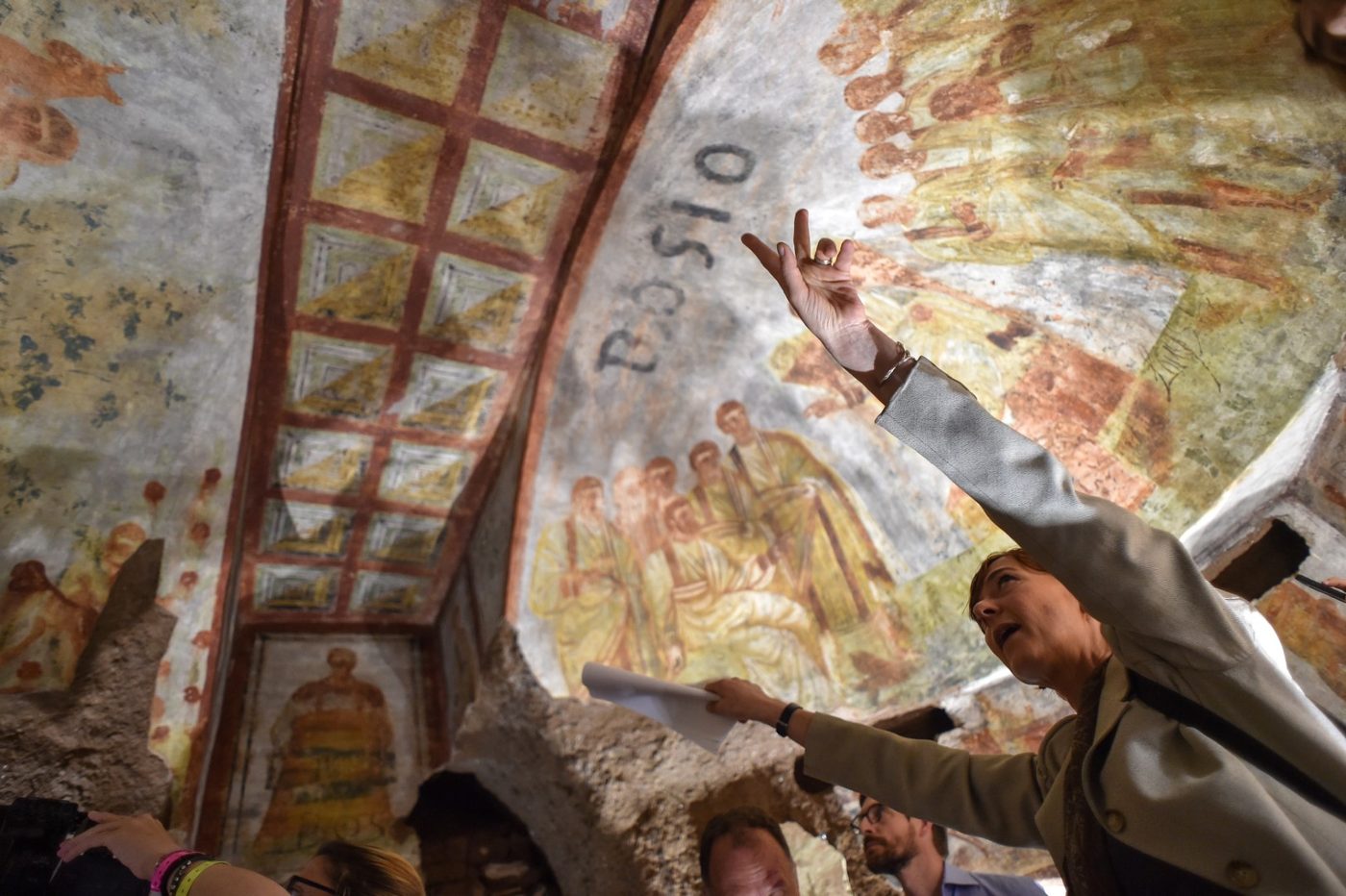
Archaeologists have used lasers to burn away centuries of grime in catacombs underneath Rome to reveal “stunning” frescoes that are 1,600 years old. The Catacombs of St Domitilla, believed to be the world’s oldest existing Christian cemetery, contain a total of 150,000 burial spots. Most are small niches carved into tunnel walls for poor Christians. The niches were sealed with a slab of marble or walled up with brick. The round and sumptuously decorated cubicula (small rooms) were built by wealthier families and trade cooperatives, whose members pooled their money for a more dignified resting place. The newest restoration work was done on the chambers for the city’s bakers. Bernardino Bartocci, president of the modern city’s association of breadmakers, told the Catholic News Service that he attended the unveiling as a sign of how bakers continue to be and “have always been united as a group, like a big family”. Barbara Mazzei, who oversaw the restoration, said that pagan symbolism – such as depictions of the four seasons or a peacock representing the afterlife – was juxtaposed with bibilical scenes without any apparent contradiction. The unifying motif is salvation and the deliverance from death, as is underlined by the depictions of Noah in his ark welcoming back the dove, Abraham’s aborted sacrifice of Isaac, Jonah and the whale, and the multiplication of the fishes and loaves, she said. Restorers used lasers to send pulses of precise frequencies to selectively remove specific substances – soot, algae and calcium carbonate – without damaging the colour pigments and underlying surfaces. Despite the seven years of meticulous work to reveal the frescoes’ original splendour, restorers intentionally left the graffiti and autographs left by visitors from the seventeenth and eighteenth centuries.
1:00 PM
Ancient frescoes revealed underneath Rome
Staff writers

3 min read



Already a subscriber? Sign in
5freearticles every month
Continue reading with a free account. No card needed.
- Five free articles every thirty days, on any device you sign in on
- The Catholic Herald newsletter, every morning
- Subscribe whenever you like for everything: every article and the magazine
Related articles
 Newsroom
Church leaders urge Drumcree dialogue: ‘Too much is at stake’
The Catholic and Church of Ireland Archbishops of Armagh have urged a renewed commitment to peace and reconciliation amid the Drumcree stand-off
Corrie Douglas-Young Newsroom
Thousands of Irish children to join global Rosary campaign
Corrie Douglas-Young Newsroom
TikTok priest urges young people to stand with persecuted Christians
Nathalie Raffray Newsroom
Baby born at 25 weeks reunites with neonatologist two years after leaving hospital
The Catholic Herald Newsroom
Joe Biden honoured by Planned Parenthood after defending abortion rights
Christine Rousselle
subscribe to the catholic herald today
Our best content is exclusively available to our subscribers. Subscribe today and gain instant access to expert analysis, in-depth articles, and thought-provoking insights—anytime, anywhere. Don’t miss out on the conversations that matter most.
Subscribe



