


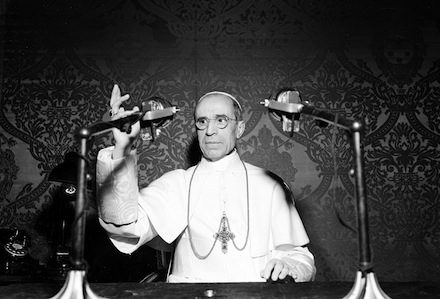
I am writing this having just spotted a piece I missed when it first appeared on Sandro Magister’s website two weeks ago. The piece was headlined “The Thousands of Jews Saved in Churches and Convents”, and drew attention to an article by the Jewish historian Anna Foa which had been picked up by L'Osservatore Romano, and also to the fact that Pope Francis will as soon as possible make available the complete documentation of the pontificate of Pius XII, from 1939 to 1958, a documentation that runs to 16 million pages, more than 15,000 folders, and 2,500 files. The work of organising this vast mound of papers has been going on for six years, in order to make it practically accessible to scholars. The prefect of the Vatican secret archive, Bishop Sergio Pagano, has told Corriere della Sera that “it will take another year, year and a half”. The point that emerges from Anna Foa’s researches, however, is that the question of access to this huge archive has dominated the whole controversy of what the pope did or didn’t do for the Jews quite wrongly for many years, with frequent insinuations of its inaccessibility being motivated by attempts to keep quiet about the shameful secrets it supposedly contains. Now, Anna Foa suggests that this was quite unnecessary, since there was always plenty of evidence of what was happening during the German occupation, outside the archives, in the witness of those Jews directly involved. This is now being properly researched by historians like Dr Foa, who insists that, as a result, we can be sure that the "more recent image of the aid given to Jews by the Church arises not from pro-Catholic ideological positions, but above all from thorough research into the lives of Jews during the occupation, from the reconstruction of the stories of families or individuals. From field work, in short.” The research in this regard, notes Sandro Magister, is highly advanced. And from this it is becoming ever more clear that the saving of many Jews was not only permitted but also coordinated by the highest leadership of the Church. And as Anna Foa unambiguously makes clear, this research “erases (my emphasis) the image proposed in the 1960s of a Pope Pius XII indifferent to the fate of Jews or even an accomplice of the Nazis”. A couple of years ago, I wrote a piece suggesting that the anti-Pius XII lobby of a few years ago was already looking weaker as Jewish opinion moved, little by little, in the general direction of the Jewish consensus of the immediate post-war years, which was that the Pope’s covert actions had saved many thousands of Jewish lives during the German occupation of Italy and that everything he could have done was in fact done. In the immediate aftermath of the war, when memories were fresh, Jews remembered that he had spoken out publicly against the Nazis (contrary to the post-Hochhuth orthodoxy that he had shamefully remained totally silent) even though he had been careful about what he he said. That lasted until the 1960s, when it was blown out of the water by Hochhuth’s defamatory play “The Vicar”; but when Pius died in 1958, it was still quite natural that Golda Meir, then Israeli prime minister , should send a cable to the Holy See paying tribute to him. “During the Nazi terror,” she recalled, “when fearful martyrdom came to our people in the decade of Nazi terror, the voice of the Pope was raised for the victims. The life of our times was enriched by a voice speaking out on the great moral truths, above the tumult of daily conflict. We mourn a great servant of peace.” All that collapsed, of course; not only did Jewish opinion harden against Pius XII in the aftermath of Hochhuth’s play depicting him virtually as a Nazi collaborator, but the Holocaust became an article of indictment in the general liberal Catholic campaign against the papacy, and especially against popes Benedict and John Paul: as Rabbi David Dalin put it: “Almost none of the recent books about Pius XII and the Holocaust is actually about Pius XII and the Holocaust. Their real topic proves to be an intra-Catholic argument about the direction of the Church today, with the Holocaust simply the biggest club available for liberal Catholics to use against traditionalists.” Well, we all understand now, or should if we didn’t, all about books like John Cornwell’s shamefully entitled Hitler’s Pope, as evidence from the Vatican archives emerges little by little. In my post I drew attention to something of a minor volte face at the museum at Yad Vashem, the memorial of the Shoah in Jerusalem. Though a wall panel at the museum still listed occasions when Pope Pius failed to protest against the slaughter of European Jews, it now also mentioned the views of those who say the Church’s “neutrality” helped to save lives. The museum issued a statement to say that this was “an update to reflect research that has been done in the recent years and presents a more complex picture than previously presented”. Well, that was something, but nothing like enough: it might have recalled Golda Meir’s tribute, for instance, which recognised that the the Church was not neutral. But still, a step in the right direction. But Yad Vashem has also been undermining its own post-1960s view of the Church of which Pius XII was supreme pontiff in other ways, by declaring a perhaps surprising number of Catholic individuals as being “Righteous among the Nations”. One name can perhaps be singled out: that of Cardinal Elia Angelo Dalla Costa, who organised the rescue of hundreds of Jews in Florence. Yad Vashem’s account of what he did is worth reading:
11:34 AM
Another Jewish historian concludes that the latest research ‘erases’ the image of a Pius XII indifferent to the fate of the Jews
Rabbi Dalin thinks that Pope Pius should be declared Righteous among the Nations: it would only be common justice if he were
William Oddie

7 min read



Already a subscriber? Sign in
5freearticles every month
Continue reading with a free account. No card needed.
- Five free articles every thirty days, on any device you sign in on
- The Catholic Herald newsletter, every morning
- Subscribe whenever you like for everything: every article and the magazine
Related articles
 Newsroom
Church leaders urge Drumcree dialogue: ‘Too much is at stake’
The Catholic and Church of Ireland Archbishops of Armagh have urged a renewed commitment to peace and reconciliation amid the Drumcree stand-off
Corrie Douglas-Young Newsroom
Thousands of Irish children to join global Rosary campaign
Corrie Douglas-Young Newsroom
TikTok priest urges young people to stand with persecuted Christians
Nathalie Raffray Newsroom
Baby born at 25 weeks reunites with neonatologist two years after leaving hospital
The Catholic Herald Newsroom
Joe Biden honoured by Planned Parenthood after defending abortion rights
Christine Rousselle
subscribe to the catholic herald today
Our best content is exclusively available to our subscribers. Subscribe today and gain instant access to expert analysis, in-depth articles, and thought-provoking insights—anytime, anywhere. Don’t miss out on the conversations that matter most.
Subscribe



