


The most interesting thing about this year’s ARC conference was not that conservative politicians spoke about civilisation – They always do. More revealing was that so many speakers, from such different traditions, kept finding their way back to God.
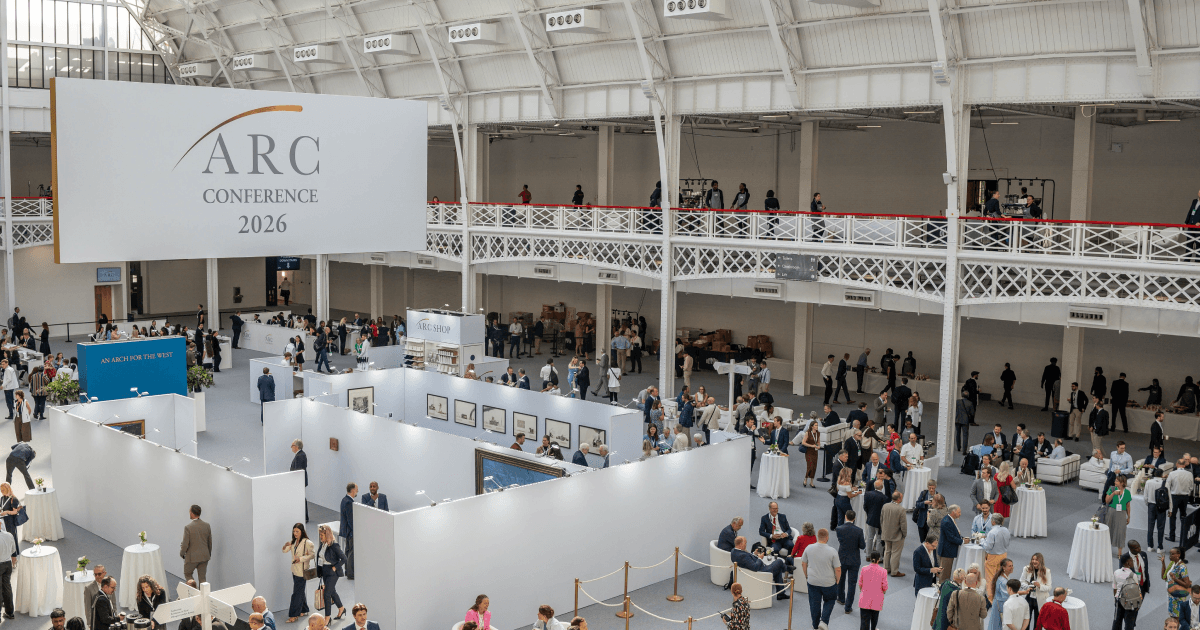
The Alliance for Responsible Citizenship (ARC) gathered in London for its third major global installment, an event that has rapidly matured from an ambitious intellectual experiment into a formidable fixture of the international centre-right. Convening at the Olympia in Kensington, the conference reportedly drew over 4,000 delegates from some 85 countries, bringing together a highly eclectically curated crowd of parliamentarians, journalists, tech entrepreneurs and cultural campaigners.
Co-founded by Canadian psychologist Jordan Peterson and Tory peer Baroness Philippa Stroud, and heavily bankrolled by the British philanthropist Sir Paul Marshall alongside the Legatum group, ARC’s public-facing taxonomy remained steadfastly civilisational, framing its sessions around the themes of societal “reconstruction” and individual responsibility. Beneath the secular policy vocabulary, a deeper, more elemental question pressed itself forward with unusual force – not just as an academic exercise, but as an existential crisis: Can a civilisation survive after it has forgotten God?
Without Jordan Peterson’s voice to anchor the proceedings, the introductory phase of the conference – tasked with diagnosing the current crisis – lacked its depth and poignancy. Instead, there was a creeping sense that we have heard these structural problems enumerated before, without ever digging into their deepest metaphysical sources and causes. Indeed, the diagnosis of contemporary crises felt somewhat flat and repetitive in the absence of Peterson’s uniquely insightful, ironic and often sardonic tone.
By contrast, the event found its footing when it turned to its stated ambition to inaugurate an “Age of Reconstruction”. This phase of the conference, centred on a phrase borrowed from Douglas Murray and adopted as a programmatic blueprint for cultural renewal, provided a solid and compelling framework. The core premise remains vital: that too many of the foundational convictions that made the West great have either been casually forgotten or allowed to slip away. Yet, while this constructive angle provided a necessary and effective roadmap for the future, the absence of the movement’s chief architect ultimately left the diagnostic portion of the event feeling more like a familiar echo than a profound breakthrough.
One can surmise that ARC does not want to present itself as a protest movement. It wants to build. It wants to recover. It wants to remind the West of what it once knew. The difficulty, of course, is that memory of this kind is never merely institutional. A civilisation is not held together by policies alone. It is held together by a shared account of reality.
This is why the religious dimension of ARC now feels harder to ignore. On one panel, James Orr opened the discussion with an image from Gaudí’s Sagrada Família. Asked why the work took so long, Gaudí famously replied that his client was not in a hurry. Orr turned the line into a provocation for the conference itself: “God is our client.” The remark was half witty, half programmatic. If Western civilisation is to be rebuilt, the work cannot be measured only by electoral cycles, fundraising strategies or think-tank white papers. It must proceed under a more patient and more demanding judgement.
From there the conversation moved quickly from politics to anthropology. One speaker described the battle for civilisation as taking place in “the hearts and minds of the young people”, especially “little girls and little boys”. This, too, was revealing. The organisers and panellists displayed a good grasp of the importance of education and character formation in passing on the values and traditions of the West. The future of the West was framed less as a contest between parties than as a struggle over formation: what children are taught to love, what they are taught to admire and whether they inherit a story capable of sustaining sacrifice.
The conference repeatedly returned to that question of story. Rod Dreher, speaking with characteristic urgency, argued that the West must recover its “sacred story”, the mythos that gives a civilisation meaning and cohesion. Without such a story, civilisations do not merely weaken; they forget why they should continue at all. Drawing on Iain McGilchrist, Dreher described the modern West as having spent five hundred years exchanging “meaning for power”. The exchange produced wealth, technological mastery and comfort. It also produced misery.
This was perhaps the most important theological claim made at ARC: modernity has not failed because it lacks power. It has failed because power without meaning becomes sterile. The digital sphere, Dreher argued, intensifies the problem by offering a “simulation of reality”. His example was chilling in its ordinariness: a woman with an AI boyfriend who knew he was not real but preferred the illusion because it made her feel good. Dreher called this “the voice of the devil”, meaning the temptation to prefer consoling falsehood to the difficult demands of reality.
That diagnosis found a different idiom in Johannes Hartl’s intervention. Ideas matter, he argued, but ideas themselves grow from a “spiritual root system”. The decisive question is “what is in the centre”. Human beings, Hartl suggested, are not made to circle endlessly around themselves. The eye is made to see light; the human being is made for transcendence. When God is removed from the centre, the first sensation may be liberation. Yet the younger generation, he suggested, increasingly sees through the promise of emancipation by unlimited choice. What looked like freedom has often become loneliness. What looked like self-expression has become exhaustion.
His most memorable line drew laughter because it was funny, and applause because it rang true: “The most punk rock thing you can do is become a Christian.” The joke worked because it reversed the old cultural map. In a society where rebellion has become institutionalised, Christianity begins to look less like conformity than defiance.
Even Nigel Farage, whose natural register is political rather than theological, framed his intervention in civilisational and religious terms. “The basis” of Western civilisation, he insisted, is “Judaeo-Christian culture”. It is, he added, “undeniable”. His concern was the loss of cultural memory: schools and universities celebrate every culture except their own, leaving young people without a sense of who they are or why their inheritance matters. Farage’s language lacks the metaphysical subtlety of Dreher or Hartl. Yet his bluntness served a purpose. ARC’s religious question is not primarily one of contemplation (though it should not forget that), but primarily civic. Families, communities, schools, laws, borders and nations all depend upon some account of the human person and the good. Once that account dissolves, politics becomes management atop ruins.
This is where ARC is at its most compelling. It has understood that the crisis of the West cannot be solved by economics alone. Its best speakers know that civilisational renewal requires more than deregulation, more than family tax credits, more than free speech protections, more than electoral victories. These may all matter. But none of them can supply a reason to live.
This balance, however, is fragile. The alliance is broad, perhaps necessarily so. Catholics, Evangelicals, Anglicans, Orthodox Christians, Jews, secular conservatives, libertarians, classical liberals, national conservatives, post-liberals and cultural traditionalists all crowd under the same roof. Their shared diagnosis is powerful: the West is spiritually exhausted, culturally forgetful and increasingly captive to false forms of liberation. Their shared cure is less clear.
Christian language can unite at the level of civilisational memory. It becomes more difficult when one asks what Christianity actually means. Authority, sacrament, ecclesiology, moral theology, natural law, Scripture, nation, markets, migration, war and the state all look different depending on whether one speaks as a Catholic, an Evangelical, an Orthodox Christian or a secular admirer of Christianity’s social effects. ARC can still gather these voices under one roof. Good. Whether it can discipline them into a durable intellectual movement remains to be seen.
There was also a perceptible thinning of explicitly ecclesial voices. The absence of Bishop Robert Barron, so prominent in previous iterations of the movement, was noticeable. His presence had given ARC a certain Catholic theological weight: confident, public, media-savvy and connected to the Church’s intellectual tradition. Without figures of that kind, the religious energy of the conference risks becoming more diffuse: powerful, sincere, often moving, but less doctrinally anchored.
And then there was the absence that mattered most. Jordan Peterson was not exactly gone. His vocabulary was everywhere: meaning, responsibility, chaos, order, myth, sacrifice, reconstruction. In panel presentations he was cited as: “As Jordan said…” more than once. ARC still bears his imprint so deeply that even those who disagree with him speak in a grammar he helped popularise. Yet his tangible absence from the centre of events left a tangible hole. One felt that the movement he helped call into being had begun to walk without him, which is both a sign of health and a source of melancholy.
Peterson’s genius was to make moral seriousness sound urgent again to a generation trained in irony. He taught many people that civilisation rests on stories, that responsibility is not oppression, that meaning is more necessary than comfort, and that the fatherless generation longed for a father. He was willing to step into that role, whether it suited him or not. ARC now seems to be discovering that such insights, if followed far enough, lead beyond psychology into theology. But that transition is delicate. A movement born from Petersonian mythopoesis and moral psychology cannot become a church, nor should it try. Yet it cannot avoid the question of God either.
This is the drama of ARC at its most interesting. It began by asking how to save civilisation. It now finds itself asking what civilisation is for. The first question can be answered by politicians and policy experts. The second cannot.
In a closing speech that brought the room to its feet for a prolonged standing ovation, Baroness Philippa Stroud aptly cited Tolkien, echoing the defiance of Aragorn before the Black Gate: “A day may come when the courage of men fails, when we forsake our friends and break all bonds of fellowship – but it is not this day.
It was a fitting climax for an event caught between two eras. Behind it lay the exhausted scripts of progressive optimism and populist anger; before it lay something older, stranger and far more demanding: prayer, worship, repentance, pilgrimage, conversion, the re-enchantment of the world and the recovery of God.
Whether ARC can truly carry that burden remains uncertain. But it has at least understood this much: the West will not be reconstructed by technique alone. It must remember its soul.