


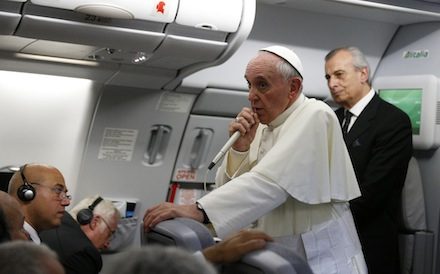
About a year ago, and thus in the early months of Pope Francis’s pontificate, Damian Thompson wrote a Daily Telegraph blogpost headlined “Meet Francis, the Chatterbox Pope”. “This new pontiff”, he noted, “is a media-savvy charmer in a way that none of his predecessors have been. Seriously, he could give Bill Clinton lessons in how to work a crowd." He was by no means unsympathetic to this; but already there are signs of uncertainty. “His morning sermons are often extemporised”, he went on [are they still? We haven’t heard about them lately] “accompanied by shrugs worthy of a harassed maître d’ and “huh?” noises that the Vatican press office has given up trying to render into English. All very sweet – but what do we really know about Francis’s views? Well, he’s not a traditionalist like his predecessor, Benedict XVI. Indeed, he’s positively anti-traditionalist, not aggressively so, but in an I-can’t-be-doing-with-all-that-fussy-nonsense kind of way.” Was “Francis the Chatterbox Pope” a recipe for disaster? Damian didn’t think so. “He won’t undo the work of the great Benedict: it would create too much ill-feeling and, at 76, he doesn’t have time. Yes, there will be gaffes, possibly so many that we stop worrying about them. But if you listen to the Pope’s improvised talks, you quickly realise that his central focus never shifts. Follow Jesus by helping the poor. Beware of the Devil, who wants you to spend all day distracting yourself with little treats. … Jorge Bergoglio has a gift that eludes the boring, risk-averse platitude merchants who have captured the machinery of most Catholic and Anglican dioceses. He relaxes you with his smiles and shrugging, and then tweaks your conscience so hard that you wince in pain.” So far, so good. And I think that most of us agreed with that assessment then and still do. But not everyone: too many don’t. I have written blog after blog explaining that there is nothing to be worried about, that the liberals who were so pleased because they thought his relaxed manner showed he was a liberal like them were deluded, that actually he was as concerned as Benedict to defend the teachings of the Church, but he wasn’t going to do the job of the cardinal prefect of the CDF for him: his focus would be pastoral not dogmatic, but he would not be weakening the Magisterium he inherited. I still think so. All the same, I note that Fr Z’s blog, which he renamed “Reading Francis through Benedict”, has now been once more renamed; now it’s simply “Fr Z’s blog”: is that because he no longer thinks that you can read Francis through Benedict, that this Pope can no longer be perceived as believing mainstream Ratzingerian Catholicism, though propagating it in his own relaxed way? Well, no it doesn’t actually. Fr Z, of the Pope’s latest airborne Press conference, notes that when Francis was asked what the forthcoming synod on the family would say about communion for the divorced and remarried, he was displeased, and made it clear that “I don’t like [it] that many people – even in the Church – priests – have said: “Ah, the Synod for giving Communion to the divorced”, and they’ve gone right there, to that point…. No, the matter is more than this, it is wider. Today, everyone knows it, the family is in crisis: it is in a global crisis.” That’s what the synod is about: the crisis of the family. And no radical changes over who may receive Holy Communion, I predict, will emerge from it. The Pope made it clear that his own thinking on giving Communion to the divorced had been guided by Benedict XVI, that what “Pope Benedict said three times about the divorced has helped me a lot. Once, in the Valle d’Aosta, another time in Milan, and the last time in the public consistory which he held for the creation of cardinals: to study the procedures for matrimonial nullity; to study the faith with which a person comes to matrimony and to clarify that the divorced are not excommunicated, and so many times they are treated as excommunicated. And this is a serious thing.” As Fr Z points out, “he was clearly prepared for this question, because he worked in that his (still living) predecessor treated the issue three times and even said where. He was telling the newsies to look up what Benedict XVI said.” All the same, I have a growing feeling that those Press conferences, and much else that looks on the face of it like inspired communication with the modern world, may be beginning to cause problems. Pope Francis conducts his press conferences in what is (according to Fr Z) not very good Italian; and secular journalists are not in any case good at understanding theologically based answers: this is not necessarily good communication. I note that another orthodox priest who admires Pope Francis, Fr Dwight Longenecker, is beginning to ask uneasy questions about Pope Francis’s grasp of the papal office:
12:24 PM
Are the Holy Father’s informal and often confusing methods of communication undermining the teaching authority of his office? Is a period of papal reserve now overdue?
Pope Francis is popular with the secular media because they think he’s about to abandon the disciplines of the Church; and they have built him up by denigrating Benedict XVI
William Oddie

7 min read



Already a subscriber? Sign in
5freearticles every month
Continue reading with a free account. No card needed.
- Five free articles every thirty days, on any device you sign in on
- The Catholic Herald newsletter, every morning
- Subscribe whenever you like for everything: every article and the magazine
Related articles
 Newsroom
Church leaders urge Drumcree dialogue: ‘Too much is at stake’
The Catholic and Church of Ireland Archbishops of Armagh have urged a renewed commitment to peace and reconciliation amid the Drumcree stand-off
Corrie Douglas-Young Newsroom
Thousands of Irish children to join global Rosary campaign
Corrie Douglas-Young Newsroom
TikTok priest urges young people to stand with persecuted Christians
Nathalie Raffray Newsroom
Baby born at 25 weeks reunites with neonatologist two years after leaving hospital
The Catholic Herald Newsroom
Joe Biden honoured by Planned Parenthood after defending abortion rights
Christine Rousselle
subscribe to the catholic herald today
Our best content is exclusively available to our subscribers. Subscribe today and gain instant access to expert analysis, in-depth articles, and thought-provoking insights—anytime, anywhere. Don’t miss out on the conversations that matter most.
Subscribe



