




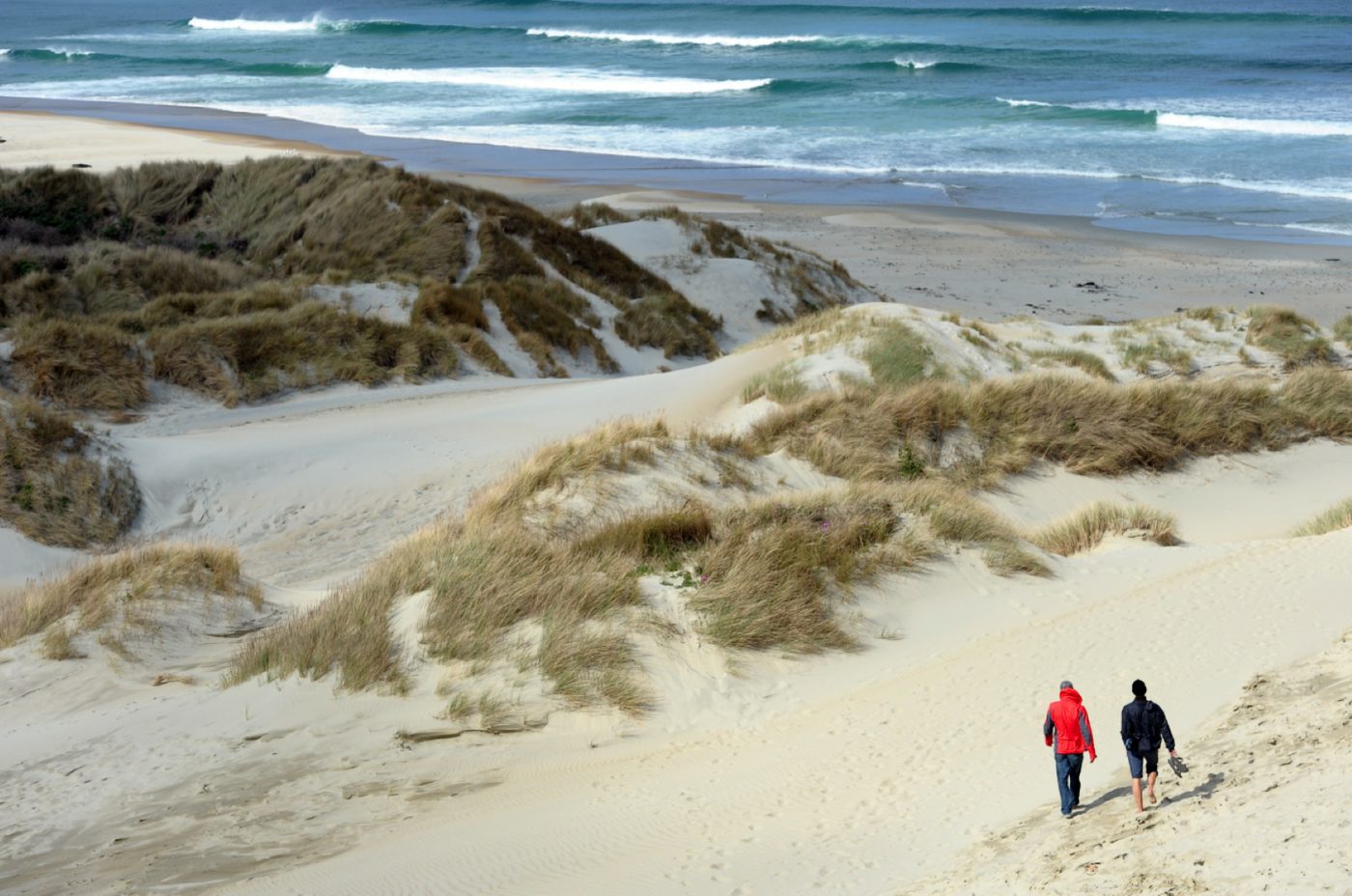
The Gallery of Living Catholic Authors was established in 1932 by an American nun, Sister Mary Joseph, at Webster College, St Louis. Its purpose was to honour contemporary Catholic writers and create interest in their work. The Gallery was by no means composed of American authors only. Its number included Ronald Knox and Jacques Maritain; and, in 1939, a New Zealand poet was admitted to its ranks. Eileen Duggan was born in 1894 in Tua Marina on the northern tip of New Zealand’s South Island to parents who had emigrated from County Kerry. Ireland, its travails and grievances, is a major theme in some of her poems, but it was New Zealand itself that ultimately commanded her greatest loyalty. Indeed, her poem “The Man Away” shows how the thoughts of an emigrant who has returned to Ireland keep running back to “Terawhiti’s storm of gulls, / To Mana drowning in the sun”. She once said: “To be asked to write of Tua Marina is almost like a request to write on self.” She identified deeply with the landscape of New Zealand whose islands “stand / A pledge, a ransom and a dare”, where one could “Conserve man’s old alliance with the earth / Of veins with rivers and of flesh with loam”. In “Titahi Bay”, the movements of the sea come to resemble those of a Maori war party: “Oh stealthy, silent, sure, like warriors descending / Head up and tense […]” There is an edge of anxiety to her poems. She knew that, in part at least, poets had to rely on “Such will as bees have when they fly by night, / Foreseeing a sour summer for the comb” (“Plea”). However, Duggan (no relation) also knew that there were rougher tasks than poetry. Though she spent most of her adult life in Wellington, her rural upbringing meant that she could begin a poem with the words, “I was driving the cows”. Her identity remained in part that of a “paddocks woman”, though she feared losing touch with humble people “who turn their sorrows into powers”. She knew well also how tenderness could break through the rough cladding of the rural scene: “My mares would shame a man. / I’ve seen them lift their feet / To let a bird through / In all the summer heat.” (“The Drayman”) And so writing of the Blessed Virgin, she could treat the Mother of Christ with great reverence and piety, while not forgetting that she was “poor, roughfingered”. Her religious belief seems to have been deep and constant, but not uncomplicated. In “And at the End”, she finds herself begging for nothing more than the faith of “a blind hound nosing the knee”. Religious and national piety combine in “The First Night”, in which native New Zealand birds take turns to give a special blessing to the newborn Christ. In 1949, a carol of hers was sung by 4,000 people in a service at St Paul’s Cathedral. Her faith informed her reactions to great events too. Of the Spanish Civil War, she wrote, in a letter to a friend: “I hope the new Spain will be neither Red-Shirt nor Black-Shirt for the individuality or rather the knowledge of the worth of the individual which was Christ’s great gift to a State-crazed earth would be temporarily defeated.” Stylistically, she was never an extreme experimentalist, but she could be fresh and inventive with language: the first stanza of the cow-driving poem finishes with the line, “The tussocks were brittling from dew into frost”. Her greatest champion in this country was Walter de la Mare who claimed, in the introduction to the English edition of Poems (1937): “The master words have been reminted.” The same volume was praised in the TLS for seeing the world anew and rediscovering “the worth and wonder of it”. The New York Times had her “carrying on with brilliancy the unquenchable lyric torch”. In the aftermath of World War II, her language seemed to grow more taut, compressed, demanding. In the “The Discipline of Consequences”, she wrote: “The last wild element is mastered now / But its revenge has taken our old world, / And man must face with awe upon his brow / Life underground, an Adam twice out-hurled.” Fr FM McKay, a friend of Eileen Duggan and author of a short study of her published by OUP in 1977, felt that what she had said of Ruth Pitter could be said of her too: “an honest poet fighting against the disease of the times – despair”. Eileen Duggan was the leading New Zealand poet of her day. But she was also the last of her country’s pre-Modernist writers. Her reputation has been beached by the tides of literary fashion. It is time to salvage and restore it. Michael Duggan is a freelance writer
12:00 PM
Arts essay: The forgotten bard of faith and humanity
Michael Duggan

5 min read



Already a subscriber? Sign in
5freearticles every month
Continue reading with a free account. No card needed.
- Five free articles every thirty days, on any device you sign in on
- The Catholic Herald newsletter, every morning
- Subscribe whenever you like for everything: every article and the magazine
Related articles
 Newsroom
Injured priest tells Poles: ‘Do not blame Ukraine’ for convent attack
Fr Adrian Mantykiewicz, who was injured in the attack that killed a fellow priest, has urged Catholics to pray for the assailant and not blame Ukrainians for his actions
Corrie Douglas-Young Newsroom
Church leaders urge Drumcree dialogue: ‘Too much is at stake’
Corrie Douglas-Young Newsroom
Thousands of Irish children to join global Rosary campaign
Corrie Douglas-Young Newsroom
TikTok priest urges young people to stand with persecuted Christians
Nathalie Raffray Newsroom
Baby born at 25 weeks reunites with neonatologist two years after leaving hospital
The Catholic Herald
subscribe to the catholic herald today
Our best content is exclusively available to our subscribers. Subscribe today and gain instant access to expert analysis, in-depth articles, and thought-provoking insights—anytime, anywhere. Don’t miss out on the conversations that matter most.
Subscribe



