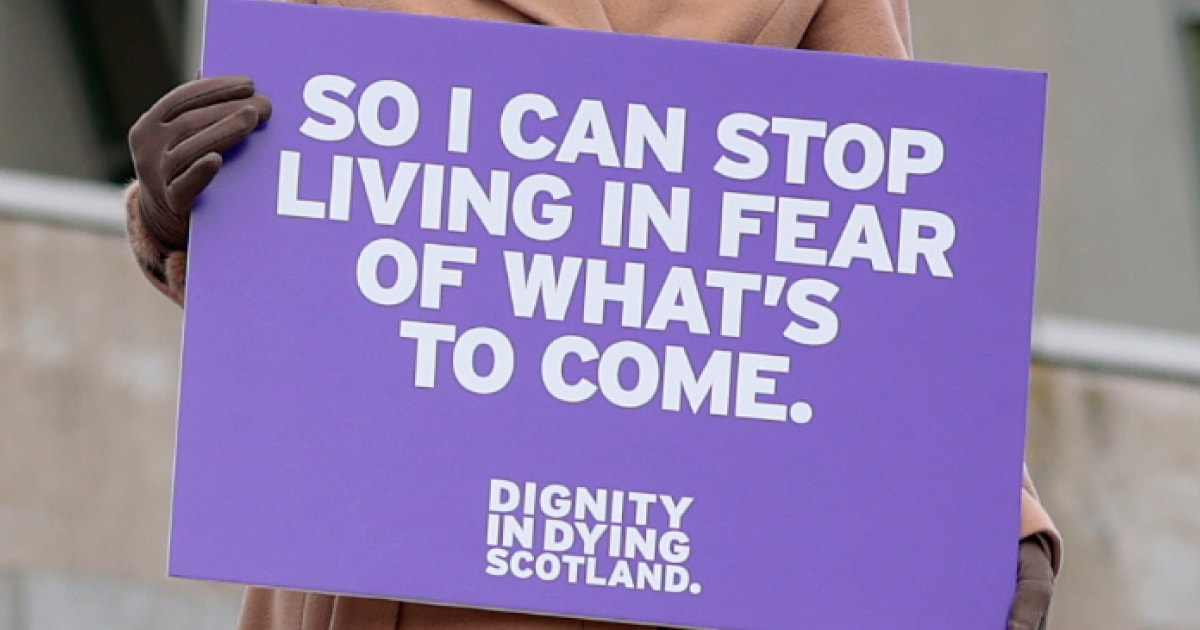



Attorney Erwan Le Morhedec said that the amount of money behind the pro-assisted suicide lobby enabling these adverts was “staggering”, arguing that it amounted to “pro-euthanasia propaganda”. The adverts appeared in the week preceding the Stage 3 debates in the Scottish Parliament.
Experts have raised concerns that vulnerable people would not have a free choice at the end of life if assisted suicide were legalised. Recent polling surveyed members of the Royal College of Physicians and Surgeons of Glasgow on the practicalities of implementing assisted suicide legislation in England, Wales and Scotland should such laws come into force.

The poll revealed that a majority of respondents in Scotland who took a firm view, 73.53 per cent, did not believe that the proposed safeguards against coercion in the legislation would be practical within current service structures and protocols. This indicates that many respondents from the Royal College of Physicians and Surgeons of Glasgow who expressed a firm view believe there are serious concerns about whether genuine choice at the end of life could exist under the Scottish assisted suicide Bill.
In addition, a majority of respondents in Scotland who took a firm view said they were concerned about their ability to competently assess individuals’ eligibility for assisted suicide. Of those who took a firm view, 90.43 per cent believed they would face challenges in assessing whether a person was free from coercion, while 86.46 per cent said they would face challenges in assessing an individual’s capacity.
Given that many members of the Royal College of Physicians and Surgeons of Glasgow who responded to the poll and took a firm view expressed concern about the potential for individuals to be coerced into ending their lives, and about the possibility that those lacking capacity might be deemed eligible for assisted suicide, critics argue that the Bill would fail to provide real choice for vulnerable people.
Dr Morven McElroy, honorary secretary at the Royal College of Physicians and Surgeons of Glasgow, said: “The survey has shown that if the bills were to become law, there is a strong need for greater clarity to protect both patients and doctors.
“Respondents to the survey were particularly concerned about the challenges of assessing whether a patient has made their decision voluntarily, and their capacity to make that decision.”
Several MSPs have also raised concerns that assisted suicide would not represent a genuine choice for vulnerable people.
Many MSPs have said that the lack of adequate social, palliative and end-of-life care in Scotland could leave vulnerable individuals feeling pressured towards ending their lives because other options are inaccessible.
Speaking during a meeting of the Scottish Parliament’s Health, Social Care and Sport Committee in November, Jeremy Balfour MSP argued that people struggling with disability or despair could be pushed towards assisted suicide when what they require is care and compassion. He described the policy as a “profound moral error”.
Bob Doris MSP made a similar point, stating that vulnerable people can “feel like a burden”, and arguing that they deserve compassion and care rather than abandonment.
Brian Whittle MSP warned that limited access to care could make assisted suicide the default option for some patients.
“My concern is that, if we do not put in place some sort of safeguard around a right to what we define as a basic level of palliative care, assisted dying may become a preferred option for patients because of the lack of suitable and deliverable palliative care,” he said.
Rhoda Grant MSP also expressed concern, saying: “I have concerns that, should it become law, people will opt for assisted dying due to a fear of having little support at the end of their lives.”
Catherine Robinson, a spokeswoman for Right To Life UK, said: “These advertisements are very disturbing. Those endangered by the assisted suicide Bill cannot afford such publicity or the glossy branding of Dignity in Dying, whose adverts sanitise the reality and hide the risks of the Bill.
“It is notable that these adverts, which are deeply irresponsible as they come close to promoting suicide, focus relentlessly on ‘choice’. But choice is an illusion when access to high-quality palliative and social care is lacking, meaning poorer people who cannot afford such care would have no meaningful choice if assisted suicide were introduced.
“This radical view of autonomy, which fails to understand the contexts that may lead people to wish to die or recognise the vulnerable people who would be put at risk, is profoundly at odds with a compassionate society which offers support, not suicide.
“MSPs should not be swayed by a powerful lobby machine. This Bill must be rejected.”
This article was originally published by Right To Life UK and is republished with permission. Read the original version of this article here.