
April 29, 2026

Pope Leo XIV recognises Spanish martyrs killed in hatred of the faith

Thomas Colsy
More
Related
Min read
share

Pope Leo XIV has formally recognised the martyrdom of 49 Spanish Religious killed during the early months of the Spanish Civil War, authorising the publication of a decree on Monday advancing their causes for beatification. The decision, announced after an April 27 meeting at the Vatican with the prefect responsible for sainthood causes, acknowledges that the men were killed “in hatred of the faith” between July and November 1936.

The decree was approved during an audience with Cardinal Marcello Semeraro, head of the Dicastery for the Causes of Saints, and concerns Stanislao Ortega García and 48 companions belonging to the Institute of the Brothers of Christian Instruction of Saint Gabriel, together with diocesan priest Emanuel Berenguer Clusella.

According to the decree authorised by Leo XIV, the group was killed in various locations across Catalonia during the violent anti-clerical persecution that accompanied the outbreak of the Spanish Civil War. Church authorities concluded that the deaths met the canonical definition of martyrdom – the deliberate killing of Christians because of their faith – which allows beatification to proceed without the verification of a miracle.

Historians widely agree that religious persecution was a defining feature of the conflict’s early phase. Contemporary records indicate that thousands of clergy and Religious were killed in Republican-controlled territory in 1936, including bishops, priests, seminarians, and members of Religious orders. In some regions, churches and monasteries were burned or confiscated, and public worship was temporarily suppressed.

Journalist Gerald Warner has explained: “The Republicans butchered a total of 13 bishops and 6,832 clergy, including 4,184 diocesan priests, 2,365 members of Religious orders and 283 nuns. Sometimes priests were castrated before being shot. Their exhumed bodies often showed bullet wounds to the right hand, having been shot while blessing their murderers. Canonisations are still flowing from this unique period of martyrdom. Lay Catholics were murdered in incalculable numbers.”

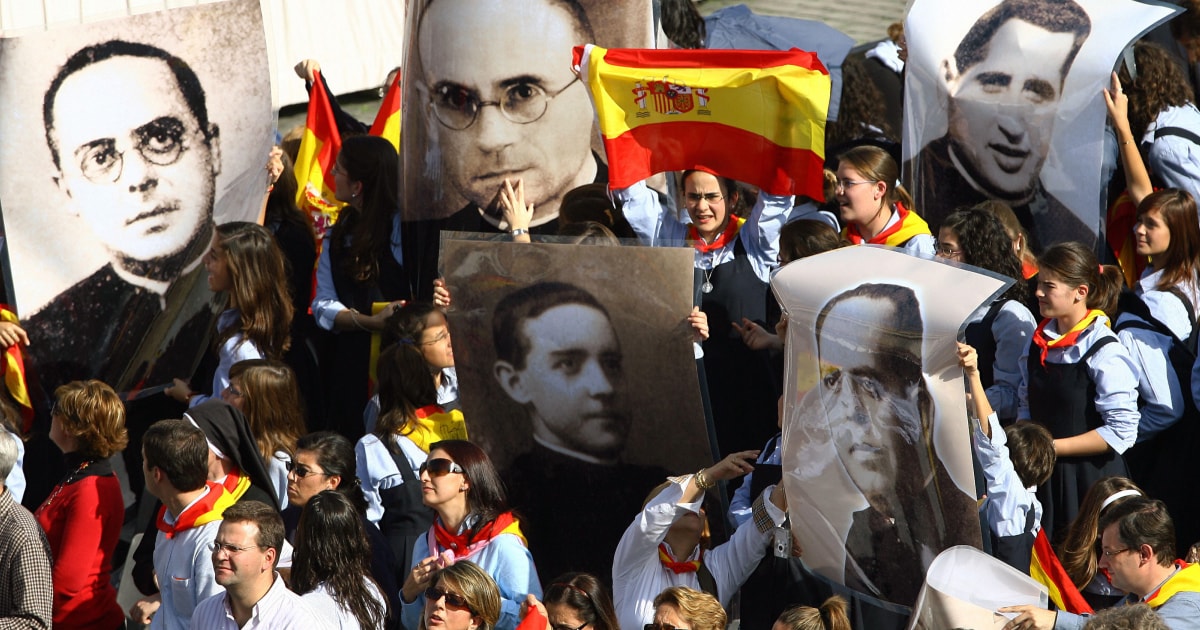
The recognition of these martyrs continues a process that has unfolded over several decades. Since the late 20th century, successive popes have advanced numerous causes related to victims of religious persecution during the Civil War. For example, John Paul II beatified hundreds of Spanish martyrs in large ceremonies in Rome, including a group of 498 in 2007 under Benedict XVI, one of the largest beatifications in the Church’s history.

The individuals recognised in the latest decree belonged primarily to a teaching congregation dedicated to the education of young people, particularly in rural and working-class communities. During the summer and autumn of 1936, many members of Religious communities were forced into hiding or fled their institutions as violence spread. Some were arrested while attempting to continue pastoral or educational work, while others were executed after refusing to renounce their religious identity. Warner has documented how, at the time, “[t]he Spanish bishops, in the face of extreme barbarism, declared the war a Crusade. In their 1937 letter ‘to the whole world’ they revealed that 20,000 churches out of the 42,000 in Spain had been destroyed.”

Church historians note that the memory of these events remains significant in Spain’s national and religious life. In many dioceses, local communities continue to commemorate clergy and lay faithful killed during the conflict through memorial Masses and historical research projects.

Alongside the Spanish decree, the Pope also approved the recognition of the “offering of life” of Pietro Emanuele Salado Alba, a Spanish layman who died in Ecuador in 2012, and authorised decrees recognising the heroic virtues of three women Religious from Italy and the Netherlands. Such decrees represent formal steps in the Catholic Church’s multi-stage process towards sainthood, which typically includes recognition of heroic virtue or martyrdom, beatification and eventual canonisation.

Continue reading with a free account

Create a free account to read up to five articles each month
Create free account

You have # free articles remaining this month.

Subscribe to get unlimited access.
Sign up

subscribe to the catholic herald today

Our best content is exclusively available to our subscribers. Subscribe today and gain instant access to expert analysis, in-depth articles, and thought-provoking insights—anytime, anywhere. Don’t miss out on the conversations that matter most.
Subscribe