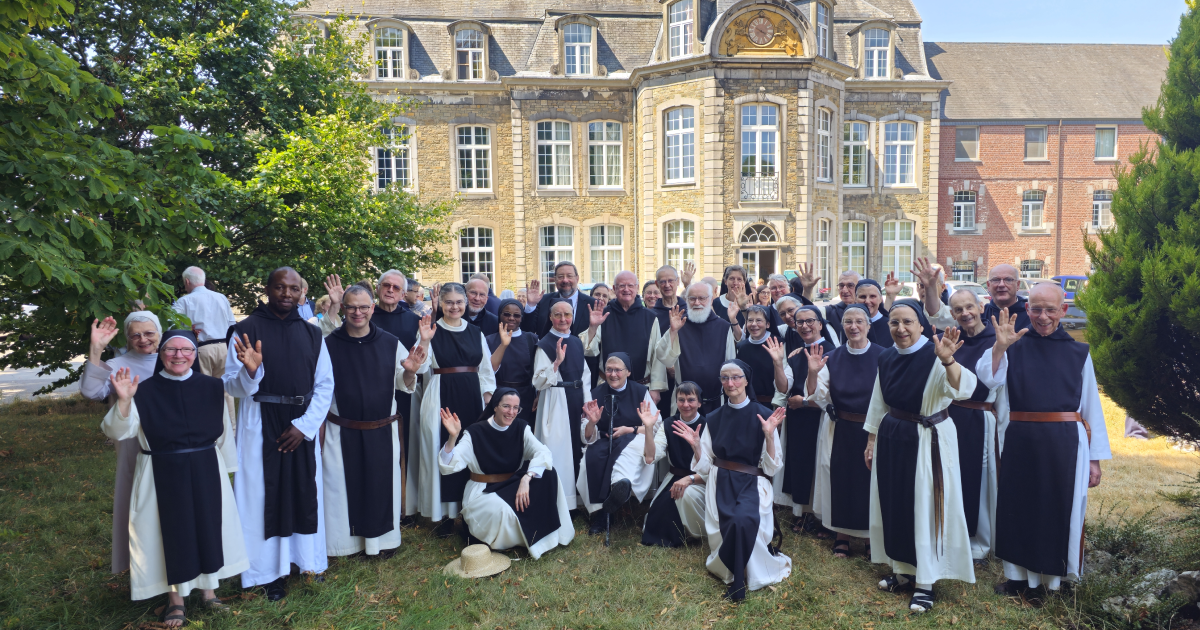


The Cistercian sisters in Brialmont Abbey in the Diocese of Liège, Belgium, held a Mass of thanksgiving before their departure from the abbey, after 65 years in the building. The abbey had announced that the Trappists would leave because of a lack of vocations to sustain itself, with six sisters still present at the time of its closing.
In June, the Society of Jesus announced its departure from Liège, after having been in the city since 1569.
The Mass of thanksgiving was celebrated by Bishop Jean-Pierre Delville of Liège, who paid tribute to the community in his homily.
The bishop said: "Everything that has been experienced in this abbey for 65 years is a treasure, carried in the fragility of our lives. Brialmont has become a real green lung of the diocese. This is where you come to go green, and that we are greening up. The consecrated life is a treasure for the Church. Even in the fragility of recent years, the sisters have continued to make monastic life shine."
The Order of Cistercians of the Strict Observance released a statement in February in which it said that it had been aware “for some time of its fragile situation” and that the community had determined that it was not possible to recover from the lack of vocations, requiring its closure.
Following the closure of the abbey, for which plans are currently under way to determine how it can be used for ecological and spiritual purposes, the remaining six nuns will join other Cistercian monasteries, which they are free to choose.
The announcement comes as France also undergoes a significant number of closures of its monastic communities. A recent study revealed that one-third of French monasteries have closed since 2007.
France has a higher number of women’s monasteries than men’s, meaning that due to an overall decline in vocations they are disproportionately affected. The study found that 32 per cent of women’s monasteries closed, compared with 21 per cent of men’s monasteries.
In an interview with the publication La Vie, sociologist Isabelle Jonveaux of the University of Fribourg, who conducted the research, said: “Women's religious life is more in crisis, because it is less adapted to the profile of young women today than in the past. In the past, religious life was a path of emancipation for women, allowing them to form or escape patriarchal authority.
“Today, in Europe, women who enter the monastery are often in their thirties, they have studied and are autonomous. As a result, the great distance from the world or what is perceived as a form of infantilisation in some structures no longer works for them.”
The study also found that of communities whose liturgical service was in the vernacular in 2007, 34 per cent closed, dropping to 19 per cent for those who used French and Latin. However, no communities closed for those whose liturgy was celebrated exclusively in Latin.
Image credit: Diocese of Liège