




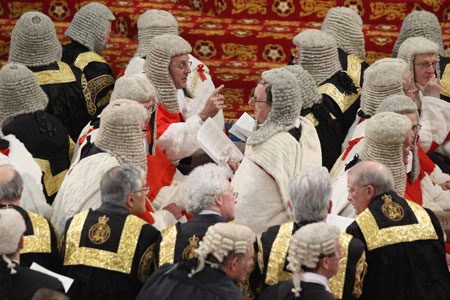
To what conceivable question is 450 more elected politicians a rational answer? That is the conundrum which comes inescapably to my mind as I contemplate the government’s proposed Lords reform Bill. And if you answer that the question to which it is the answer is “how is the House of Lords to be made more ‘democratic’,” I have to ask, what on earth do you mean by “democratic”? It’s an interesting word, democratic. It doesn’t, for instance, necessarily mean representative, in the sense of representing, or being in tune with, public opinion. Time and again, the Lords over the years have spoken for the people against the Commons, because the Lords, being largely independent of the government machine, have been more able to express what the people actually wanted than the Commons, whose members mostly have to vote as the whips tell them to vote or risk the loss of their political careers. Of course the Lords are not directly “accountable” to the electorate in the same sense that an elected politician is. But as the splendid Betty Boothroyd — who was Speaker of the House of Commons in the era when the Speaker was still someone we all respected — put it, “nor are the monarchy, the judiciary, the chiefs of the armed services, the Prime Minister, his deputy Mr Clegg or - let us face it - the Cabinet directly accountable”. How would our political system be improved by giving vastly more power to the existing party machines? A freely elected politician rather than an appointed one sounds like a wonderful thing; but how will you get to be one of these wondrous creatures? You will have to be appointed as a candidate, that’s how. This new reformed chamber will be “elected” by proportional representation: that means that it is the powers that be in the political establishment who will decide on the list of candidates to be elected, that is, on who actually gets to stand for office in the first place. Only then will we get a say; we will “choose” someone we have never heard of, someone from whom we are entirely remote or, more likely, we will stay at home. That’s how elections to the European Parliament unfold. Do you really FEEL democratically represented in the European Parliament? Of course you don’t: this isn’t a democratic institution at all, but a pseudo-democratic Potemkin village, just as the supposedly reformed House of Lords will be. I repeat: it won’t be a freely elected House at all: it will be pre-selected by the political establishment against which the House of Lords we actually have is a frequently splendid counterbalance. It may be the case that the present Lords is appointed in a number of ways (including the political, but encompassing also an on the whole well-conducted selection of those who have made in some way an outstandingly distinguished contribution to the national life): but once appointed, no political party has any further control of a peer’s speaking or voting: peers are free to do what they actually do rather well: use their considerable collective experience (as I say, they include senior physicians, jurists, civil servants, economists, soldiers, religious leaders, and others as well as senior politicians) to revise legislation. And to quote Baroness Boothroyd again, “I … ask in the simplest and most mundane terms that I can command: in what way would the nation benefit and parliamentary proceedings be enhanced by the abolition of this House of experts and experience, and its replacement by a senate of paid politicians?” I return to the question with which I began: To what conceivable question is 450 more elected politicians a rational answer? The answer actually is that it is the question of how on earth the Liberals can go into the next election able to say to their core voters that they have actually achieved something radical by going into coalition with the old enemy: in other words, how are they to avoid being electorally wiped out (so far as I am concerned, a consummation devoutly to be wished)? It was put rather well (as well as amusingly; Lords speeches are so much less boring than Commons ones) by Lord (Michael) Forsyth of Drumlean:
1:39 PM
Cameron, Clegg and Miliband want us to have hundreds more politicians (elected from candidates they will choose). So, how is <em>that</em> more representative?
The abolition of the Lords will destroy our Parliamentary constitution
William Oddie

6 min read



Already a subscriber? Sign in
5freearticles every month
Continue reading with a free account. No card needed.
- Five free articles every thirty days, on any device you sign in on
- The Catholic Herald newsletter, every morning
- Subscribe whenever you like for everything: every article and the magazine
Related articles
 Newsroom
Church leaders urge Drumcree dialogue: ‘Too much is at stake’
The Catholic and Church of Ireland Archbishops of Armagh have urged a renewed commitment to peace and reconciliation amid the Drumcree stand-off
Corrie Douglas-Young Newsroom
Thousands of Irish children to join global Rosary campaign
Corrie Douglas-Young Newsroom
TikTok priest urges young people to stand with persecuted Christians
Nathalie Raffray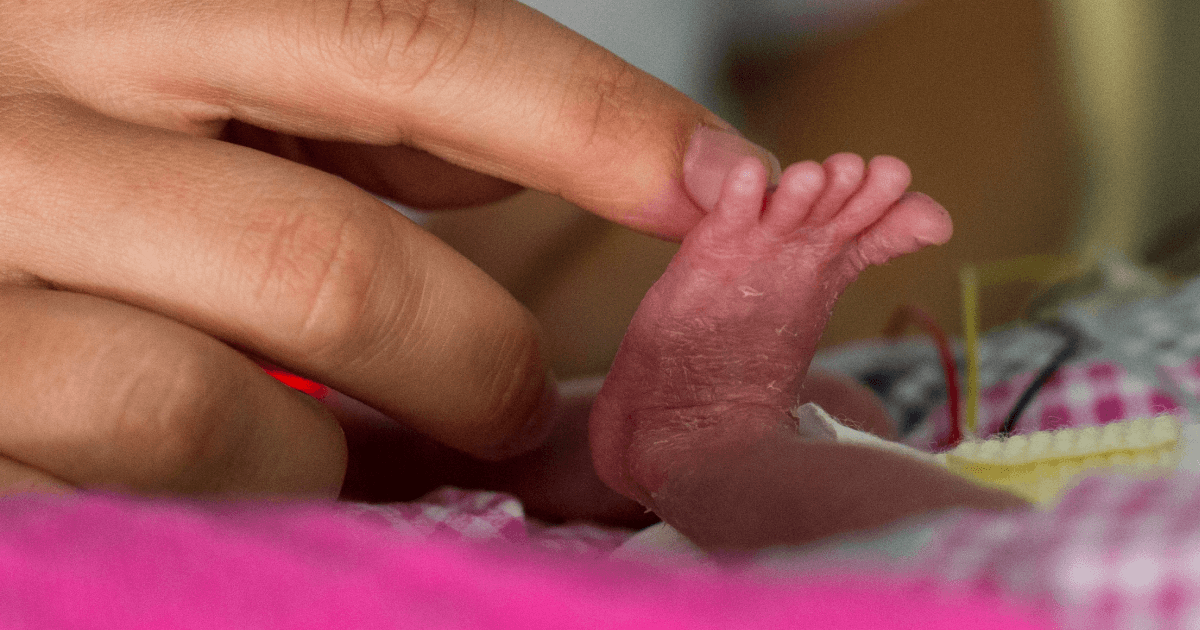 Newsroom
Baby born at 25 weeks reunites with neonatologist two years after leaving hospital
The Catholic Herald Newsroom
Joe Biden honoured by Planned Parenthood after defending abortion rights
Christine Rousselle
subscribe to the catholic herald today
Our best content is exclusively available to our subscribers. Subscribe today and gain instant access to expert analysis, in-depth articles, and thought-provoking insights—anytime, anywhere. Don’t miss out on the conversations that matter most.
Subscribe



