

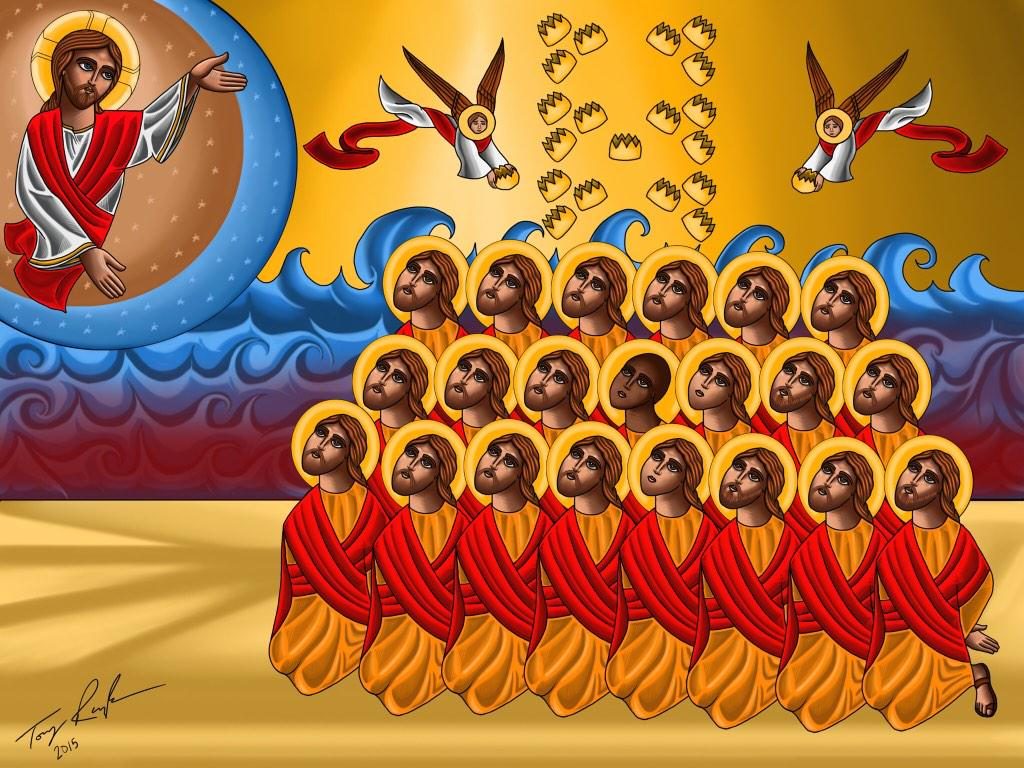
The murder of the 21 Coptic Christians in Libya by ISIS has raised the issue for Catholics as to whether we can acknowledge them as martyrs as the Copts have done. The SSPX and the Josias blog, for instance, contend that the Copts are heretics and schismatics. The Josias asks if a Copt being murdered by a militant anti-Christian “for his Christian profession, would... suddenly... [be] a good Christian? Would it gain him entry into heaven and blot out his sins?” First, are Copts actually heretics? After the Council of Chalcedon in 451 the Copts, with other Oriental churches, were cast out as monophysite heretics. As so often happens, the argument was more about vocabulary than substance. The Copts formally rejected monophysitism, but they explained their orthodox view of the two natures of Christ with a vocabulary different to Chalcedon’s. However, the issue is dead. In 1988 the Catholic and Coptic Churches issued an Agreed Statement which affirmed the orthodox understanding of Christ. After another agreed Christological statement, in 1994 with the Assyrian Church of the East, it became possible for members of either Church to receive Communion in the other under certain conditions. Could not the same arrangement could be made with the Copts? Yet perhaps we can be bolder yet. When I discussed these martyrs with Graham Hutton, chairman of Aid to the Church in Need, we addressed Pope Francis’s recent reference to an “ecumenism of blood” that unites Christians. He has not developed it theologically, which leaves the way for theologians to take this up and run with it. So we took this ecumenism of blood a little further in light of the ancient doctrine of baptism by blood, which holds that the unbaptised who die for Christ are baptised by their death. So could it be possible to speak of an absolution by blood, by which a Christian’s dying for Christ would absolve any grave sins, even those of schism or even heresy? Pope Francis implies this when he said a few days ago that...
9:37 AM
Can Catholics recognise the 21 murdered Coptic Christians as martyrs?
The 21 Coptic Martyrs are role models for all Christians and a Catholic heart wants to honour them as such
Fr Hugh Somerville-Knapman OSB

3 min read



Already a subscriber? Sign in
5freearticles every month
Continue reading with a free account. No card needed.
- Five free articles every thirty days, on any device you sign in on
- The Catholic Herald newsletter, every morning
- Subscribe whenever you like for everything: every article and the magazine
Related articles
 Newsroom
Church leaders urge Drumcree dialogue: ‘Too much is at stake’
The Catholic and Church of Ireland Archbishops of Armagh have urged a renewed commitment to peace and reconciliation amid the Drumcree stand-off
Corrie Douglas-Young Newsroom
Thousands of Irish children to join global Rosary campaign
Corrie Douglas-Young Newsroom
TikTok priest urges young people to stand with persecuted Christians
Nathalie Raffray Newsroom
Baby born at 25 weeks reunites with neonatologist two years after leaving hospital
The Catholic Herald Newsroom
Joe Biden honoured by Planned Parenthood after defending abortion rights
Christine Rousselle
subscribe to the catholic herald today
Our best content is exclusively available to our subscribers. Subscribe today and gain instant access to expert analysis, in-depth articles, and thought-provoking insights—anytime, anywhere. Don’t miss out on the conversations that matter most.
Subscribe



