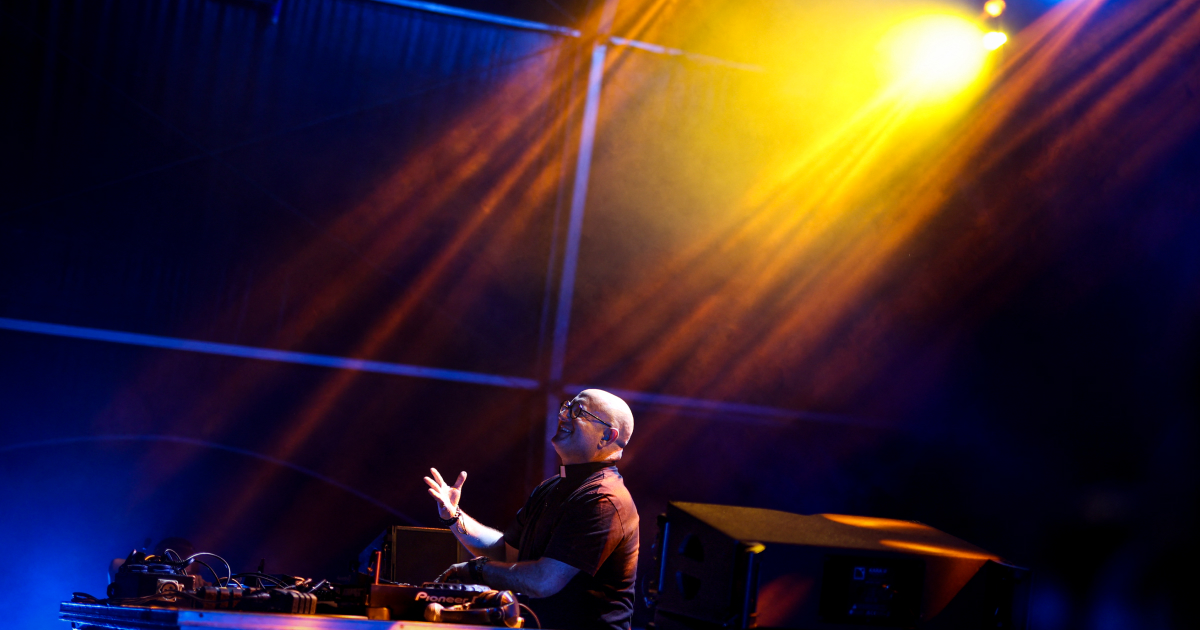


Earlier this year, the Portuguese electronic dance music sensation Padre Guilherme graced London’s aptly named Ministry of Sound with an evening show, which I attended with friends. We had first encountered the Padre on Instagram, where footage of his January 2025 set beneath the towering statue of Christ the Redeemer in Rio has gone viral. In the videos, the clerical-collared priest-DJ, wearing a permanent smile, presides over a crowd of enthusiastic ravers with outstretched arms mirroring those of the statue behind him.
Another video from November 2025 shows an outdoor set, attended by vast crowds, in front of the splendid Cathedral of Košice, Slovakia, on the occasion of Archbishop Bernard Bober’s 75th birthday. The centrepiece of the performance was a track which began with a video address from Pope Leo XIV to the young people of Slovakia, which he recorded days before the show, seemingly for the purpose of the concert. The Pope’s synth-backed blessing builds up to the beat drop, and it is rousing: ‘Your presence is a tangible sign of the fraternity and peace which is instilled in our hearts… the youthful face of the Church will continue to shine in the heart of Central Europe, where the faith of your forebears remains even today a source of new life.’ The enthusiasm of a spectacle like an EDM rave, in which attendees stand side by side, at once packed together like sardines and bursting with movement, certainly befits the Pontiff’s words: ‘Do not be afraid, then, to show that you are Christians, to live the Gospel with enthusiasm.’
Some videos of Padre Guilherme are accompanied by the caption ‘the Pope’s official DJ’, a nickname which is self-consciously cheeky. There is an unmistakable cheekiness to the whole affair, though I do not doubt the Padre’s sincerity in ministering to people via electronic music. For many Catholics, this genre might seem to jar against its worshipful end, or at least not quite suit it. The Catholic devotional tradition intimately unites music with liturgy. By no means does this fact prohibit Catholics from enjoying non-liturgical music for the purposes of spiritual meditation or religious celebration; dozens of genres in the musical canon have accompanied religious festivities outside Mass. Even as he participates in the long and mutable folk tradition of public jubilation with a religious overcurrent, Padre Guilherme is certainly doing something novel in gearing EDM to Catholicism. While techno- and electronic-based genres of worship music have been around for a while in Evangelical circles – which more readily follow the example of David who ‘danced before the Lord with all his might’ (2 Samuel 6:14) – I am not aware of any explicitly Catholic musical acts quite as thumping as this. If they exist, they do not have the Padre’s massive reach.
Being conscious of this novelty, the spirit of my attendance was half tongue in cheek. I saw Padre Guilherme as evidence of Catholicism’s attractiveness to a certain swathe of young people who are sufficiently ‘of their time’ to go to the Ministry of Sound. Perhaps this appeal owes to Catholicism’s relatively newfound countercultural soft power, a hypothesis much speculated about of late. I went along for the purposes of relishing that.
The music itself was undeniably fun: most of the Padre’s tracks, like the very to-the-point ‘We Want Peace’ (accompanied by a visual of the Holy Ghost as a dove flitting its wings in time) are platitudinous but well produced. ‘Lift Up the Fallen’ is an equally simple call to virtue and community-spiritedness: these are not songs about transubstantiation or Pontifical High Mass at the Throne, but about the wide appeal which the Catholic faith, and a pope like Leo, can have as a source of encouragement to live according to the theological virtues of faith, hope and charity. The set mostly comprised original tracks, but the Padre pleased the audience with a remix of the famous football anthem ‘Freed from Desire’, whose lyrics appeared to me anew in this context.
While I would not listen to this music in my day-to-day life, I expected to – and did – to find it particularly moving in person. I cannot overstate the elevating effect of a packed crowd, especially if that crowd is mobilised by a current of reverence for the DJ. The crowd was doubtless not entirely Christian, but regardless of its mixed provenance, its affection for the middle-aged Padre Guilherme – a rotund man with a gleaming collar and equally gleaming smile who stood above us in his capacity as a benevolent patriarch – was palpable. Universal chants of ‘Padre! Padre!’ broke out periodically.
To assess a phenomenon like Padre Guilherme, I take the view that its context is everything: Padre Guilherme is introducing Catholicism into an already mainstream activity, rather than the other way round. As I danced, I felt this was a triumphant inverse of the liturgical modernisation which marched through the churches in the latter half of the 20th century. Nothing about the enterprise seemed forced or redolent of the meme depicting Steve Buscemi decked in streetwear with a skateboard slung over his shoulder and the caption ‘How do you do, fellow kids?’
That said, I would not insist that electronic dance music is just as capable of orienting the passions towards religious worship and right reason as contrapuntal polyphony, for example. The Church has long held that music, when composed soli Deo gloria, is the highest medium of sanctifying expression whose aim, in the words of J S Bach, ‘should be none else but the Glory of God and the permitted delectation of the mind. Where this is not observed, there will be no real music but only a devilish hubbub.’ Bach’s remarks reflect not just on the purpose of the music but the way its form reflects that purpose. There should be no debate as to why, in the words of Pope Pius XII, ‘the Church always held [Gregorian] polyphonic chant in the highest esteem’.
The merging of Catholic sentiment with a genre as sensorily stimulating and lyrically simple as EDM recalls St Augustine’s mixed views on music in chapter 33 of Book X of the Confessions: on hearing music, which interacts with the senses before it does with reason, it is easy to let the sensory delight in the song occlude the rational delight of the thing being sung, or praised. Some will instinctively find Padre Guilherme’s form incongruent with his message: electronic music is usually designed for often drug-fuelled raves, in which the raver’s goal is to attain a sense of wonder not through thought aided by musical stimuli, but through an escape from thought altogether. Whether aided by substances or not, raving to high-tempo, repetitive EDM tracks induces euphoria by practically crippling the prefrontal cortex and massaging the limbic system into a sensory frenzy. It is less conducive to the exaltation of God than to sheer maenadic overwhelm which, at the best of times, is peppered with moments of hippyish ‘insight’ into the benevolence and interconnectedness of the universe. It is no surprise that EDM listeners often view the experience as transcendent, a replacement for liturgical worship rather than an addition to it.
For centuries, and for good reason, composers of devotional music have agonised over the unity of musical form and lyrical sentiment. The canon of devotional music needs no remixing. Take Tomás Luis de Victoria’s responsory for five voices, ‘O Vos Omnes’, which is often sung on Holy Saturday. To listen to ‘O Vos Omnes’ on the eve of Easter Day is like peeking around the corner and spying on the beatific vision before turning back. It is the utter distillation of sorrow, yet the listener is borne up on an incomprehensible hope. That hope derives not just from the expectation of the Resurrection but from the sheer confrontation with beauty which the experience of listening comprises. It is the perfect distillation of the Catholic temperament; it is a masterclass in the unity of musical form and word which exemplifies the Augustinian adage that ‘he who sings prays twice’. My own father shared this insight: ‘It is one of the most sublime masterpieces ever composed, along with the rest of Victoria’s Tenebrae Responsories. Nothing more poignant, nor consonant with the text’ – in this case, the Vulgate translation of Lamentations 1:12 – ‘has ever been written.’ I cannot imagine it ever being surpassed, nor do I want to imagine it being sampled in an electronic dance track. This belief, that the heights of devotional music have been reached and are not likely to be reached again, let alone bettered, accompanies my approach to contemporary worship music. Enjoy it perhaps, but listen to the greats always.
Padre Guilherme’s show is enjoyable because it is a bit of fun which yet might bring people closer to God and because his innovation in Catholic music does not attempt to change or replace the already perfect. It is not designed to encroach on proper worship. ‘We Want Peace’ is not being used to ornament religious ceremonies; it will not furnish Holy Week services or echo through church halls during Communion. In Padre Guilherme’s harmless and exuberant contributions to DJing, EDM has been adapted; devotional music has not.