December 25, 2025
December 25, 2025

Interview: Cardinal Burke on the liturgy, Christmas, and the conclave

Min read
share

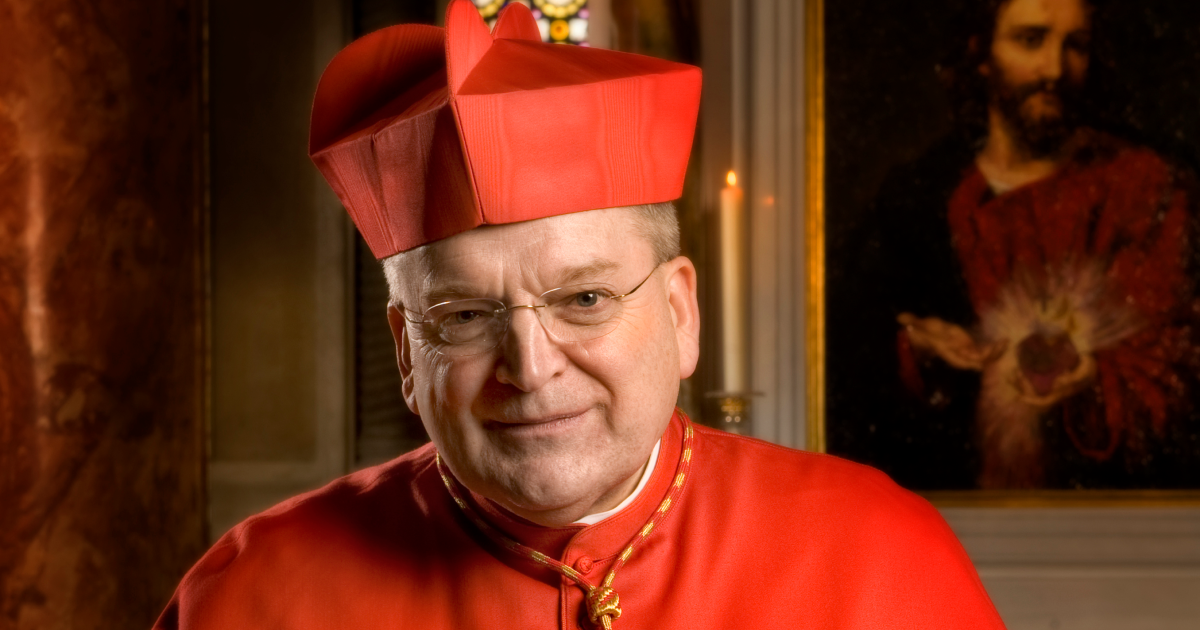
Christmas has always been a moment when the Church pauses to remember not only what she believes, but why she believes it. The modern situation of the Church is sometimes marked by doctrinal confusion, ecclesial tension and cultural volatility, but the Feast of the Incarnation forces a reckoning with truth, with authority, and with the enduring claims of Christ upon His Church. Few voices embody that reckoning more visibly than Cardinal Raymond Leo Burke.

Once Prefect of the Supreme Tribunal of the Apostolic Signatura and a central figure in some of the most contested debates of recent Catholic life, Cardinal Burke has become, for many Catholics, a symbol, sometimes controversial and often misunderstood, of continuity, clarity and resistance to theological drift. As the Church enters a new pontificate under Pope Leo XIV, and as questions surrounding liturgy, authority, youth and tradition press ever more urgently, Burke’s words carry a particular weight.

In this Christmas Day conversation, recorded for The Catholic Herald, Cardinal Burke speaks about the mystery of the Nativity, his experience of the conclave, his hopes for the Church, and the surprising re-emergence of young Catholics drawn to tradition rather than novelty and spectacle.

CH: Your Eminence, Christmas is upon us, and at its heart stands the mystery of the Word made flesh. As the Church prepares to celebrate the Nativity in a moment marked by cultural anxiety and ecclesial strain, what do you believe Catholics are especially called to remember, or perhaps to recover, today?

Cardinal Burke: I think we are called above all to remember the simple and fundamental truth that God the Son has become man. In the Incarnation, He has united our human nature to His divine nature. He has suffered, died, risen from the dead, ascended to the right hand of the Father, and He is alive with us now, present in the Church and active in the world.

For that reason, Catholics should be filled with hope. At the same time, we must resist the temptation to discouragement, or even to abandoning the living of our Catholic faith and the Christian life. The world today presents so many trials, wars and civil conflicts, along with very serious moral problems. In such circumstances, even good Christians can become discouraged, or feel tempted to withdraw from the world altogether.

But we know that Our Lord is with us. We are in the world, and we are called, with hope and with courage, to persevere. As Saint Paul exhorts us, we must “fight the good fight”, stay the course, and be heralds of the truth of Christmas in everything we say and do: that Christ has come, that He remains with us, and that He will be with us until He returns in glory on the last day.

CH: If I may turn from the universal to the personal for a moment: when you think back to your own childhood, is there a particular Christmas tradition or memory that has stayed with you, something that still shapes how you experience the feast now?

CB: When I think back to my childhood, one memory stands out very clearly: going to Midnight Mass. There was always such excitement at home. I was the youngest of six children, and thanks be to God, we were raised by devout Catholic parents.

We would always open our presents on Christmas Eve before going to Mass, as you can imagine, something children think about quite a lot [laughs]. And then we would go together to Midnight Mass. It was always very beautiful, even in our rural community. The local church, the music, the ceremony, all of it made a deep impression on me. Those celebrations of Midnight Mass remain my most cherished Christmas memories.

CH: Without breaching the confidentiality of the conclave, could you reflect on your experience of participating in the election of Pope Leo XIV? What struck you most about the spiritual atmosphere of that moment, and how did it shape your sense of responsibility as a cardinal elector?

CB: As you know, the conclave itself is fundamentally a liturgical act. The cardinals are vested in full choir dress, as is fitting, and the entire process is framed by prayer. We begin by celebrating Holy Mass together, and during the conclave itself, in the Sistine Chapel, we pray the hours of the Divine Office.

At the very beginning of the conclave, there is also a formal exhortation. On this occasion, it was given by the former preacher of the Papal Household, Father Raniero Cantalamessa. What struck me most deeply was the gravity of the responsibility entrusted to us: the task of choosing a successor of Saint Peter.

That gravity was felt especially keenly because of the particular circumstances of this conclave. The College of Cardinals had become very large, thirteen above the norm of 120, from which Pope Francis had dispensed in order to create additional cardinals. At the same time, we had not held an extraordinary consistory for over ten years. Those consistories are normally the occasions when cardinals come to know one another better and exercise their role as counsellors to the pope, sometimes described as a kind of “papal senate”.

As a result, many of us did not know one another well. That fact intensified the sense of responsibility, and it was something many cardinals remarked upon. I felt it very strongly myself. Still, we trusted, and continue to trust, in the presence of the Holy Spirit in the conclave. And, of course, as we often say, it is one thing for the Holy Spirit to be present; it is another for the cardinals to be obedient to Him. We trust that this obedience was given.

CH: When Benedict XVI was elected, I remember feeling particularly close to him, not only because he was German, but also because we had followed him for years and he was not a new name to us. Do you feel a similar closeness to Pope Leo XIV because he is American?

CB: You know, some stories circulated on social media suggesting that we met frequently or that I was especially close to Pope Leo. That simply was not the case. I had met him once briefly after he completed his term as Prior General of the Augustinians, and then once more here in Rome after he became Prefect of the Dicastery for Bishops.

That said, I do feel a natural affinity with him. He was raised in South Chicago, in the Midwest, where I am from as well, although I come from a farming background and he from the city, and he is several years younger than I am. Still, we share something of the same cultural and ecclesial background.

It is also important to remember that while Pope Leo was born and raised in the United States and received his early seminary formation there, he spent roughly thirty years in Peru, both as a missionary and later as a bishop. In that sense, he is deeply shaped by South American ecclesial life as well. I think many of the South American cardinals see him very much as one of their own, just as I do as a North American. His experience bridges both worlds.

CH: Many Catholics, and not a few young Catholics, remain concerned about the place of the traditional Latin Mass in the life of the Church today. How do you assess its role, and what pastoral approach do you consider most faithful both to tradition and to ecclesial unity?

CB: I believe that Pope Benedict XVI provided the most correct direction and legislation for the relationship between the more ancient usage of the Roman Rite and the more recent usage, what is often called the ordinary form of the Roman Rite. His guiding principle was that both forms should be celebrated in their integrity and according to their very nature as divine worship.

As Pope Benedict made clear in Summorum Pontificum, the more ancient form of the Roman Rite, which was in use for roughly fifteen centuries, from the time of Pope Gregory the Great and even before, nourished the spiritual life of countless saints, confessors, martyrs, great theologians, great spiritual writers, and all the faithful. This heritage can never be lost. In all its beauty and goodness, it is a treasure that the Church must always conserve and promote.

What we see today is very telling. Many young people, who did not grow up with this more ancient usage, discover it later in life and find it deeply spiritually nourishing, both for themselves and for their families. My hope, therefore, is that the wisdom of Pope Benedict XVI will be retrieved, so to speak, and that there can once again be a wider usage of both forms of the Roman Rite, always celebrated reverently, always understood as the action of Christ Himself, who renews sacramentally His sacrifice on Calvary. I am convinced that this will bring great blessings to the Church.

CH: Under Benedict XVI, many Catholics felt that there was something like a period of “liturgical peace”. Perhaps we may hope for that again?

CB: Yes, indeed. That peace was experienced in many places, and it can be restored.

CH: Recent studies suggest that so-called “Generation Z”, those born roughly from the mid 1990s to the mid 2010s, are more religiously and morally conservative than previous generations. This is evident in rising church attendance, not only in the United States but internationally. In England, for instance, practising Catholics now outnumber practising Anglicans. It took five hundred years, but we are back. How do you interpret this phenomenon? Does it surprise you?

CB: It does not surprise me at all. This generation has grown up in a society that is morally and spiritually bankrupt. They have seen the fruits of living as if God did not exist, of living, as Saint John Paul II said, according to whatever pleases us at any given moment rather than according to what God asks of us.

Young people have experienced the emptiness of this way of life. And so they are searching for something solid, for truth, beauty and goodness. Naturally, they are drawn to the living tradition of the Church: the faith handed on from the Apostles, the Church’s divine worship, and her moral teaching.

My own generation was blessed to grow up in a time of greater stability in these areas. It was not a perfect era, there never is one, but divine worship, moral teaching and doctrinal clarity were largely taken for granted. Over time, many of these treasures were neglected or abandoned, to the impoverishment of subsequent generations.

Now young people want to retrieve what was lost. I see this as an expression of baptismal grace, the work of the Holy Spirit stirring the heart that longs to know God, to love Him and to serve Him. As Saint Augustine prayed to Our Lord in his Confessions, “our hearts are restless until they rest in You”.

CH: What strikes me is that this rediscovery among the young also creates a kind of responsibility flowing backward. Parents and grandparents suddenly realise that they possess something precious, something the younger generation desires, and that they have a duty to pass it on.

CB: Absolutely.

CH: Many people read interviews like this in a polemical spirit, especially when questions of Church and politics arise. How can the Church best respond to young Catholics today without reducing the faith to political or sociological categories? At the same time, Christians must live in society, engage public life and be, as Our Lord says, the salt of the earth. How should this balance be struck?

CB: The Church must always begin with what she is: the instrument of Christ’s saving work. The faith can never be reduced to a political programme or a sociological movement. At the same time, faith necessarily shapes how we live in the world, how we act in society, how we pursue justice, how we defend human dignity.

The balance is achieved when politics is understood as flowing from faith, not replacing it. When the faith is reduced to ideology, it is emptied of its power. But when faith is lived fully, in worship, in the moral life and in charity, it naturally becomes leaven in society. That is how Christians truly transform the world: not by politicising the Gospel, but by living it.

CH: On the one hand, we must not turn the faith into politics; on the other, Christians live in society, engage in public life and are called to be the leaven and the salt of the earth. How can that balance be achieved today? How can the Church best respond to young Catholics without reducing the faith to political or sociological categories? In other words, how does the Church strike the right balance? Is there one element that you find particularly important or striking from your own experience?

CB: I believe that the most important task before us is to deepen our understanding of the truths of the faith as they have been taught, in an unbroken line, throughout the Christian centuries. Today, many people are very poorly catechised. For decades now, catechesis has often been reduced to what might be called a “feel-good” approach, but without substance. Why should I feel good? I should feel good because I know God’s law, and I am striving to live according to it.

At the same time, we now possess a powerful tool in social media. It can be used for very harmful purposes, to spread falsehoods and confusion, but it can also be used in a very positive way: to help people deepen their understanding of the Church’s teaching and to apply that teaching to the concrete circumstances of life.

This is not a matter of sentimentality, nor of aligning oneself emotionally with one political party or movement or another. Our allegiance is to Christ the King. And we strive, then, to be faithful subjects of Christ in the concrete circumstances in which we live.

Yet instead of drawing on this rich teaching, public discussion often degenerates into emotional outbursts or diatribes against one politician or another. If we truly apply the Church’s teaching, we will arrive at solutions that are just for everyone involved.

CH: I have to ask a polemical question at the end: what is your favourite Christmas carol?

CB: [laughs] That is a very good question. I am particularly fond of the Coventry Carol. Of course, there are many others we have sung for years, Silent Night, Joy to the World, and so forth, but Christmas music is extraordinarily rich. Still, I think I would choose the Coventry Carol, which should be pleasing here in England.
Christmas has always been a moment when the Church pauses to remember not only what she believes, but why she believes it. The modern situation of the Church is sometimes marked by doctrinal confusion, ecclesial tension and cultural volatility, but the Feast of the Incarnation forces a reckoning with truth, with authority, and with the enduring claims of Christ upon His Church. Few voices embody that reckoning more visibly than Cardinal Raymond Leo Burke.

Once Prefect of the Supreme Tribunal of the Apostolic Signatura and a central figure in some of the most contested debates of recent Catholic life, Cardinal Burke has become, for many Catholics, a symbol, sometimes controversial and often misunderstood, of continuity, clarity and resistance to theological drift. As the Church enters a new pontificate under Pope Leo XIV, and as questions surrounding liturgy, authority, youth and tradition press ever more urgently, Burke’s words carry a particular weight.

In this Christmas Day conversation, recorded for The Catholic Herald, Cardinal Burke speaks about the mystery of the Nativity, his experience of the conclave, his hopes for the Church, and the surprising re-emergence of young Catholics drawn to tradition rather than novelty and spectacle.

CH: Your Eminence, Christmas is upon us, and at its heart stands the mystery of the Word made flesh. As the Church prepares to celebrate the Nativity in a moment marked by cultural anxiety and ecclesial strain, what do you believe Catholics are especially called to remember, or perhaps to recover, today?

Cardinal Burke: I think we are called above all to remember the simple and fundamental truth that God the Son has become man. In the Incarnation, He has united our human nature to His divine nature. He has suffered, died, risen from the dead, ascended to the right hand of the Father, and He is alive with us now, present in the Church and active in the world.

For that reason, Catholics should be filled with hope. At the same time, we must resist the temptation to discouragement, or even to abandoning the living of our Catholic faith and the Christian life. The world today presents so many trials, wars and civil conflicts, along with very serious moral problems. In such circumstances, even good Christians can become discouraged, or feel tempted to withdraw from the world altogether.

But we know that Our Lord is with us. We are in the world, and we are called, with hope and with courage, to persevere. As Saint Paul exhorts us, we must “fight the good fight”, stay the course, and be heralds of the truth of Christmas in everything we say and do: that Christ has come, that He remains with us, and that He will be with us until He returns in glory on the last day.

CH: If I may turn from the universal to the personal for a moment: when you think back to your own childhood, is there a particular Christmas tradition or memory that has stayed with you, something that still shapes how you experience the feast now?

CB: When I think back to my childhood, one memory stands out very clearly: going to Midnight Mass. There was always such excitement at home. I was the youngest of six children, and thanks be to God, we were raised by devout Catholic parents.

We would always open our presents on Christmas Eve before going to Mass, as you can imagine, something children think about quite a lot [laughs]. And then we would go together to Midnight Mass. It was always very beautiful, even in our rural community. The local church, the music, the ceremony, all of it made a deep impression on me. Those celebrations of Midnight Mass remain my most cherished Christmas memories.

CH: Without breaching the confidentiality of the conclave, could you reflect on your experience of participating in the election of Pope Leo XIV? What struck you most about the spiritual atmosphere of that moment, and how did it shape your sense of responsibility as a cardinal elector?

CB: As you know, the conclave itself is fundamentally a liturgical act. The cardinals are vested in full choir dress, as is fitting, and the entire process is framed by prayer. We begin by celebrating Holy Mass together, and during the conclave itself, in the Sistine Chapel, we pray the hours of the Divine Office.

At the very beginning of the conclave, there is also a formal exhortation. On this occasion, it was given by the former preacher of the Papal Household, Father Raniero Cantalamessa. What struck me most deeply was the gravity of the responsibility entrusted to us: the task of choosing a successor of Saint Peter.

That gravity was felt especially keenly because of the particular circumstances of this conclave. The College of Cardinals had become very large, thirteen above the norm of 120, from which Pope Francis had dispensed in order to create additional cardinals. At the same time, we had not held an extraordinary consistory for over ten years. Those consistories are normally the occasions when cardinals come to know one another better and exercise their role as counsellors to the pope, sometimes described as a kind of “papal senate”.

As a result, many of us did not know one another well. That fact intensified the sense of responsibility, and it was something many cardinals remarked upon. I felt it very strongly myself. Still, we trusted, and continue to trust, in the presence of the Holy Spirit in the conclave. And, of course, as we often say, it is one thing for the Holy Spirit to be present; it is another for the cardinals to be obedient to Him. We trust that this obedience was given.

CH: When Benedict XVI was elected, I remember feeling particularly close to him, not only because he was German, but also because we had followed him for years and he was not a new name to us. Do you feel a similar closeness to Pope Leo XIV because he is American?

CB: You know, some stories circulated on social media suggesting that we met frequently or that I was especially close to Pope Leo. That simply was not the case. I had met him once briefly after he completed his term as Prior General of the Augustinians, and then once more here in Rome after he became Prefect of the Dicastery for Bishops.

That said, I do feel a natural affinity with him. He was raised in South Chicago, in the Midwest, where I am from as well, although I come from a farming background and he from the city, and he is several years younger than I am. Still, we share something of the same cultural and ecclesial background.

It is also important to remember that while Pope Leo was born and raised in the United States and received his early seminary formation there, he spent roughly thirty years in Peru, both as a missionary and later as a bishop. In that sense, he is deeply shaped by South American ecclesial life as well. I think many of the South American cardinals see him very much as one of their own, just as I do as a North American. His experience bridges both worlds.

CH: Many Catholics, and not a few young Catholics, remain concerned about the place of the traditional Latin Mass in the life of the Church today. How do you assess its role, and what pastoral approach do you consider most faithful both to tradition and to ecclesial unity?

CB: I believe that Pope Benedict XVI provided the most correct direction and legislation for the relationship between the more ancient usage of the Roman Rite and the more recent usage, what is often called the ordinary form of the Roman Rite. His guiding principle was that both forms should be celebrated in their integrity and according to their very nature as divine worship.

As Pope Benedict made clear in Summorum Pontificum, the more ancient form of the Roman Rite, which was in use for roughly fifteen centuries, from the time of Pope Gregory the Great and even before, nourished the spiritual life of countless saints, confessors, martyrs, great theologians, great spiritual writers, and all the faithful. This heritage can never be lost. In all its beauty and goodness, it is a treasure that the Church must always conserve and promote.

What we see today is very telling. Many young people, who did not grow up with this more ancient usage, discover it later in life and find it deeply spiritually nourishing, both for themselves and for their families. My hope, therefore, is that the wisdom of Pope Benedict XVI will be retrieved, so to speak, and that there can once again be a wider usage of both forms of the Roman Rite, always celebrated reverently, always understood as the action of Christ Himself, who renews sacramentally His sacrifice on Calvary. I am convinced that this will bring great blessings to the Church.

CH: Under Benedict XVI, many Catholics felt that there was something like a period of “liturgical peace”. Perhaps we may hope for that again?

CB: Yes, indeed. That peace was experienced in many places, and it can be restored.

CH: Recent studies suggest that so-called “Generation Z”, those born roughly from the mid 1990s to the mid 2010s, are more religiously and morally conservative than previous generations. This is evident in rising church attendance, not only in the United States but internationally. In England, for instance, practising Catholics now outnumber practising Anglicans. It took five hundred years, but we are back. How do you interpret this phenomenon? Does it surprise you?

CB: It does not surprise me at all. This generation has grown up in a society that is morally and spiritually bankrupt. They have seen the fruits of living as if God did not exist, of living, as Saint John Paul II said, according to whatever pleases us at any given moment rather than according to what God asks of us.

Young people have experienced the emptiness of this way of life. And so they are searching for something solid, for truth, beauty and goodness. Naturally, they are drawn to the living tradition of the Church: the faith handed on from the Apostles, the Church’s divine worship, and her moral teaching.

My own generation was blessed to grow up in a time of greater stability in these areas. It was not a perfect era, there never is one, but divine worship, moral teaching and doctrinal clarity were largely taken for granted. Over time, many of these treasures were neglected or abandoned, to the impoverishment of subsequent generations.

Now young people want to retrieve what was lost. I see this as an expression of baptismal grace, the work of the Holy Spirit stirring the heart that longs to know God, to love Him and to serve Him. As Saint Augustine prayed to Our Lord in his Confessions, “our hearts are restless until they rest in You”.

CH: What strikes me is that this rediscovery among the young also creates a kind of responsibility flowing backward. Parents and grandparents suddenly realise that they possess something precious, something the younger generation desires, and that they have a duty to pass it on.

CB: Absolutely.

CH: Many people read interviews like this in a polemical spirit, especially when questions of Church and politics arise. How can the Church best respond to young Catholics today without reducing the faith to political or sociological categories? At the same time, Christians must live in society, engage public life and be, as Our Lord says, the salt of the earth. How should this balance be struck?

CB: The Church must always begin with what she is: the instrument of Christ’s saving work. The faith can never be reduced to a political programme or a sociological movement. At the same time, faith necessarily shapes how we live in the world, how we act in society, how we pursue justice, how we defend human dignity.

The balance is achieved when politics is understood as flowing from faith, not replacing it. When the faith is reduced to ideology, it is emptied of its power. But when faith is lived fully, in worship, in the moral life and in charity, it naturally becomes leaven in society. That is how Christians truly transform the world: not by politicising the Gospel, but by living it.

CH: On the one hand, we must not turn the faith into politics; on the other, Christians live in society, engage in public life and are called to be the leaven and the salt of the earth. How can that balance be achieved today? How can the Church best respond to young Catholics without reducing the faith to political or sociological categories? In other words, how does the Church strike the right balance? Is there one element that you find particularly important or striking from your own experience?

CB: I believe that the most important task before us is to deepen our understanding of the truths of the faith as they have been taught, in an unbroken line, throughout the Christian centuries. Today, many people are very poorly catechised. For decades now, catechesis has often been reduced to what might be called a “feel-good” approach, but without substance. Why should I feel good? I should feel good because I know God’s law, and I am striving to live according to it.

At the same time, we now possess a powerful tool in social media. It can be used for very harmful purposes, to spread falsehoods and confusion, but it can also be used in a very positive way: to help people deepen their understanding of the Church’s teaching and to apply that teaching to the concrete circumstances of life.

This is not a matter of sentimentality, nor of aligning oneself emotionally with one political party or movement or another. Our allegiance is to Christ the King. And we strive, then, to be faithful subjects of Christ in the concrete circumstances in which we live.

Yet instead of drawing on this rich teaching, public discussion often degenerates into emotional outbursts or diatribes against one politician or another. If we truly apply the Church’s teaching, we will arrive at solutions that are just for everyone involved.

CH: I have to ask a polemical question at the end: what is your favourite Christmas carol?

CB: [laughs] That is a very good question. I am particularly fond of the Coventry Carol. Of course, there are many others we have sung for years, Silent Night, Joy to the World, and so forth, but Christmas music is extraordinarily rich. Still, I think I would choose the Coventry Carol, which should be pleasing here in England.
share

subscribe to the catholic herald today

Our best content is exclusively available to our subscribers. Subscribe today and gain instant access to expert analysis, in-depth articles, and thought-provoking insights—anytime, anywhere. Don’t miss out on the conversations that matter most.
Subscribe