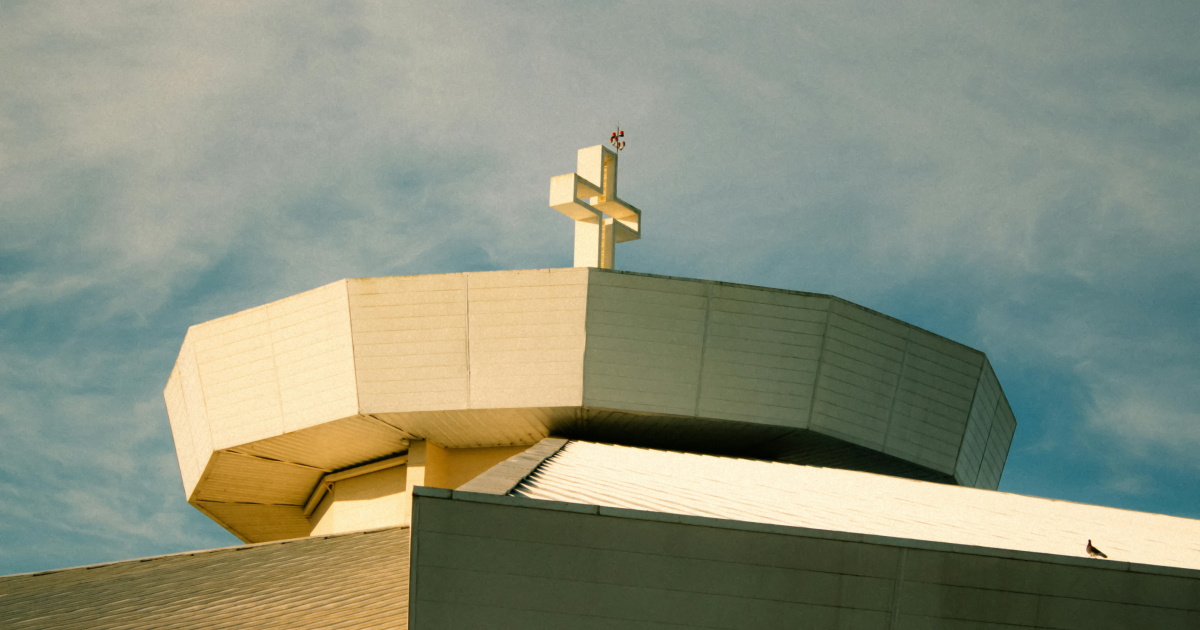


For many Catholics, the experience is familiar and disquieting: newly built churches that feel more like conference centres than places of worship, stripped of ornament, symbolism and the Holy. The question of ugliness in modern church architecture is often dismissed as a matter of taste or nostalgia. Yet for David Clayton, artist, educator and one of the most articulate contemporary defenders of traditional Catholic aesthetics, the issue runs far deeper. At stake is not merely style, but theology: how the Church understands worship, the human person and the relationship between beauty and truth.
In this conversation, Clayton argues that modern ecclesial ugliness reflects a loss of Catholic inculturation, a failure of formation, especially in seminaries, and a philosophical rupture that predates the Second Vatican Council by more than a century. Drawing on Benedict XVI, classical harmony and proportion and the liturgical traditions of East and West, he makes the case that beauty is not decoration but necessity: a formative power that shapes belief, prayer and even faith itself.
Jan C. Bentz (JCB): Many modern churches appear deliberately resistant to beauty, ornament and symbolic density. Do you think this widespread ugliness is primarily a failure of taste, or does it reflect a deeper theological, or even anthropological, confusion about what a church actually is?
David Clayton (DC): It is, I would say, a combination of all three. There is certainly a failure of taste, but that failure itself is rooted in something deeper: a loss of awareness of Catholic tradition and of how that tradition is inseparable from theology and anthropology, specifically, the Church’s understanding of what man is and what worship does to him.
We have become dislocated from our own inheritance. That rupture is largely the result of inadequate education and formation among Catholics today, and unfortunately this includes the formation of priests in seminaries, where these questions are often not given the attention they deserve. One of the most significant gaps is a lack of understanding of form, by which I mean not simply what is depicted, but how it is depicted. Style, proportion, harmony and architectural language all express a philosophical and theological world-view.
When this connection is lost, architecture and art are reduced to matters of personal taste. And taste, when it is not properly formed, becomes highly susceptible to contemporary trends and cultural fashion. People end up liking what they think they ought to like, rather than judging according to universal principles. At that point, beauty no longer refers to reality but to preference. That, I think, is at the heart of the problem.
JCB: You mentioned formation, especially in seminaries. Do you think there is an active lack of education in these areas? Should seminaries be more intentional about teaching beauty across architecture, art and music?
DC: Yes, very much so. Seminarians may encounter aesthetics in a philosophical sense, but what is really needed is a deeper Catholic inculturation. They need to be formed within a living tradition, not simply taught concepts in isolation. If you look at Orthodox or Byzantine Catholic priestly formation, the contrast is striking. Their clergy are required to understand what icons belong in a church, how iconographic schemas function and how art, architecture and liturgy work together as a unified whole. They are formed liturgically in a very concrete way. By comparison, Roman seminaries often teach what the liturgy is without sufficiently explaining how architecture, music and visual art are ordered towards it. There is, in short, a significant gap in formation. Without that integration, priests are left unequipped to make informed decisions about church buildings, and the results are all around us.
JCB: Do you see a connection between this loss of formation and a post-conciliar loss of confidence in symbolism, transcendence and tradition more broadly?
DC: Yes, but it is essential to be precise here. This is not the fault of the Second Vatican Council itself. Rather, the Council was used as a pretext by those who already wished to introduce changes, often in ways that directly contradicted what the Council actually taught.
Following Benedict XVI, especially in The Spirit of the Liturgy, I would trace the deeper roots of this problem back to the early nineteenth century. The real issue lies in a distorted understanding of worship itself and in the separation of liturgy from the artistic forms that properly belong to it.
Architecture is not merely a neutral container for worship. The church building actively forms those who worship within it. Its structure, orientation and beauty guide the faithful towards participation in the liturgy. When this formative role is forgotten, worship becomes increasingly internalised and cerebral, almost purely intellectual.
As long as liturgical structures were fixed and immovable, they exercised a kind of corrective force. But once change was permitted without sufficient theological grounding, the floodgates opened. What we saw after the Council was not a sudden rupture but the acceleration of a trajectory long in the making.
JCB: Turning to architecture more directly: are modern movements such as functionalism or Brutalism fundamentally incompatible with Catholic liturgical theology?
DC: Yes, because these movements are grounded in materialist philosophies. They fail to acknowledge the metaphysical and spiritual dimension of the human person. Ironically, they are not even functional in the fullest sense, because they do not fulfil the true function of a church, which includes nourishing the spiritual life of those who worship there.
Utility has been reduced to purely material concerns: keeping out the rain, ensuring audibility and accommodating bodies. Those things matter, of course, but they are not sufficient. Beauty is not optional. It is essential, because it raises hearts and minds to God.
And not just any beauty will do. A railway station can be beautiful, but beautiful as a railway station. A church must be beautiful as a church. Its form must be ordered towards worship, towards encounter with Christ in the Eucharist.
Brutalist architecture, in particular, quite literally brutalises man by reducing him to a creature with purely material needs. Designing a church according to such principles is therefore incoherent.
Traditional harmony and proportion presuppose that beauty is objective, that it is rooted in reality itself, even though it is perceived subjectively. This assumption was undermined by Enlightenment philosophy, especially by Kant’s separation of perception from reality. Once that happens, beauty becomes merely emotional response.
Those ideas eventually filtered into architecture schools. By the mid-twentieth century, traditional harmony and proportion were no longer taught. Interestingly, many architects understood they were rejecting Christianity long before Christians themselves recognised it.
JCB: Defenders of modernist simplicity often argue that it fosters humility and prayer. How would you respond?
DC: Accessibility is important. People should not need a university education to respond to beauty. Traditional forms achieve this remarkably well, but they are not simple. They are complex, in the same way that the cosmos is complex: immediately accessible, yet inexhaustible.
The claim that complexity distracts is ancient. It goes back at least to the iconoclastic controversies, and even figures such as St Bernard worried that beauty might draw attention to itself. But authentic beauty does not trap the gaze; it draws us beyond itself, towards its source, who is God.
Experience overwhelmingly confirms this. The forms that have endured in Christian worship are not simplistic designs but richly ordered ones, capable of forming the soul precisely because of their depth.
JCB: Finally, on a practical level: if a parish or diocese were to build or renovate a church today, what principles should guide the project?
DC: The first principle is to find the right architect, someone deeply immersed in tradition. Whether classical or Gothic matters less than whether the architect truly understands a living tradition. But it is equally important not to reproduce the past uncritically.
Here I follow the guidance of Pius XII and Benedict XVI’s hermeneutic of continuity. We do not change forms unless we must. Modern elements may be incorporated, but only if they genuinely serve the needs of the worshipping community.
The liturgy is the wellspring of Catholic culture. Architecture, art and music must flow from it. Only then can the Church engage modern culture discerningly, rejecting what is harmful and integrating what is good.
If we begin with worship, grace will do the rest. Beauty will attract. And from that beauty, a truly Catholic culture can once again emerge.