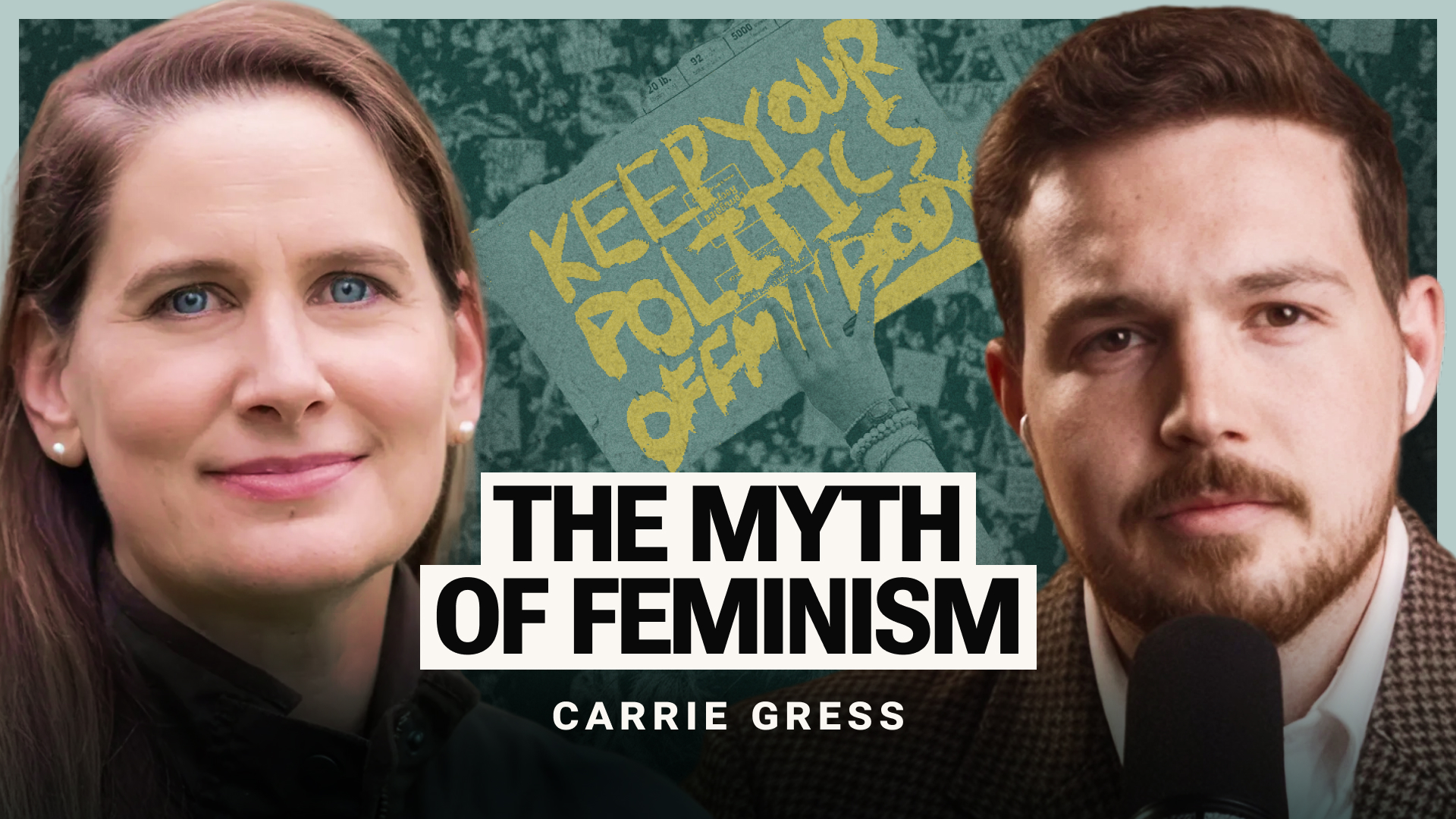


Dr Carrie Gress, author of The End of Woman and the newly published Something Wicked, joined David Hahn this week to make a case that will unsettle plenty of listeners: feminism, she argues, was never really a grassroots movement for women at all, and its foundations lie in envy, contempt for men and a deliberate break from Christianity.
Gress traces the movement back to Mary Wollstonecraft, whom she calls "the feminist grandmother," and argues that the popular story of feminism winning women their education and independence does not match the historical record. Women were already receiving educations before Wollstonecraft wrote, she points out, citing Elizabeth Ann Seton's foundation of America's first parochial schools and the Ursuline nuns who educated both slaves and Native American girls in New Orleans. The real engine of change, she says, was the industrial revolution, which gave ordinary people discretionary income and time for the first time. What Wollstonecraft actually offers, in Gress's reading, is an anthropology built on envy, the idea that men are contemptible and women must become like them. She calls it "fundamentally about envy" and links it directly to Marxism, noting that feminism grew up alongside socialism and communism and has been woven through both movements for two centuries. She points to recent data suggesting only 60 per cent of women now want to marry as evidence of the anthropology's ongoing cost, calling the whole movement "a bit of a Trojan horse."
Pressed on whether the movement was at least a justified response to real abuse, given that Wollstonecraft's own father was an alcoholic, Gress does not concede the point. "Has feminism gotten rid of drunk men? Abusive husbands? Men who are cads?" she asks, arguing it has made things worse by encouraging women to be promiscuous and "behave like bad men" rather than addressing the underlying brokenness. She places Wollstonecraft's writing firmly in the context of the French Revolution, which she supported, and argues that England's intellectual climate at the time, shaped by David Hume's philosophy that reduced all value to property, is what actually produced the "women as property" framing Wollstonecraft was reacting against. She cites Jane Austen and Hannah More as contemporaries who saw the same problem without concluding that everything needed tearing down.
Gress is equally sceptical of attempts to redeem the term for Christians. Efforts to build a "Christian feminism" on Pope John Paul II's theology of the body, she argues, misread what he actually wrote, since his framework in Genesis 1 does not map onto feminist categories at all, comparing the attempt to imagining a "Catholic Marxism." The deeper error, in her view, is that feminism fixates on the "accidents" of womanhood, things like bank accounts and legal rights that never actually required overhauling male and female anthropology, while the real substance of womanhood, bound up with fertility and motherhood, has been allowed to slip away. She points to the row over male athletes in the WNBA as the logical endpoint of that confusion.
On a more personal note, Gress, who did not marry until she was almost thirty five, offers advice to women still waiting on marriage: resist making it an idol, and focus instead on becoming a woman others want to be around rather than an angry, envious competitor. She speaks warmly of staying friends with men she dated before meeting her husband, crediting "ordered" friendship for relationships that outlasted the romance, and reflects on how having children forces couples out of individualism and into sacrifice for a shared good, calling the exhausting parts of early motherhood "a feature, not a flaw."
The interview's most surprising turn is Gress's account of the men behind feminism's founding ideas. She points to the Romantic poet Percy Bysshe Shelley, Mary Wollstonecraft's son in law by his marriage to Mary Godwin, as the architect of a key strand, arguing his poetry, written partly to justify his own opposition to monogamy, wove together contempt for men, promiscuity and the occult in a single character, an anthropology later carried forward by figures such as Madame Blavatsky and Elizabeth Cady Stanton. Gress argues the same three markers, hostility to men, promiscuity and occult practice, still describe many young women on campuses today, and offers a theological reading of why: each one, she says, severs a woman's relationship with a different Person of the Trinity, cutting off God the Father through contempt for men, the Holy Spirit through promiscuity and Christ's authority through the occult.
From there, Gress traces a line through twentieth century politics. Communists and feminists, she says, initially distrusted one another but by the 1920s recognised a shared goal in dismantling the family and Christian faith, a partnership she credits with helping establish International Women's Day. She points to Herbert Marcuse and Wilhelm Reich's writing on the sexual revolution, and to their students Kate Millett and Angela Davis, as the figures who recast Marxist class conflict as conflict between the sexes. She also revisits the campaign that put abortion on the platform of the National Organization for Women, crediting Bernard Nathanson and Lawrence Lader with pressuring Betty Friedan into the position that helped pave the way for Roe v Wade. Feminism, Gress concludes, serves bad men by giving cover to abortion, trafficking and pornography, while silencing good men whose instincts to protect and provide have been dismissed as toxic.
Gress ends on a note of cautious optimism. Vulnerability, she argues, is the genius of femininity that feminism trained women out of, and she sees younger women increasingly rejecting the "power suit" model their mothers were sold. Her prescription is not a reformed feminism but the abandonment of the word altogether, following what she says was John Paul II's own practice of using the term only a handful of times across his pontificate. She credits the trans movement, however uncomfortably, with forcing a wider cultural reckoning with what womanhood actually means.
What ties the conversation together is Gress's insistence that feminism was never really a women's movement at all, but an anthropology, first sketched by a Romantic poet justifying his own infidelities, later adopted by communists chasing a revolution and lobbyists chasing a legal platform, and never seriously tested against Christian theology until now. Her case is provocative and not every reader will agree with it, but it reframes the whole debate, from "was feminism good for women" to "who actually built it, and for what."