


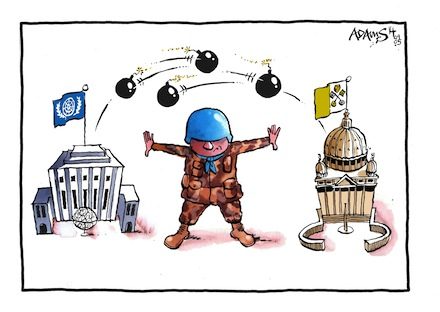
The United Nations is a strange beast: many of its 193 member states have a religiously conservative character, but its bureaucracy tends to regard religious traditions as a regrettable obstacle to the international enforcement of human rights. It’s little wonder that UN bureaucrats tend to embrace an extreme philosophy of moral autonomy when they are constantly surrounded by a well-funded army of bodies seeking to swing the UN brand behind their radical agendas. The Holy See does not sit easily within this framework. It is not, of course, a UN member state, but rather a permanent observer. It is in this capacity that it has signed various UN treaties, which are now being used to wage a public relations war against the Holy See and even, in some instances, the Catholic faith itself. Last February the UN Committee on the Rights of the Child savaged the Holy See’s handling of clerical abuse. Some of its criticism was, of course, valid. But rather than suggesting effective means of combating the abuse, the committee instead urged the Church to promote abortion and even offered advice on how it should interpret Scripture related to corporal punishment. As Archbishop Silvano Tomasi put it, it was “almost as if they wanted to teach theology to the Vatican”. On Monday, what was billed as round two of the battle between the Vatican and the UN system began, when the Holy See’s representative appeared before the UN Committee on the Convention against Torture. That committee is charged with opposing the degradation of prisoners around the world. But its members, too, seem to have succumbed to creeping ideological bias in recent years, railing against member states that restrict abortion. This time the Holy See not only anticipated the tendentious line of questioning, but also prepared well for it, mounting a small media offensive and circulating a briefing that responded crisply to the committee’s likely accusations. We will see how effective this strategy has been when the committee releases its report on May 23, shortly before Pope Francis’s visit to the Holy Land. Where does all this leave relations between the UN and the Holy See? On the face it, in a mess. But the UN is such a complex body that, while some of its committees wage ideological warfare against the Holy See, Francis himself seems to be building a strong relationship with the UN secretary general Ban Ki-moon. Indeed, the Pope will deliver a major address to the heads of UN agencies this very Saturday. While Francis is unlikely to address recent tensions directly, he may urge the UN to dedicate itself to its founding mission, which it has often strayed from since the Declaration on Human Rights was promulgated in 1948. There is little doubt that, in an age in which the most grotesque human rights abuses are reported daily, we need some kind of international forum that promotes the authentic dignity of every human being. Let’s hope that Francis is able to persuade the UN to be that institution. This article first appeared in the print edition of The Catholic Herald (9/5/14)
12:35 PM
Catholic Herald View: Let’s hope Francis can help the UN get back on course
United Nations bureaucracy tends to regard religious traditions as an obstacle to the international enforcement of human rights
The Catholic Herald

4 min read



Already a subscriber? Sign in
5freearticles every month
Continue reading with a free account. No card needed.
- Five free articles every thirty days, on any device you sign in on
- The Catholic Herald newsletter, every morning
- Subscribe whenever you like for everything: every article and the magazine
Related articles
 Newsroom
Church leaders urge Drumcree dialogue: ‘Too much is at stake’
The Catholic and Church of Ireland Archbishops of Armagh have urged a renewed commitment to peace and reconciliation amid the Drumcree stand-off
Corrie Douglas-Young Newsroom
Thousands of Irish children to join global Rosary campaign
Corrie Douglas-Young Newsroom
TikTok priest urges young people to stand with persecuted Christians
Nathalie Raffray Newsroom
Baby born at 25 weeks reunites with neonatologist two years after leaving hospital
The Catholic Herald Newsroom
Joe Biden honoured by Planned Parenthood after defending abortion rights
Christine Rousselle
subscribe to the catholic herald today
Our best content is exclusively available to our subscribers. Subscribe today and gain instant access to expert analysis, in-depth articles, and thought-provoking insights—anytime, anywhere. Don’t miss out on the conversations that matter most.
Subscribe



