

“Do you not know that in a race the runners all compete, but only one receives the prize? Run in such a way that you may win it. Athletes exercise self-control in all things; they do it to receive a perishable wreath, but we an imperishable one. So I do not run aimlessly, nor do I box as though beating the air; but I punish my body and enslave it, so that after proclaiming to others I myself should not be disqualified.” 1 Corinthians 9:24-27
Anyone who has ever skirted even close to the periphery of the Christian Faith’s intersection with sport will be justifiably rolling their eyes at the triteness of St Paul’s overused passage. He was speaking to an ancient Greek audience for whom athleticism and sport were an integral part of the nation’s philosophy and mythos. With the 2026 Fifa World Cup hitting billions of screens around the world this summer, we would be foolish to think our world is entirely different in this regard. It would similarly be wrongheaded to think that sport’s symbolic and analogous relationship with our religion is fruitless. Contemporary football shows this is not the case in surprising ways.
It’s perhaps highly significant that St Paul used σταδίῳ, transliterated and pronounced stadiō, for the term “race” in his passage to the Corinthians – declaring distinctly spectator-sport connotations. Football is the most-watched spectator sport of our era. And God’s relationship to it runs deep.
The athlete, to the ancient world, represented a particular vision of human excellence: striving towards a divinely ordered telos, patient formation and the pursuit of a prize not yet possessed – which, for the believing player, ultimately orients towards the Beatific Vision. All of this is quite congruent with Christian thinking, especially when natural ends are subordinated to supernatural ones. This goes some distance to explaining why contemporary football, for all its commercial gloss and occasional vulgarity, remains a surprisingly fertile field for Catholic expression.
It is all too easy to fall into tired truisms when talking about football and Christian Faith. I will endeavour not to do that. Attempting to avoid the usual tropes, Sacred Scripture and the Holy Ghost recognised in sport a pursuit of excellence – eudaimonia, blessedness, flourishing – as a form of training and witness. When an impressionable spectator or aspirational child sees the glorified heroes, as Odysseus and many of the Greek demigods, rendering back to the heavens gratitude for their gifts in piety, it can have a profound effect. When audiences, in admiration of the sportsmen’s flourish and self-mastery, view their idols demonstrating a character which appears to extend their laudable competence in physical matters to rarely seen spiritual behaviours, the mimetic power this can have is great.
Contemporary football is an increasingly modern spectacle: globalised, commercialised, politicised and soullessly professional. Yet for all the wealth, analytics and corporate branding that now surround the game, elite football remains one of the few genuinely global institutions in which overt religious belief continues to appear boldly and often sincerely. In an age where many cultural elites treat faith as a private eccentricity, footballers continue to cross themselves before entering the pitch, kneel in prayer before kick-off, point, as Raúl Jiménez, who netted the tournament’s second goal in its opening game for Mexico against South Africa, did, heavenwards after scoring and speak openly about God before audiences numbering in the hundreds of millions.
Indeed, the United States and Mexico, two of the host nations at this year’s noted tournament, have produced in Christian Pulisic and Javier Hernández figures whose careers illuminate football’s enduring relationship with Catholicism. Hernández, known throughout the footballing world as Chicharito, has long spoken openly about God, providence and gratitude.
Hernández, the Mexican striker whose kneeling prayer before kick-off became a familiar sight at Manchester United and beyond, began the ritual at a low point when he nearly quit the game as a young man. “I started praying before games when I was considering quitting,” he explained. “I feel he’s helped me a lot and is always there. That’s why I always say thank you before kick-off, for letting me play in another game.” A devout Roman Catholic, with public gratitude he persistently refused to reduce his success to self alone. Though still playing, being in the twilight of his career he is not accompanying Mexico as part of their squad this tournament, but his legacy as its all-time top goalscorer, with 52 goals, and his career which spanned playing for Real Madrid and in the top leagues in Germany, England, Spain, the United States and Mexico leaves him with one of the most pronounced legacies of any contemporary player.
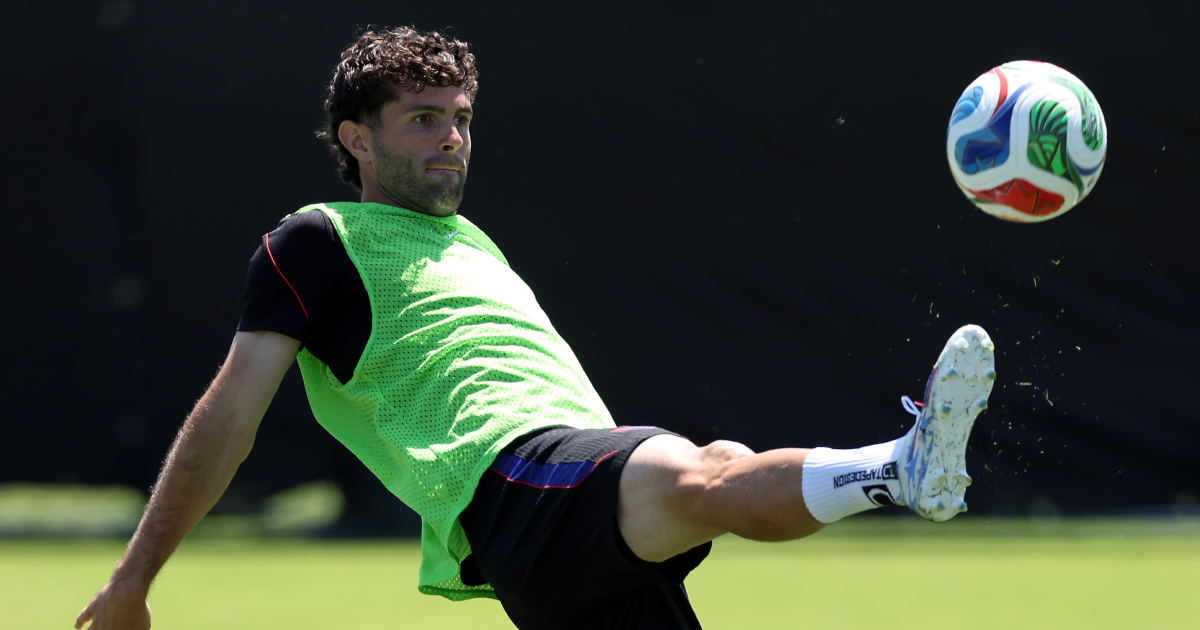
Pulisic is another matter. The United States team’s captain is a figure who rediscovered and deepened his faith while already a professional. An AC Milan starter and former Chelsea and Borussia Dortmund star, often called “Captain America”, he has spoken openly about turning to prayer during injuries and setbacks. He posts images of his Bible study on social media, underlining passages such as Ephesians 2:8-9 on grace.
A practising Catholic who wears a cross, he has described how faith provided companionship during lonely periods abroad in European clubs: “I feel like I always have Someone who’s with me.” Pulisic has generally been less demonstrative than Chicharito. Yet his Catholic background is more substantial than many observers realise. His family’s connection to St Joan of Arc parish in Hershey, Pennsylvania, has remained visible long after his rise to international prominence. In 2022, his family donated an autographed game-worn Chelsea shirt to support a parish fundraiser, with the parish identifying him as a former parishioner. Such details are easily overlooked amid the noise of modern celebrity culture. They are nevertheless revealing. Behind the commercial apparatus of elite football often remain older loyalties: family, parish, hometown and faith.
Neither player has built an entire public identity around religion. That is precisely what makes them interesting. Their faith appears less as a carefully curated brand than as part of the ordinary texture of life. And this is something, when it comes to football, far from unique. Perhaps above all, and unusually so, does this appear to be the case for Catholicism.
When Argentina won the 2022 World Cup in Qatar, much of the world’s attention understandably focused on Lionel Messi, who later credited the victory as a “gift from God”. Yet another image flashed briefly across television screens around the globe. Only moments after the result – Gonzalo Montiel, scorer of the decisive penalty – as the crowds roared and the French squad and fans sank into misery – tore his shirt off and flashed a curious image squared, central and large within the frame of camera amid a scene watched by billions. As he pulled his hands and his shirt to his face in disbelief and exhilaration, a tattoo of the Virgin Mary on his left shoulder filled screens across the world. One of the most widely viewed sporting moments in history became, however fleetingly, a vehicle for Marian imagery.
The examples of Catholicism’s somewhat unique prominence in the beautiful game abound. Olivier Giroud, all-time leading goalscorer for France, World Cup and multiple national and Champions League winner, whose career stretched from Arsenal and Chelsea to AC Milan, is a player whose roster of medals and trophies rank him among the all-time most accomplished. He made a habit of reading Scripture on the team bus and offering prayer on the pitch both before matches and after goals, often pointing skyward in quiet acknowledgment. A tattoo on his arm carries the Latin of Psalm 23: “The Lord is my shepherd, I shall not want.” Known for his flair and charm, Giroud won the Puskás Award for the most skilful and attractive goal scored across the entire sport in the year of 2017. Recently, for the 63rd pilgrimage to Chartres, Giroud recorded a special message of personal encouragement and support for traditional, Latin Mass-devoted Catholics who made the walk.
Sergio Ramos, an indomitable Spaniard often regarded as the best defender of his generation, bears an array of religious tattoos across his body – crucifixes, portraits of Christ and the Virgin – visible markers on a frame honed for the game’s most physical contests. Only baptised in 2019, after which he began to speak more candidly about his Faith, after moving to his hometown club of Sevilla, he reportedly remarked about the Holy Week tradition: “Seville cannot be explained. Seville is felt. Holy Week is our culture, our history, and that heritage that passes from father to child as the greatest treasure we have … This year has been different for me. For the first time, my professional path gave me a break, allowing me to live our faith in a way I had never been able to before. It was a privilege to accompany El Señor de Sevilla, El Gran Poder. A reunion with my own history and with the faith my family taught me.”
Sergio Ramos once quipped that God supported Real Madrid – his club, which also happens to be the most accomplished team in the entire history of the sport. Pope Leo XIV, it seems, agrees – and on his latest visit to Spain remarked on the papal plane that as Robert Prevost he preferred Madrid in the El Clásico derby against Barcelona, and was soon thereafter warmly welcomed by the club and its president, Florentino Pérez. He was subsequently made an honorary member of its board. Madrid, whose logo sports a cross atop its crown, often celebrate in a Catholic church and the squad give respects to statues of the Virgin Mary after league or cup successes.
Meanwhile, two of the most accomplished managers at the international level in recent times have an unusual devotion to the rosary. At the 2020 Euros, which actually took place in 2021 due to the pandemic, the manager of the victorious nation similarly brought the Catholic Faith into strange prominence. Roberto Mancini has long been noted for his good nature and piety. Former England star and present-day commentator Micah Richards even claims to “love” his former manager for these reasons. Seeing successes at the highest level for both club and country, Mancini would pray the beaded Marian devotion during games – even reportedly during his team’s league-winning deciding game against Queens Park Rangers in 2012. An altar boy in his youth, a priest once lent Mancini a relic of St Thérèse of Lisieux for another crucial game, and he remains a regularly observant Catholic who has made pilgrimages to Marian shrines. Having won the Premier League with Manchester City, Serie A with Inter Milan and the European Championship with Italy, he is one of the most successful managers of all time.
Similar in performance, though with less abundant firepower at his disposal, is Zlatko Dalić. A practising believer who has described faith as the foundation of both his personal life and his professional path, Dalić carries a rosary with him at all times and has been photographed on the touchline with his hand in his pocket, quietly holding it during moments of tension. “When I feel that I am going through a difficult time I put my hand in my pocket, I cling to it and then everything is easier,” he has said, framing the practice not as superstition but as a habitual turning to prayer that accompanies his daily routine.
Under his guidance the squad has attended team Masses and made pilgrimages to Marian shrines, including Međugorje and Marija Bistrica, with senior players such as Luka Modrić and Mateo Kovačić participating; the latter of whom has even worn images of the Sacred Heart of Jesus and the Immaculate Heart of Mary on his shinpads. In a country where Catholicism and national identity have long been entwined, Dalić’s approach has on more than one occasion galvanised his squad. Croats rarely fail to make a sign of the cross when entering the pitch or after scoring. And, in 2018, their nation of barely 3.8 million inhabitants impressed the world and for the first time earned silver medals in the World Cup, and made an unprecedented run – giant-slaying nations such as England.
Football’s upper reaches possess an unexpectedly Catholic flavour. Historically Catholic nations have won 17 of the 22 World Cups contested to date. This rises to 20 if you class West Germany as Catholic, where a 42 per cent Catholic plurality existed before reunification. Recent Ballon d’Or, the sport’s highest individual honour, winners have disproportionately come from Catholic backgrounds or nations. Nine of the past 11 have gone to players from Catholic countries, including multiple wins for Lionel Messi and the 2018 award for Luka Modrić. Brazil, Argentina, Italy, Spain, France and, more recently, Croatia occupy an outsized place within football’s mythology. The game’s pantheon is crowded with figures formed by Catholic cultures: Pelé, Maradona, Messi, Cristiano Ronaldo, Platini, Modrić, Rodri and countless others. A faith comprising roughly one-sixth of humanity has supplied a disproportionate share of football’s royalty.
Christianity is not a performance-enhancing drug. The Church has never taught that grace manifests itself through league tables or Ballon d’Or rankings. Yet, on such a stage, are we to believe providence is uninterested?
Football rewards talent, discipline, tactical intelligence and no small measure of fortune; Catholics, like all men, are capable of failure and moral lapse. The imperfections of Cristiano Ronaldo – perhaps football’s all-time great – have been exhaustively catalogued. Yet he nevertheless stated in 2018: “I go to church every week. Every week. I am Catholic and I go to thank God for everything He gives me. I don’t ask for anything. Thank God I have everything. I simply thank Him for protecting my family and my friends. In Turin there are several churches, so I can choose.”
We may here make a Scholastic reflection: the cardinal virtues sharpened on the pitch – prudence in split-second decisions, justice in the give-and-take of teamwork, temperance in the rigours of preparation, fortitude and hope amid defeat or pain – sit naturally alongside a sacramental understanding of the body as temple and of ordered contest as participation in the dynamism of creation. Grace perfects nature. A player who orients his striving sub specie aeternitatis may discover reserves that the thoroughgoing materialist cannot name. Ronaldo was known for putting his body through gruelling training, in contrast to the laissez-faire “natural talent” approach of his rival – Leo Messi. Even if Ronaldo’s romantic life has been less orthodox or disciplined, perhaps the overlap isn’t coincidental. Ronaldo appears to be settling down into a maturer adulthood today, and he attends the 2026 World Cup in a Portugal team tipped to perform well.
In the roar of stadiums and the flicker of countless screens, these gestures – a knee bent in thanks, a cross sporting Jesus of Nazareth traced on the chest, a tattoo glimpsed in celebration – persist. Of course, God should not be treated as a cosmic vending machine, and the Catholic gestures and origins do not guarantee silverware. However, curiously, they do just seem to correlate.
For decades Western societies have been told that religion would inevitably retreat from public life. Faith would become increasingly private, increasingly marginal and increasingly invisible. Elite football, however, suggests a more complicated reality. One of the world’s most globalised, commercialised and technologically sophisticated industries remains populated by men who still pray before matches, thank God after victories and carry particularly Catholic symbols onto the field.
The power this can have, even through imperfect vessels, is actual. I should know. Non-practising for my entire childhood, I instinctively cheered when I saw a player make a sign of the cross – a humble tribute of honour to their Creator which I instinctively knew linked them to the heavens above and their fellow Churchman down here, steadying their egos and keeping them grounded. Only much later would I convert as a young adult, for different reasons. But the witness of these impressive men likely planted a seed. I wonder how many others this continues to be the case for today.