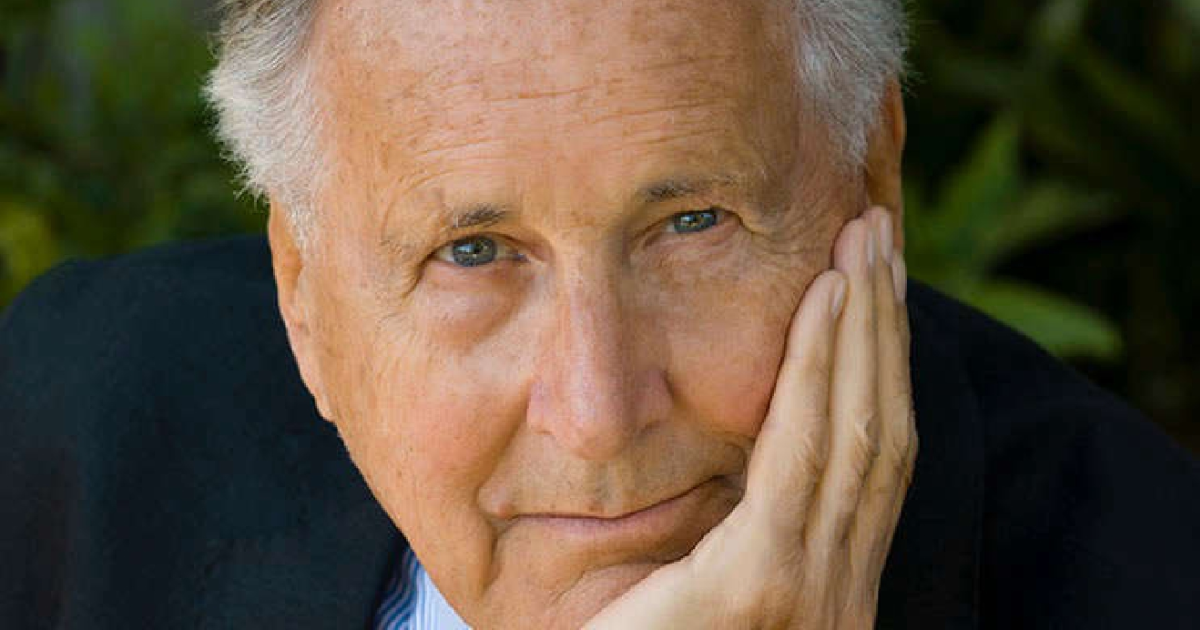


David Willey, the veteran BBC correspondent whose reporting from Rome spanned more than half a century and five pontificates, has died in Italy at the age of 93.
Few journalists could claim so long or intimate an acquaintance with the workings of the Vatican and the wider world of Rome. Willey first glimpsed Pope Pius XII as a student, carried aloft through St Peter’s Basilica on the sedia gestatoria, flanked by ostrich-feather flabella and surrounded by elaborately attired courtiers. In 2025, more than seven decades later, he met the newly elected Pope Leo XIV from Chicago.
Between those two encounters lay one of the longest and most remarkable careers in British foreign reporting. Willey covered revolution and decolonisation in Africa, war in Vietnam, communism in China and the making of modern Europe. But it was Rome – the city he made his home and whose successive transformations he observed with an affectionate but unsentimental eye – that became the great subject of his life.
Willey reported on five popes, travelled with three of them and accompanied Pope St John Paul II on more than 40 foreign journeys. He covered the attempted assassination of the Polish pontiff in St Peter’s Square in 1981, his long decline and death, the subsequent election and resignation of Benedict XVI, and the disruptive, often unpredictable pontificate of Francis. By the time of Francis’s death in 2025, Willey could observe, with characteristic dryness, that his own life extended through no fewer than eight papal reigns.
The Vatican he observed was at once the remote court of Pius XII, the institution transformed by the Second Vatican Council, the global platform of John Paul II and the media-conscious papacy of the 21st century. By the end of his career, the Holy See possessed its own website and video service, while the elaborate secrecy of an earlier age had given way – at least in part – to press conferences, live broadcasts and the ceaseless demands of global media.
Willey had known the older journalistic methods too. During his apprenticeship at Reuters in the 1950s, the agency relied on a corrupt Vatican official to secure advance copies of important papal speeches. On one Easter Sunday morning, the young trainee was instructed to take a bus to a café opposite the workers’ entrance to Vatican City and surreptitiously collect a smuggled document. In the age of the forwarded email, the screenshot, and the WhatsApp message, he could recall scenes as much from a vanished profession as from a vanished Rome.
David Douglas Willey was born in High Wycombe, Buckinghamshire, in December 1932 and brought up in nearby Marlow. His Italian connection preceded his eventual adoption of Rome, as his grandfather was a master woodcarver from Venice who had settled in Buckinghamshire.
Willey attended Sir William Borlase’s Grammar School before going up to Queens’ College, Cambridge to study law and modern languages. He took part in the college’s dramatic life and belonged to the Cherubs dining society, early evidence perhaps of the sociability and taste for storytelling that colleagues would remember throughout his career. After Cambridge he joined Reuters as a trainee in Rome.
One of his first significant assignments was the signing of the Treaty of Rome in March 1957, establishing the European Economic Community from which the European Union would eventually emerge. The ceremony took place in the frescoed splendour of the Palazzo dei Conservatori on the Capitoline Hill. The leaders of the six founding nations, arrayed in formal dress, appended their names beneath depictions of ancient Roman battles and under the gaze of monumental statues of Renaissance popes.
Willey later recalled it as an occasion of almost overpowering symbolism. It was also considered of such limited interest to the British press that Reuters assigned the story to its office junior. His dispatch appears to have vanished without trace and the following day The Times devoted only a third of a column to the occasion.
The Rome of 1957 remained in many ways a poor and somehow provincial city. Families lived in corrugated-iron dwellings beneath the arches of ancient aqueducts. Dialect remained more common than standard Italian, and television had yet to impose its great linguistic uniformity upon the peninsula. One Sunday morning Willey saw a shepherd leading several hundred sheep down the Via del Corso. There was scarcely any traffic to impede them. In later decades, amid the horns and exhaust fumes of the modern capital, that remembered flock became for him an emblem of an Italy that had disappeared.
From Rome he went to Algeria, working as a freelance reporter during the turbulent years surrounding independence from France. In 1964 he became the BBC’s East Africa correspondent. He subsequently reported from Asia, including Saigon during the early stages of the Vietnam War, and from Beijing, becoming one of the first BBC correspondents to report from China after the Communist revolution. After a period in London as the BBC’s assistant diplomatic correspondent, he returned to Italy in 1971, becoming Rome correspondent in 1972. Thereafter his name and voice became inseparable from British broadcasting’s coverage of the Vatican.
Rome rewards longevity: its institutions disclose themselves reluctantly, and the Vatican more reluctantly than most. Willey’s authority derived not only from the number of years he had spent observing the Holy See but from the accumulated understanding those years afforded him. He knew which changes were genuine, which were theatrical and which merely appeared novel to reporters arriving for their first conclave.
He was no mere court chronicler. His 1992 biography of John Paul II, God’s Politician, was a critical examination of a pontiff whose global impact he had observed at close quarters. His other books included Italians, published in 1984, and The Promise of Francis: The Man, the Pope and the Challenge of Change, which appeared in 2015. The following year he presented a copy to Pope Francis during a private audience.
His view of Francis was broadly sympathetic to the pontiff’s attempt to alter the style and emphasis of the Church’s government. Willey believed the Argentine pope had changed the mentality of the Vatican, replacing some of the alleged remoteness of the old papal court with a more immediate language of mercy, encounter and informality.
“Dogma is out, empathy is in,” he wrote after Francis’s death in 2025 – a formulation that displayed both Willey’s gift for compression and the limitations of the secular journalistic lens through which he sometimes viewed the Church.
His judgements were grounded in a breadth of direct experience that few could rival, even when some readers might dispute his conclusions. He had seen the papacy before the Council and after it, before mass air travel and during the emergence of the globe-trotting pope, before television conquered Italy and after Vatican events became spectacles transmitted instantaneously throughout the world. In 2003 he was appointed an Officer of the Order of the British Empire for services to broadcast journalism.
Willey remained active into his nineties. In April 2025, following the death of Pope Francis, he produced one final panoramic reflection on the institution he had covered for so long. In his own final year, he had a personal meeting with Pope Leo XIV.
Veteran BBC broadcaster John Simpson said that Willey’s “courage, insight, wit and humanity were magnificent”.
“As a young journo I admired him and wanted to emulate him,” Simpson recalled. “His reporting of the Vatican was unsurpassed.”
Mark Lowen, the BBC correspondent and presenter, described him as “an incredible authority on the Vatican” and recalled the kindness with which Willey had offered insight and encouragement when Lowen arrived in Rome in 2019.
CNN’s Christopher Lamb recalled “a generous colleague, always curious and reporting on the Vatican until the end”. Robin Lustig, another sometime BBC colleague, hailed Willey as the “very epitome of the well-informed, well-connected foreign correspondent”.
Gillian Hazell, a BBC news producer who worked closely with him (and accompanied him to his meeting with Pope Leo), remembered an esteemed friend and colleague with “a mischievous sense of humour and endless fascinating stories from his assignments around the world”.
The BBC reported that Willey died of heart failure in Italy, the country he had chosen and chronicled for most of his adult life. He leaves behind not merely a substantial body of reporting, but a record of Rome’s passage from the austerity and poverty of the post-war years to the crowded, globalised city of the present.
Flocks of sheep no longer make their way down the Via del Corso, and no pope is borne aloft flanked by ostrich plumes. With the death of David Willey, the Rome that was takes another step towards escaping living memory.