



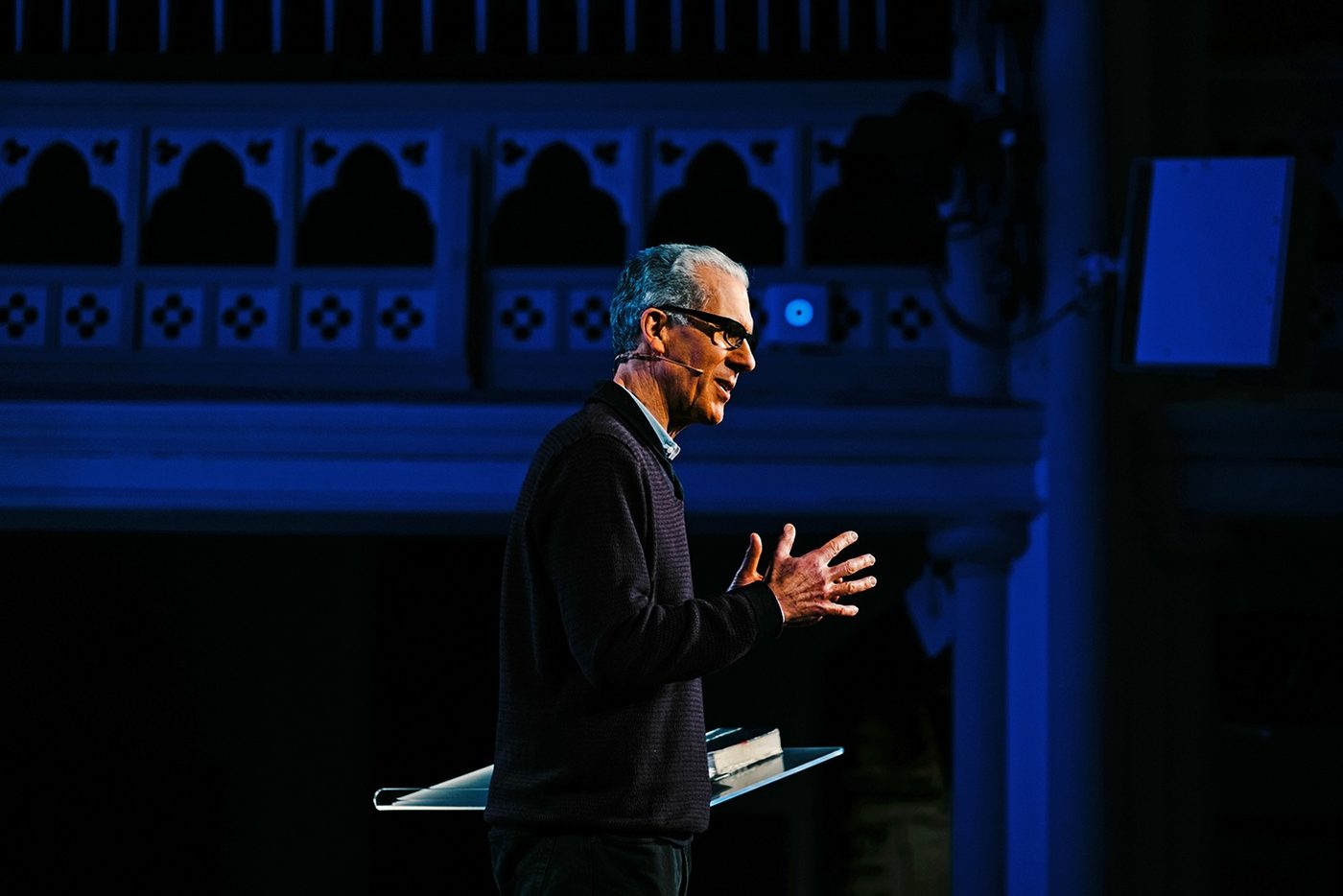
I’m curious. Not about whether the Alpha course is legitimate – people are speculating about this all the time. I just want to find out why it works, since it has claimed nearly 30 million participants across 169 countries during the past 30 years. Alpha is not big – it’s huge, and growing. How come? I talk to Nicky Gumbel, the person behind Alpha at both parish and global level, who himself was brought up in a secular household (though his father was Jewish). He had a transformative spiritual experience while studying economics at Cambridge and, after a brief career as a barrister, decided to become an Anglican priest, taking over Alpha in 1990 and becoming the vicar of Holy Trinity Brompton (HTB) in 2005. We meet at the vicarage – a stone’s throw from Harrods – where HTB, in collaboration with three other nearby churches, offers 10 services, attracting regular attendance of 5,000 each Sunday. How, I wonder, is Alpha funded, since what it states on the tin is: “No pressure. No follow-up. No charge”? “Donations,” answers Gumbel. “Almost all donations are from the congregation, who come in from all over London. And we do a whip-round at the end of a course. People contribute what they like.” Back in the 1980s, when the Alpha course was set up, it was shorter than its current 10 weekly meetings plus a weekend away, attracting mostly regular churchgoers. “But things were changing,” says Gumbel, “so we adapted it. I would say there is a mixture of people now, some totally unchurched.” The Office for National Statistics identified 25 per cent of people describing themselves as “non-believers” in 2011. This elides with the global Pew Research Center, which notes that the vaguer “religiously unaffiliated” are becoming increasingly secular (worldwide, they were 23 per cent of the adult population two years ago, up from 16 per cent in 2007). Such figures are important to Alpha. In its offices inside an extensive media centre, on four floors of a large building in nearby Cromwell Road, sit 200-odd youthful employees in front of computers, developing the latest support materials. This is where the image-sensitive public face of Alpha is being brought to life. Each month the total download of HTB podcasts amounts to some 40,000, making it into the top 10 in the “Religion and Spirituality” section of iTunes. Yet it seems that the actual focus of Alpha has never changed. “It’s all about giving people the opportunity to meet Jesus,” says Gumbel, a man whose lean form and ready smile exude energy and enthusiasm – though not of the overworked variety, which can feel patronising. He questions those who predict that the relentless trend in declining church numbers must lead in the end to zero, or even (wryly) minus zero figures, describing the movement of religious affiliation travelling, rather, in a series of waves across time. For example, there was another low point in the mid-18th century which was succeeded by Victorian reforms, leading to a reversal. HTB’s own vision statement proposes nothing less than “the evangelisation of the nations and the transformation of society”. “There’s a long way to go, certainly,” concedes the man whose mission it is to make Alpha’s appeal truly universal. “But I rather love the idea of the British cycling team whose manager called progress something like the accumulation of marginal improvements, meaning that if you clip a quarter of an ounce off the weight of helmets, for example, there’s a way forward. Alpha is, I think, such an aggregation.” Above all, Alpha is determinedly ecumenical. “I love all Christian denominations,” he insists. “We want the whole church to flourish – Catholics, Salvation Army, Anglican, Protestant – it really doesn’t matter. I encourage people who have once been part of a church to return to it. If people transfer from elsewhere to the Anglicans as a result of doing an Alpha course, that’s not going to help. “We focus on what unites us, and what unites us is infinitely more than what divides us. People in different ‘families’ of Christianity will have disagreements, but that’s OK. They’re just another version of the body of Christ. Of course there are divergences within the global church, and that’s healthy. We can learn a lot from each other – we need one another – but it’s what we all believe in that’s important, the central things: who Jesus is, why he died, the importance of prayer, the Bible. “This is my absolute longing: that our children and grandchildren will make every effort at unity by laying aside personal agendas and unite around Jesus, seeing each other as brothers and sisters. All the world’s problems are to do with division. But we have the answer: one God.” Alpha is only a beginning, then, an introduction to basic Christianity. Also, by leaving denominational issues to be explored later in a church context, listening seems to be a fundamental part of the course’s lasting appeal. “Life is about relationship, it’s not about success,” Gumbel says. “It’s about connection with God and friendship with Jesus. Listening to people [in small Alpha groups] is a mark of love. Whether you agree with them or not, it is a mark of respect. As the weeks go on people will say something honest about what’s going on in their lives and it creates that connection. It depends on the extent to which people are prepared to be vulnerable, because when they are, connection begins to happen. Then you realise that that’s what God sees in us.” I check out “Alpha Connect” on the website and count nearly 50 groups all over greater London where those who’ve bonded on an Alpha course independently choose to continue connecting with each other to explore biblical issues. One recent Alpha graduate told me: “It’s amazing. You know, it’s the first group I’ve ever taken part in where nobody got round to asking me what I do until nearly the last session.” Instead, gradually opening up some of their baggage, they discovered ways of relating to each other at a deeper level. “It’s a soul level,” he says. “Something very special is happening here.” Even for Catholics? On the Catholic page of the Alpha website are endorsements from eight cardinals, four archbishops and one bishop. Fr Christopher Jamison, former abbot of Worth Abbey, affirms: “Alpha’s just in the atmosphere.” Worth School is currently using the youth Alpha film series. “This is very much an exciting new emphasis on the formation of pupils in the Catholic faith, and a response to the Holy Father’s call to evangelisation,” Will Desmond, of the school’s chaplaincy, tells me. I leave Gumbel in an expectant mood on the eve of his 78th Alpha course, anticipating up to 1,000 new guests with 200 supporting volunteers and group leaders on hand ready to welcome them. Many of those planning to turn up must be on the cusp of making a leap of faith. It’s as simple (and profound) as that. No wonder he is excited. Jane Taylor is the author of the novel Over Here (Thunderpoint Publishing Ltd)
1:00 PM
Decline? Don’t you believe it
Jane Taylor

6 min read



Already a subscriber? Sign in
5freearticles every month
Continue reading with a free account. No card needed.
- Five free articles every thirty days, on any device you sign in on
- The Catholic Herald newsletter, every morning
- Subscribe whenever you like for everything: every article and the magazine
Related articles
 Newsroom
Church leaders urge Drumcree dialogue: ‘Too much is at stake’
The Catholic and Church of Ireland Archbishops of Armagh have urged a renewed commitment to peace and reconciliation amid the Drumcree stand-off
Corrie Douglas-Young Newsroom
Thousands of Irish children to join global Rosary campaign
Corrie Douglas-Young Newsroom
TikTok priest urges young people to stand with persecuted Christians
Nathalie Raffray Newsroom
Baby born at 25 weeks reunites with neonatologist two years after leaving hospital
The Catholic Herald Newsroom
Joe Biden honoured by Planned Parenthood after defending abortion rights
Christine Rousselle
subscribe to the catholic herald today
Our best content is exclusively available to our subscribers. Subscribe today and gain instant access to expert analysis, in-depth articles, and thought-provoking insights—anytime, anywhere. Don’t miss out on the conversations that matter most.
Subscribe



