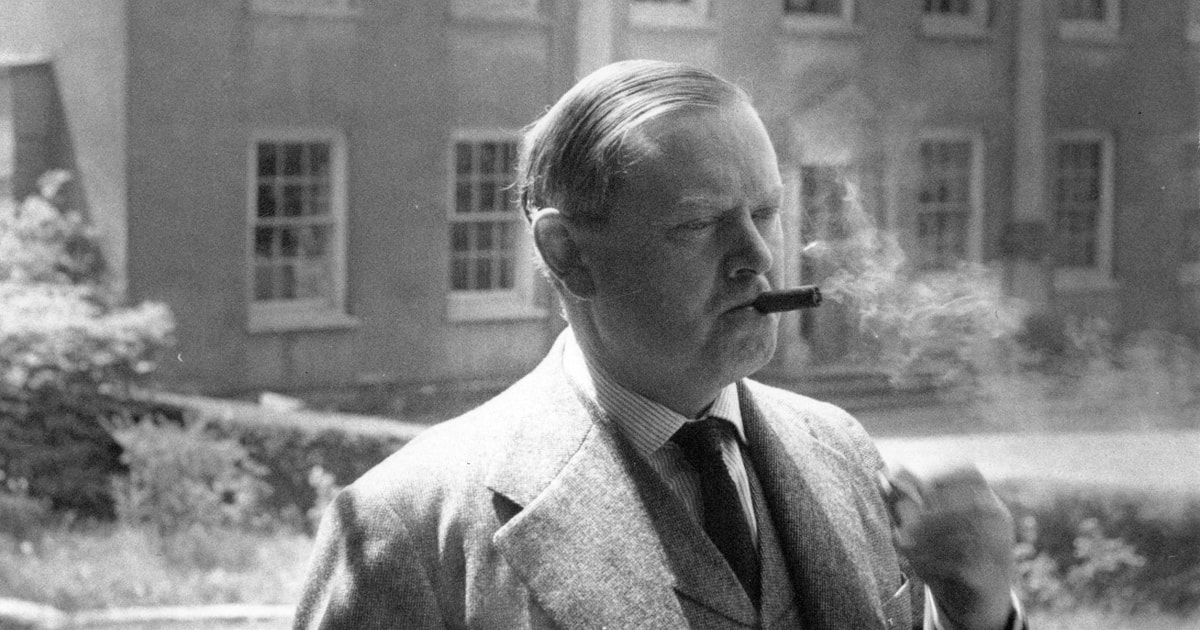

On Easter Sunday, April 10, 1966, Evelyn Waugh was at his most benign. He had not seemed this content for years. With his family, he had just heard Mass, celebrated by his favourite Jesuit, Fr Philip Caraman SJ, in the ancient, beleaguered Tridentine rite at a church near his country house, Combe Florey, in Somerset. After the family party returned home, he retreated to the downstairs lavatory, where he suffered a fatal coronary.
He could not have chosen a better day, the Feast of the Resurrection, to meet his Maker.
Writing to her father’s great friend Lady Diana Cooper, his model for Sword of Honour’s Julia Stitch, Waugh’s beloved daughter Margaret said: ‘You know that [Papa] longed to die and dying as he did on Easter Sunday, when all the liturgy is about death and resurrection, after a Latin Mass and Holy Communion, would be exactly what he wanted… I am very, very happy for him.’
While he may have preferred to exit from his much-loved library, his God had chosen to take him from Waugh’s other sanctuary. It was not quite as dramatic as the exploding thunder-box he fixed for the squatting Apthorpe in Men at Arms, but it was still a very Wavian passing – a mixture of the sacred and the profane.
He had converted 36 years earlier, on September 29, 1930, at the age of 26, having found fame two years earlier on the publication of his first novel, Decline and Fall. A few months before, he had wed the Hon. Evelyn Gardner, who promptly became She-Evelyn and almost just as promptly fell in love with another man. Divorce followed.
In April 2016, on the 50th anniversary of Waugh’s death, his great-granddaughter Constance Watson wrote in the Catholic Herald that he did not convert to hasten the dissolution of his marriage, or indeed because conversion had become fashionable.
There had been a trickle of ‘smart’ conversions – Compton Mackenzie, CK Scott Moncrieff, Ronald Knox and GK Chesterton – in the previous few decades. But as Joseph Pearce noted in his seminal Literary Converts (1999), ‘By the 1930s, the tide of converts had become a torrent, and throughout that decade there were some 12,000 converts a year in England alone.’
The case of Scott Moncrieff is an interesting one. It was Moncrieff, a survivor of the Great War and the translator of Proust, who had sought, in 1925, a secretary to join him in Pisa. Waugh was so sure he had the post that he resigned his teaching role at Arnold House. When he heard he was unsuccessful, he attempted to drown himself. Having left a farewell note quoting Euripides, he walked out to sea, only to return to shore when he was stung by a smack of jellyfish. A sting in the tail would lead to that twitch upon the thread.
The convert Moncrieff was horrified by the ‘hideous drab little RC chapel at Portland’ he found himself attending. Waugh would later relate a similar experience. Nor was it socially advantageous to become a Catholic: although a few aristocratic families – the Stonors, Stourtons, de Traffords and Howards – belonged to the old Faith, in most cases, as Pearce noted, ‘becoming a Catholic meant going to church with the servants’.
Waugh describes in his diary meeting Fr Martin D’Arcy SJ in early July 1930 at the Jesuit clergy house in Mount Street, Mayfair. He describes Fr D’Arcy, the leading Jesuit of his day, as ‘Blue chin and fine slippery mind’. He would soon appear as Fr Rothschild in Vile Bodies (1930) and later Fr Mowbray in Brideshead Revisited. Waugh records a discussion on verbal inspiration and Noah’s Ark; a few days later it was infallibility and indulgences.
‘I have never myself,’ Fr D’Arcy remarked, ‘met a convert who so strongly based his assents on truth.’
He wanted to return to the true Christendom, to the world before Henry VIII and the desecration of the monasteries.
His reception into the Church prompted a quip from his father, Arthur, about his son’s ‘perversion to Rome’, while the Daily Express expressed astonishment that the author of Vile Bodies, the ultramodern novel, had joined the ultramontanes.
Three weeks after his conversion, the Express published ‘Converted to Rome: Why It Has Happened to Me’, in which Waugh dismissed the very suggestion that he had been ‘captivated by the ritual’ of the Church, or that he wanted to have his mind made up for him. Instead, he insisted that the ‘essential issue’ that had led to his conversion was a belief that the modern world was facing a choice between ‘Christianity and Chaos’.
He would write in 1949 that England had been Catholic for nine centuries, Protestant for three and agnostic for one. ‘The Catholic structure still lies lightly buried beneath every phase of English life; history, topography, law, archaeology… everywhere reveals Catholic origins.’
His elegant, authoritative biographies of Edmund Campion (1935) and his friend Ronald Knox (1959) cemented his Catholic credentials and, of course, his magnum opus, Brideshead Revisited (1945), will forever be the great Catholic novel of the 20th century. His portrayal of the noble Gervase and Guy Crouchback in his brilliant trilogy, Sword of Honour, offered another affirming aspect of Waugh’s Catholicity. But it is worth citing his favourite novel, Helena (1950), which confirms that while Waugh’s devotion to his new Faith never wavered, it did not extinguish that worldly, upper-class Wavian wit.
In his First Things review of Philip Eade’s life of Waugh (2016), Paul Mankowski SJ reminds us of the scene where the Roman general Constantinus Chlorus asks King Coel of Colchester for the hand of his daughter, Helena. As Fr Mankowski puts it, ‘Coel is transformed from a mossy minor prince to become the upper-class Edwardian father, alarmed at the prospect of a southern European for a son-in-law.’
King Coel’s reluctance prompted Constantinus to say: ‘I am of the Imperial Family.’ …
It fell flat. ‘You are, are you?’ said Coel. ‘It’s the first time I’ve ever heard of there being such a thing.’
‘I am the great-nephew of the Divine Claudius … Also,’ he added, ‘of the Divine Quintilius, whose reign, though brief, was entirely constitutional.’
‘Yes,’ said Coel, ‘and apart from their divinity, who were they? Some of the emperors we’ve had lately, you know, have been’ – very literally – ‘nothing to make a song about. It’s one thing burning incense to them and quite another having them in the family. You must see that.’
“Apart from their divinity, who were they?”
Of course, for Waugh there was a greater divinity.
His last years were dogged by chronic melancholia, exacerbated by the changes wrought by Vatican II. His innate tendency to anarchy and chaos was matched by a longing for order and routine. He clung to his Faith but not its new form. Death was, for him – and his family – a release. As early as 1921, he had asked God to make his world weariness and physical decay as short as possible when they eventually came… and God proved obliging. He was only 62.
An abidingly characteristic image of Waugh as Catholic was his letter of delight to his friend, the music critic and novelist Eddie Sackville-West, later the fifth Baron Sackville, on his conversion in 1949. Waugh penned surely the most magnificently ‘U’ description of the ritual: ‘Conversion is like stepping across the chimney piece out of a Looking-Glass world, where everything is an absurd caricature, into the real world God made.’


.jpg)