


There is a lot of anticipation – much of it negative, I’m afraid – regarding Christopher Nolan’s upcoming film adaptation of Homer’s saga The Odyssey.
I hope that the film, Ulysses, manages somehow to include the story of the landing of Ulysses and his men in the land of the Lotus Eaters, a kind of Greek hippie commune where the natives are essentially stoned all day on the fruit of the lotus plant. I hope it does, because this little episode in the saga has so much to say to our society.
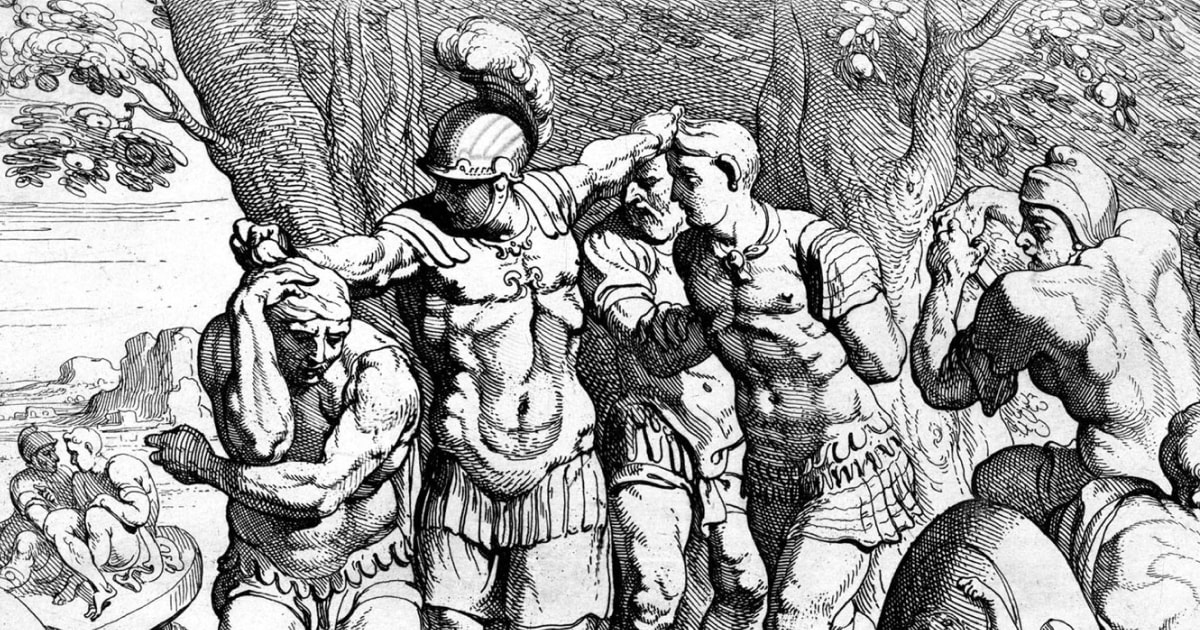
When they land in the region of the Lotus Eaters, Ulysses sends three men ahead of him to explore the land. However, they unfortunately fall in with the Lotus Eaters and:
“Never cared to report, nor to return:
they longed to stay forever, browsing on
that native bloom, forgetful of their homeland.”
Ulysses has no alternative but to force them back to the ship:
“I drove them, all three wailing, to the ships,
tied them down under their rowing benches,”
It never crosses Homer’s mind that the trio might have been right to settle down in the commune and spend the rest of their lives in blissful amnesia.
In the same way, Plato never for a moment sympathises with his famous imprisoned cave-dwellers in The Republic; men who have to be dragged away from the fourth-century-BC version of the computer screen: the cave wall onto which those infamous shadows are projected. They will not go willingly, given the discomfort of the climb out of the cave and the pain unaccustomed sunlight causes their eyes. For Plato, they, like Homer’s Lotus Eaters, will be glad afterwards to have escaped.
And so what of those millions of latter-day caves where young men, in particular, gaze at their cave walls for hours on end, immersed in a world of pleasure-inducing phantasms – ones which AI will soon make immeasurably more seductive?
These young men have opted for the choice of the Matrix character Cypher, who famously declares – while tucking into a very juicy, albeit virtual, steak: “You know, I know this steak doesn’t exist. I know that when I put it in my mouth, the Matrix is telling my brain that it is juicy and delicious. After nine years, you know what I realise? Ignorance is bliss.” They have discovered just how much fantasy trumps real life. Why have awkward encounters with real girls when the final goal is just pleasure? The “middle man” – the flesh-and-blood female – is now obsolete.
But instinctively we side with Ulysses, who drags his three companions away from the Lotus Eaters and ties them down in the boat. For him, what could be worse than that they would become “forgetful of their homeland”? It is the very love of home that drives Ulysses and his companions on. It is the only thing that fills their journey with meaning and purpose. Home is the fount of a true beauty, leading Ulysses and his crew to shun the counterfeits of beauty and joy.
It is no different for us. St John Climacus, a sixth-century abbot of Mount Sinai, observed how people caught up in what nowadays we would call sexual addiction were freed by the discovery of something much greater to love. This is what cured the unnamed sinful woman in the Gospel of Luke: “That is why, when talking of that chaste prostitute, the Lord does not say, ‘because she feared’, but rather, ‘because she loved much’, she was able to drive out love with love.”
This is a beautiful remedy for the deluge of today’s addictions, online and elsewhere: “drive out love with love”. As the love of home leads Ulysses and his men to reject lotus-induced highs, or the love of the light of the celestial sun, for Plato, drives away the slavery to shadows in a dank cave, so it is love of God which brings us ex umbris et imaginibus in veritatem: “Out of shadows and phantasms into the truth.”


.jpg)


.jpg)