

February 12, 2026

Film: Clichéd and ludicrous - it must be a Dan Brown thriller

David V Barrett
More
Related
Min read
share

Inferno (12A, 121 mins, )

Can a third Dan Brown thriller starring Tom Hanks as symbology professor Robert Langdon, once again saving the world with seconds to spare, be an improvement on The Da Vinci Code and Angels and Demons? Unfortunately not.

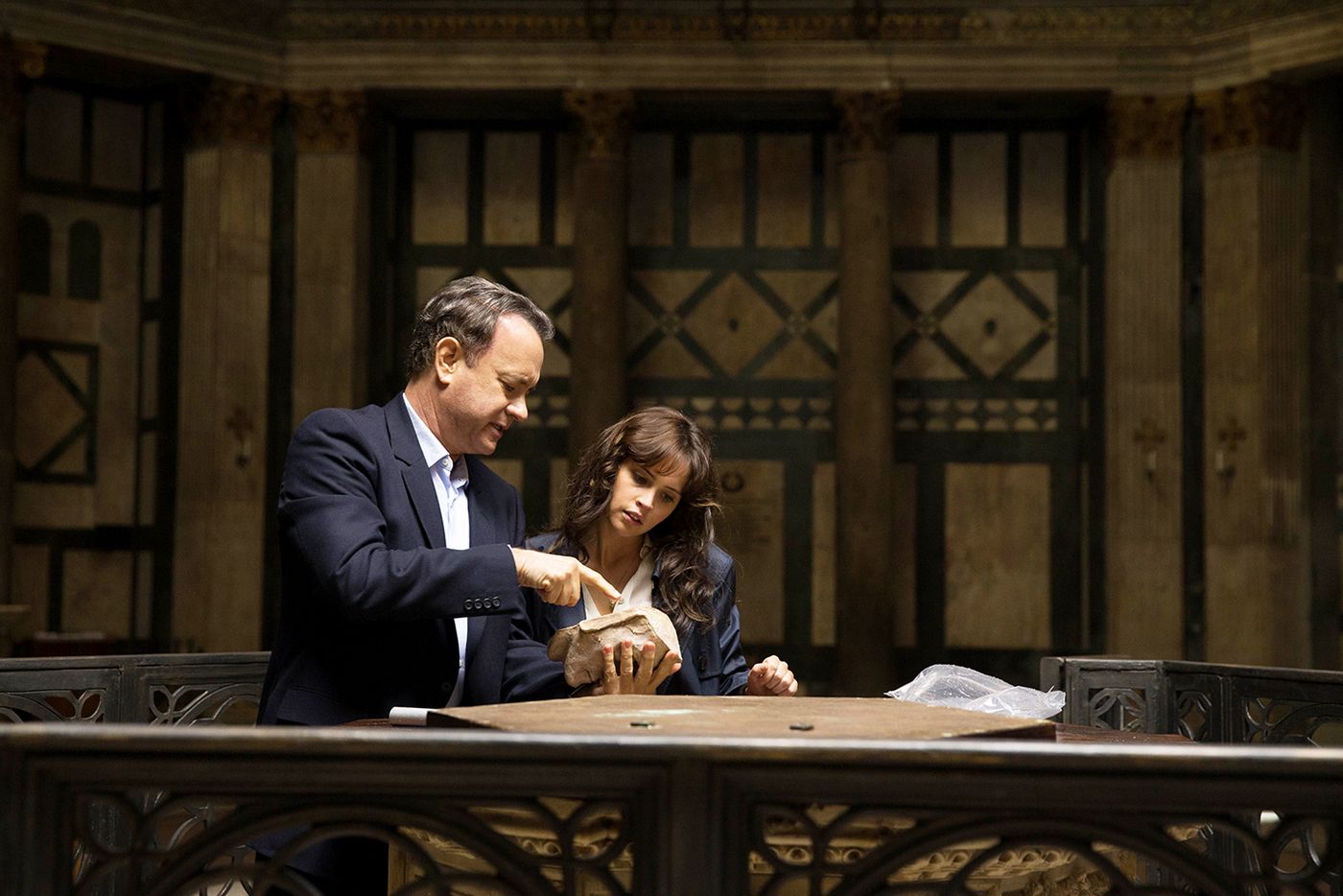
Langdon wakes up in hospital in Florence with no knowledge of what he’s doing there; apparently he has a bullet wound to the head. He has confused hellish visions (the clue’s in the film’s title). He’s rescued from an assassin’s attack by a cute doctor (recall his previous sidekicks), Sienna Brooks (played by Felicity Jones).

Meanwhile, population guru Bertrand Zobrist (Ben Foster) has thrown himself off a picturesque medieval bell tower to his death, having set up a timebomb plague called Inferno that will wipe out half the world’s population (obviously for the good of mankind – but still!). Langdon and Brooks have just hours to unravel a complex series of clues to avert the potential apocalypse.

Why do villains in novels and films never just press the button to unleash their catastrophe, but instead leave a trail of metaphorical breadcrumbs? How are Our Heroes always able to solve them, step by step, each leading neatly to the next?

And considering that Robert Langdon, as a professor of symbology, is an expert in solving clues hidden in works of Renaissance art, how come his doctor friend can do it just as easily – as can a host of baddies?

Langdon’s presumed concussion doesn’t seem to slow him down as he’s chased through the streets of Florence and Venice by assorted groups of heavies with guns, and his amnesia doesn’t stop him knowing the secret exits in galleries and churches.

It’s a huge sprawling mess of a film. The plotting is risible. The twists and turns of who is on which side get to the point where you really don’t care any more; you just want the whole thing to be over, please.

The body count rises towards the end, but there’s no rising excitement, no sense of climax. The dialogue includes Langdon and Brooks spouting infodumps of history and art at each other – and the cliché count in the last few minutes is frankly unbelievable.

As for the acting ... Tom Hanks follows his performance in the previous films by playing Langdon as wooden and expressionless. You simply can’t care for a character whose face barely changes throughout the film. And as before, there’s no chemistry whatsoever between him and his young female sidekick.

At some point director Ron Howard, or the financial backers, will realise that making bad films based on bad books is really neither art nor commercial good sense. The artificially created publicity event that was The Da Vinci Code was 13 years ago; the Dan Brown bubble has long since burst.

Inferno (12A, 121 mins, )

Can a third Dan Brown thriller starring Tom Hanks as symbology professor Robert Langdon, once again saving the world with seconds to spare, be an improvement on The Da Vinci Code and Angels and Demons? Unfortunately not.

Langdon wakes up in hospital in Florence with no knowledge of what he’s doing there; apparently he has a bullet wound to the head. He has confused hellish visions (the clue’s in the film’s title). He’s rescued from an assassin’s attack by a cute doctor (recall his previous sidekicks), Sienna Brooks (played by Felicity Jones).
Meanwhile, population guru Bertrand Zobrist (Ben Foster) has thrown himself off a picturesque medieval bell tower to his death, having set up a timebomb plague called Inferno that will wipe out half the world’s population (obviously for the good of mankind – but still!). Langdon and Brooks have just hours to unravel a complex series of clues to avert the potential apocalypse.

Why do villains in novels and films never just press the button to unleash their catastrophe, but instead leave a trail of metaphorical breadcrumbs? How are Our Heroes always able to solve them, step by step, each leading neatly to the next?

And considering that Robert Langdon, as a professor of symbology, is an expert in solving clues hidden in works of Renaissance art, how come his doctor friend can do it just as easily – as can a host of baddies?

Langdon’s presumed concussion doesn’t seem to slow him down as he’s chased through the streets of Florence and Venice by assorted groups of heavies with guns, and his amnesia doesn’t stop him knowing the secret exits in galleries and churches.

It’s a huge sprawling mess of a film. The plotting is risible. The twists and turns of who is on which side get to the point where you really don’t care any more; you just want the whole thing to be over, please.

The body count rises towards the end, but there’s no rising excitement, no sense of climax. The dialogue includes Langdon and Brooks spouting infodumps of history and art at each other – and the cliché count in the last few minutes is frankly unbelievable.

As for the acting ... Tom Hanks follows his performance in the previous films by playing Langdon as wooden and expressionless. You simply can’t care for a character whose face barely changes throughout the film. And as before, there’s no chemistry whatsoever between him and his young female sidekick.

At some point director Ron Howard, or the financial backers, will realise that making bad films based on bad books is really neither art nor commercial good sense. The artificially created publicity event that was The Da Vinci Code was 13 years ago; the Dan Brown bubble has long since burst.

subscribe to
the catholic herald

Continue reading your article with a subscription.
Read 5 articles with our free plan.
Subscribe

subscribe to the catholic herald today

Our best content is exclusively available to our subscribers. Subscribe today and gain instant access to expert analysis, in-depth articles, and thought-provoking insights—anytime, anywhere. Don’t miss out on the conversations that matter most.
Subscribe